

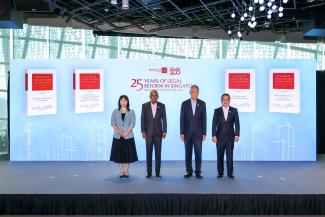
When Senior Minister Lee Hsien Loong launched 25 Years of Legal Reform in Singapore: Innovations in Policy and Law (2000-2025) on 28 July 2026 at Gardens by the Bay, he spoke of law reform as a continuous undertaking each generation must carry forward: reviewing what has been inherited, deciding what remains fit for purpose, and legislating anew for changed circumstances.
Behind the four-volume series putting that quarter-century of reform into a single record is Singapore Management University (SMU) Professor of Law Yip Man, who served as the series' Managing Editor. Professor Yip is concurrently the V3 Group Professor in Family Entrepreneurship at SMU's Yong Pung How School of Law (YPHSL).
Launched by MinLaw in commemoration of SGLaw200, which marks 200 years of legal development in Singapore, the book series documents key legislative and legal reforms undertaken between 2000 and 2025, and offers insight into the policy thinking, trade-offs and human effort behind some of the Republic's most significant legislative developments.
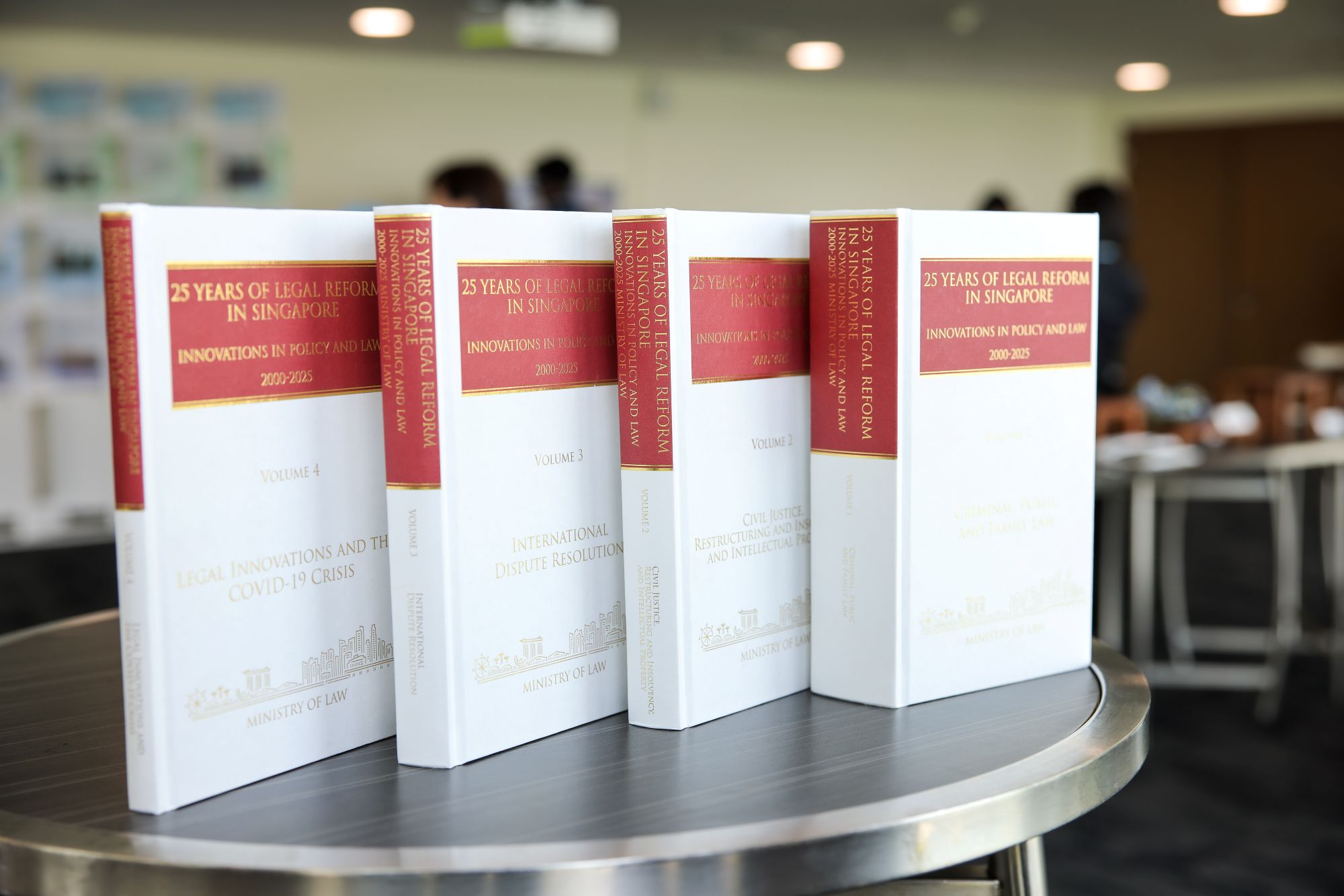
The four volumes – Criminal, Public and Family Law; Civil Justice, Restructuring and Insolvency, and Intellectual Property; International Dispute Resolution; and Legal Innovations and the COVID-19 Crisis – bring together perspectives from government policymakers, judges, legal practitioners, academics and sector experts, illuminating the policy thinking and societal considerations behind Singapore's law reform journey.
Besides Senior Minister Lee, the launch was also officiated by Senior Minister and Coordinating Minister for National Security and Minister for Home Affairs K Shanmugam SC, and Minister for Law and Second Minister for Home Affairs Edwin Tong SC. It was attended by around 200 guests, including representatives from the legal industry and the volume editors and writers who contributed to the series.
In his speech, Senior Minister Lee said a defining feature of Singapore's approach to governance was to keep abreast of social changes, emerging threats and technological disruptions to sustain the rule of law. "Each generation must review the system it has inherited, decide what remains fit for purpose, update or repeal those parts which are outdated, and design and pass new laws to deal with new circumstances," he said.
This book series chronicles one important chapter in that longer journey.
A story told from many angles
Indeed, for Professor Yip, the defining challenge was making sure the process behind the law reforms was not lost in the telling.
"Reform projects are collaborative and progressive in nature, involving stakeholders and experts working together and civil society providing feedback from the ground. We did not want the complexity and structure of the process of reform to be flattened or lost. Therefore, a hallmark feature of the series is that each reform project is told through multiple perspectives. We spotlight on the process and not simply the outcome," said Professor Yip.
Law reform for public good
Senior Minister Shanmugam, who was law minister from 2008 to 2025, shared in his speech at the event that close to 1,000 laws were passed in the past 25 years as the Government proactively reformed legislation to deal with real-world problems, make difficult choices and advance the public interest. Those laws have reshaped the legal landscape across many areas of Singapore society and in doing so, they have also reshaped the framework of society itself, benefiting a substantial section of the public, he said.
")
Indeed, for Professor Yip, the law reform across the 25 years that stood out to her personally was the COVID-19 (Temporary Measures) Act 2020, passed within nine days of its conception, which introduced, amongst other measures, a temporary moratorium on legal and enforcement actions for parties unable to perform contractual obligations because of COVID-19.
"I research in private law, including contract law," she said. "This intervention was exceptional because it was contrary to the fundamental principle of sanctity of contract, the foundation of our contract law. But it also shows us that in times of crisis, there is a need for the law to be flexible and to recalibrate the balance between safeguarding private rights and obligations and protecting the whole society from greater harm."
From the archive to the classroom
For her, the series' relevance extends into her own classroom at SMU. "Teaching and this series are, at heart, the same enterprise: helping people see not just what the law is, but why it is what it is," she said.
"So yes, the chapters will find their way into my classroom, and I suspect into many others... students will be able to appreciate the options that were weighed, the trade-offs made, as well as the ideas that worked and those that did not. This will train them to think like law reformers. I have no doubt that some of them will be involved in the meaningful work of law reform in the future."
A resource for every kind of reader
Professor Yip sees the series speaking to a wide readership, from judges and policymakers seeking "a deep study of our law reform reasoning and process" to "foreign legal jurists" looking for comparative insights. But it is the general reader she returns to when asked what she hopes people take away.
"The law is not remote, it is part of the lived experiences of ordinary citizens – from protecting the vulnerable to helping business capture new economic opportunities," she said. "I would like a reader to close a chapter and think: a team of people had thought hard about the problem from different angles, and I now see how they thought and planned the change in the law."
Reflecting on the collaborative nature of the project, Professor Yip extends her heartfelt thanks to the volume editors and contributors.
- End -