
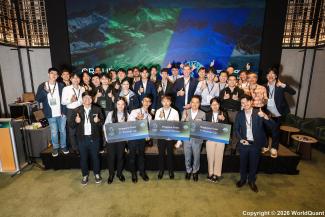
A team of Singapore Management University (SMU) students clinched a podium finish with national third place at the 2026 WorldQuant International Quant Championship (IQC). Lucius Li and Mark Bosco, both Year 1 undergraduates, emerged among the country’s top teams in a global competition that attracted more than 156,000 participants this year.
Lucius, from the School of Economics (SOE) pursuing a second major in Actuarial Science, and Mark from the Lee Kong Chian School of Business (LKCSB), made steady strides during the global competition, progressing from 607th in the first round to 45th globally (and second runner up in Singapore). They faced off against stiff competition from undergraduates and PhD students in Singaporean universities, as well as researchers and students from institutions overseas.
Launched in 2018, the IQC challenges participants to develop quantitative investment strategies using historical market data. Over three rounds from March to July 2026, the SMU team used WorldQuant’s BRAIN back-testing platform to build “alphas”, which referred to mathematical models designed to predict future price movements. They were assessed on both the performance of their models and their ability to explain their research approach.
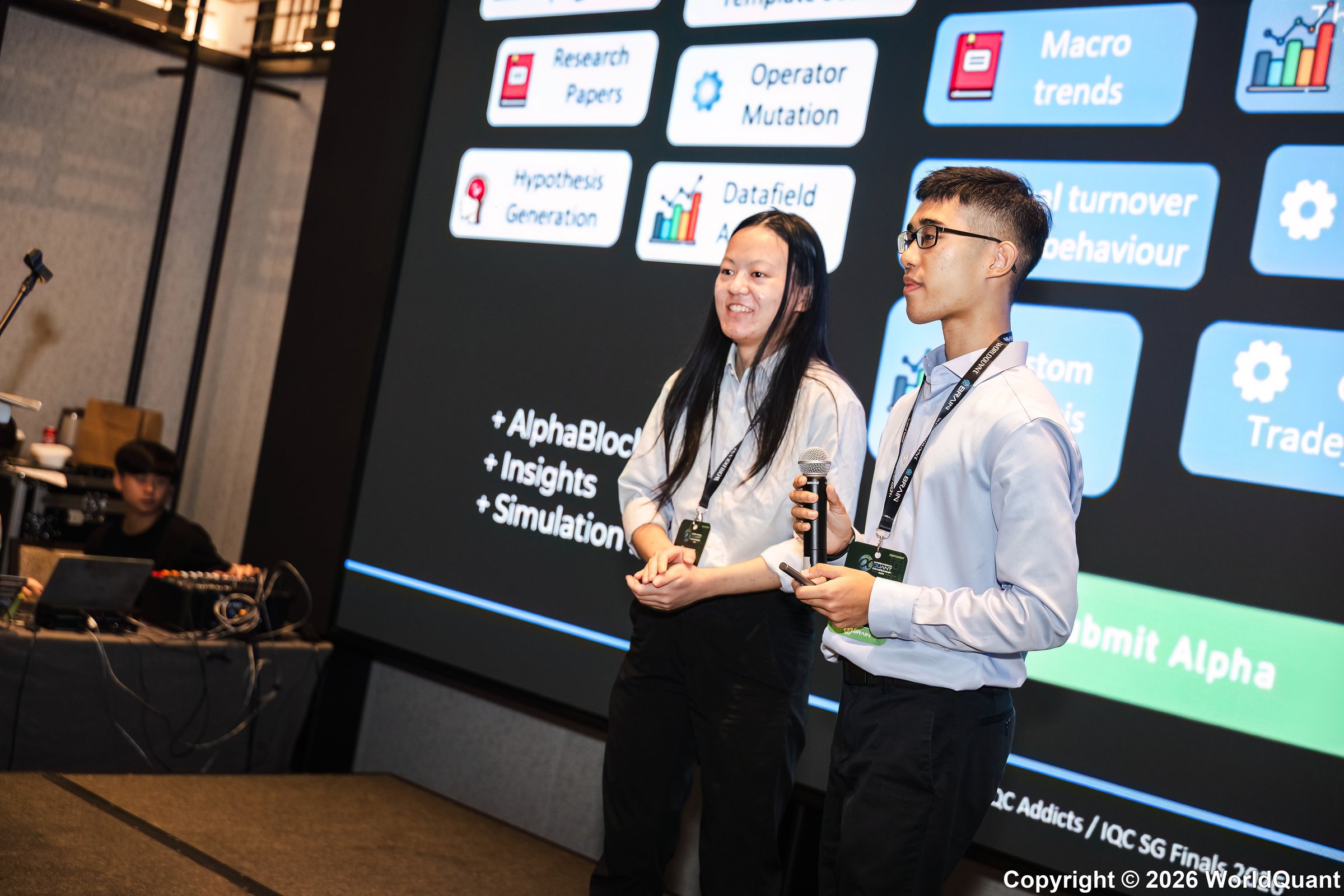
For the students, the competition offered a direct test of skills that extend beyond any single discipline.
“Everything was new, and I had to speedrun the holy trinity of statistics, coding and finance to improve my research efficiency,” said Lucius. “It was a great learning opportunity to acquire multiple new skills and build systematic thinking.”
That interdisciplinary approach reflected how SMU students are equipped to apply knowledge across disciplines and translate it into practical problem-solving. Rather than relying solely on classroom knowledge, the team independently sought advice from SMU faculty, including Professor Liu Peng on portfolio management and workflow optimisation, and Professor Zhao Yibao on vector concepts. They also reached out to SMU alumnus Jorden Seet, a former IQC international top-three winner, after discovering his experience through a story that was published on SMU channels, thus tapping on the University’s alumni network for rich insights.
The team subsequently incorporated agentic AI into its research workflow, using AI to generate hypotheses and scripts under human guidance and allowing them to scale up their research process.
This ability to combine technical knowledge with emerging technologies, independent learning and problem-solving is increasingly relevant to the workplace — particularly in quantitative finance, where mathematics, programming, data analysis and financial reasoning intersect.
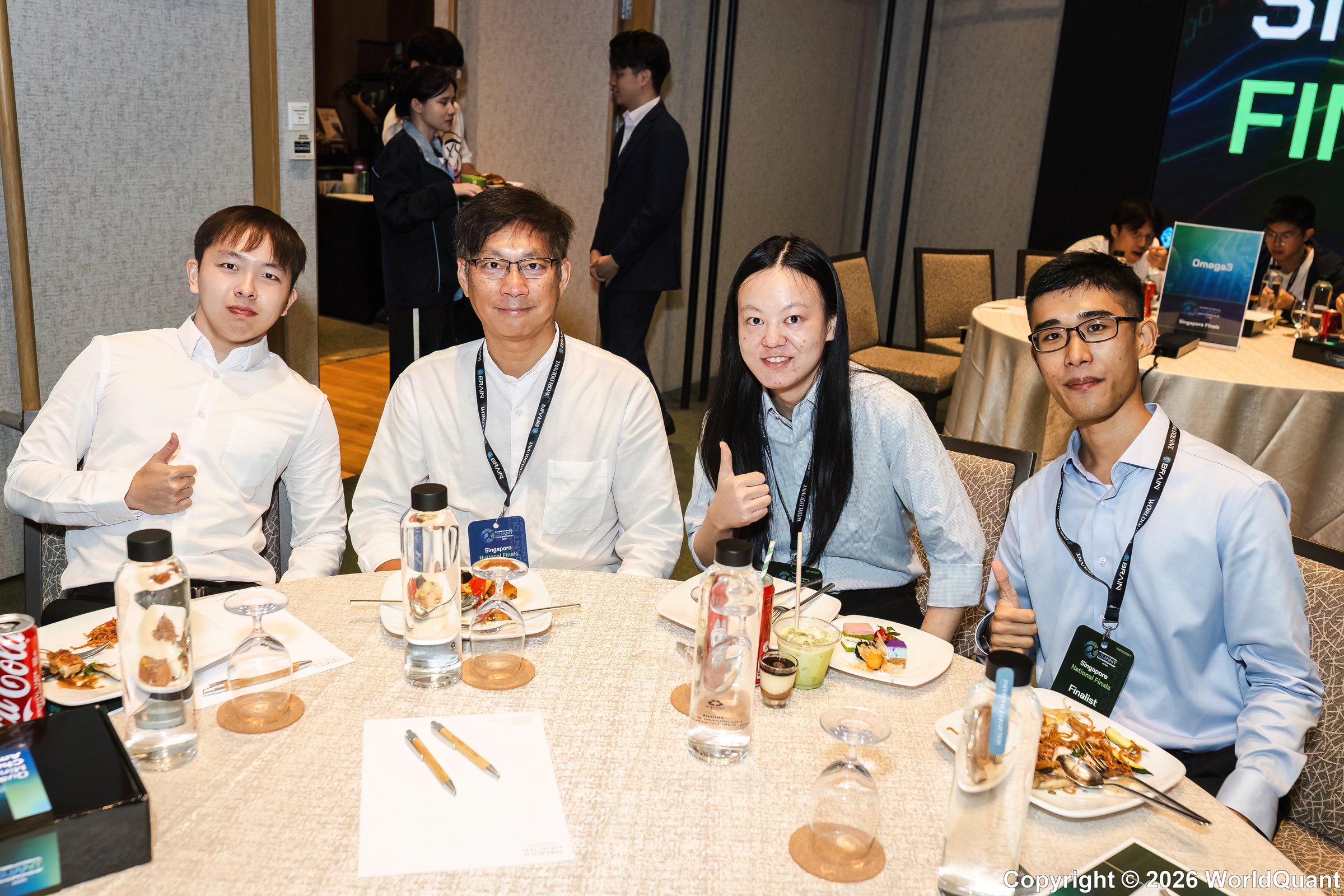
For Lucius, the competition reinforced a career direction that began with his interest in mathematics and probability. He chose Actuarial Science after discovering probability concepts in an actuarial examination paper during secondary school .
“I saw the probability questions and instantly knew this is what I want to do in the future. It’s more like a calling than a choice,” observed Lucius.
For Mark, the experience has broadened his interest in the quantitative finance industry. He is considering a major in Quantitative Finance or Marketing Analytics, alongside a second major in Data Science and Analytics from SOE.
“This event has certainly ignited our interest in the Quant Finance industry,” said Mark. “We would be glad to share more with any fellow SMU students who are keen on participating next year.”
The team’s experience illustrated how SMU students might put their academic training into practice early in their university journey. By combining disciplinary knowledge, cross-disciplinary learning, students might leverage on faculty expertise and emerging technologies to tackle problems that mirror those they are likely to encounter in the workplace.
Congratulations Team SMU for the stellar achievement!
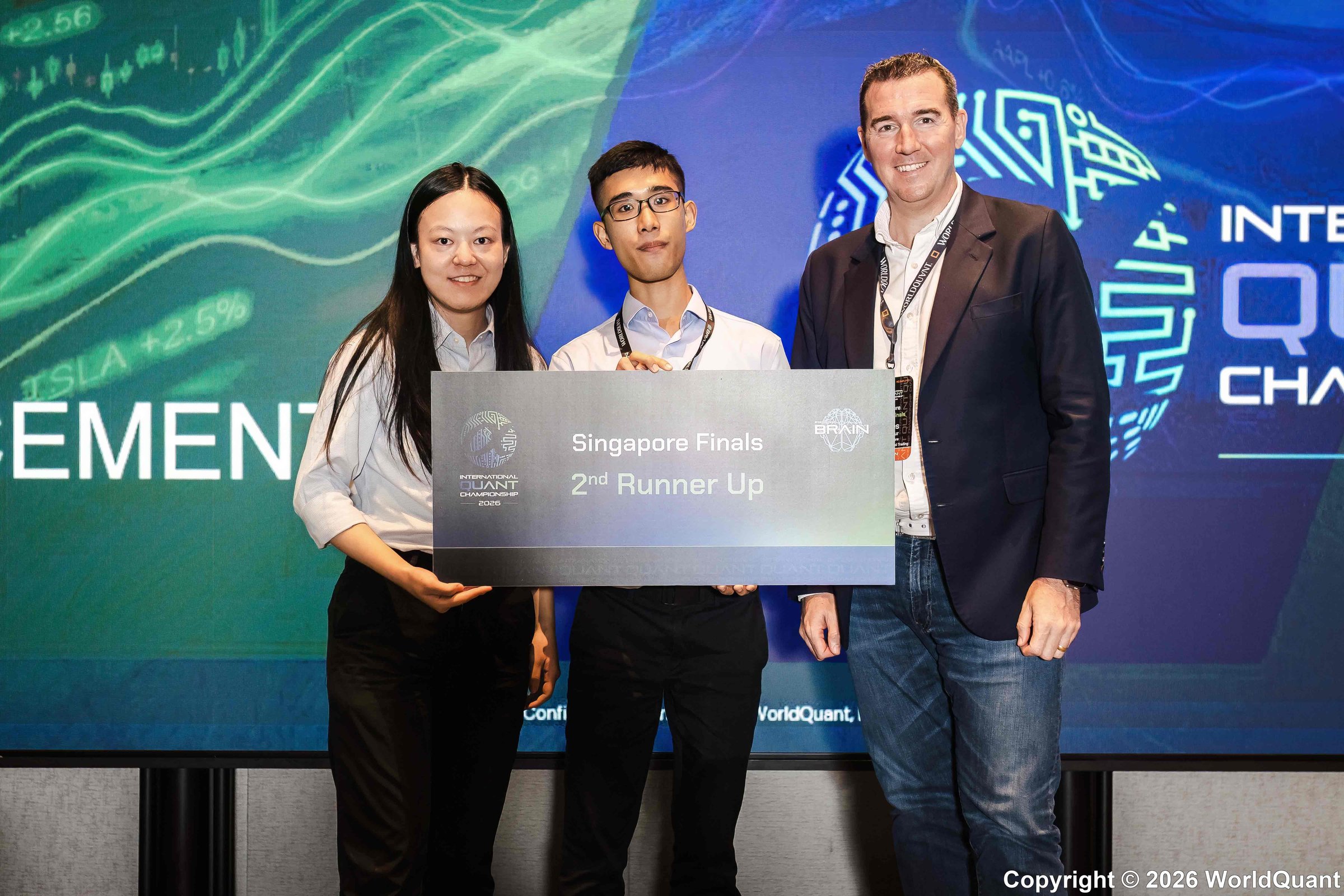
Photo credit: 2026 WorldQuant.