
A LETTER TO SMU
Why do we do the work we do at SMU? Ultimately, it is to make a difference.
To change what is possible for a student.
To bring new knowledge into the world.
To help solve problems that matter.
To strengthen the communities and society we are a part of.
That is impact.
It is not simply about what we achieve. Publications. Citation counts. Rankings.
It is about what changes because we are here.
What is different because of what we do?
SMU’s ambition should never simply be to do more.
It should be to matter more – to our students, our partners, our communities, and to society.
That is what impact means. And that is the opportunity before us.
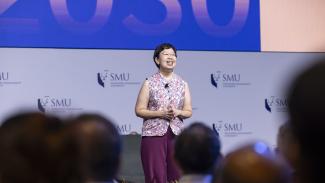
SMU President Professor Lily Kong opened the President’s State of the University Address (PSOUA) 2026 with a personal letter to the SMU community asking: “Why do we do the work we do at SMU?” Its answer – “to make a difference and matter more” – framed her call to turn the University’s commitment to impact into momentum. The Address was held at SMU Hall on 25 September.
Attended by about 540 faculty and staff, her Address reviewed progress under SMU2030 and outlined how the University will turn ambition into lasting impact. Building on 2025’s Shaping Impact, Transforming Lives, this year’s theme, From Commitment to Momentum, focused on the actions, partnerships and capabilities needed to deliver results.
Understanding what changes because SMU is here
Prof Kong framed SMU’s contribution across four connected domains: human capital, knowledge, economic value, and social and community life. Revisiting the Input-Output-Outcome-Impact (IOOI) framework introduced at PSOUA 2025, she stressed the need to trace resources and activities to outcomes and lasting change. “Activity is not the same as impact, and aspiration is not evidence,” she said.
For SMU staff, the message linked strategy to everyday work. “This year’s PSOUA brought SMU2030 to life by showing how every department has a part to play in achieving our shared vision,” said Yvonne Chan, Chief Financial Officer and Vice President. “It left me optimistic about how we can work together to extend SMU’s impact beyond our shores.”
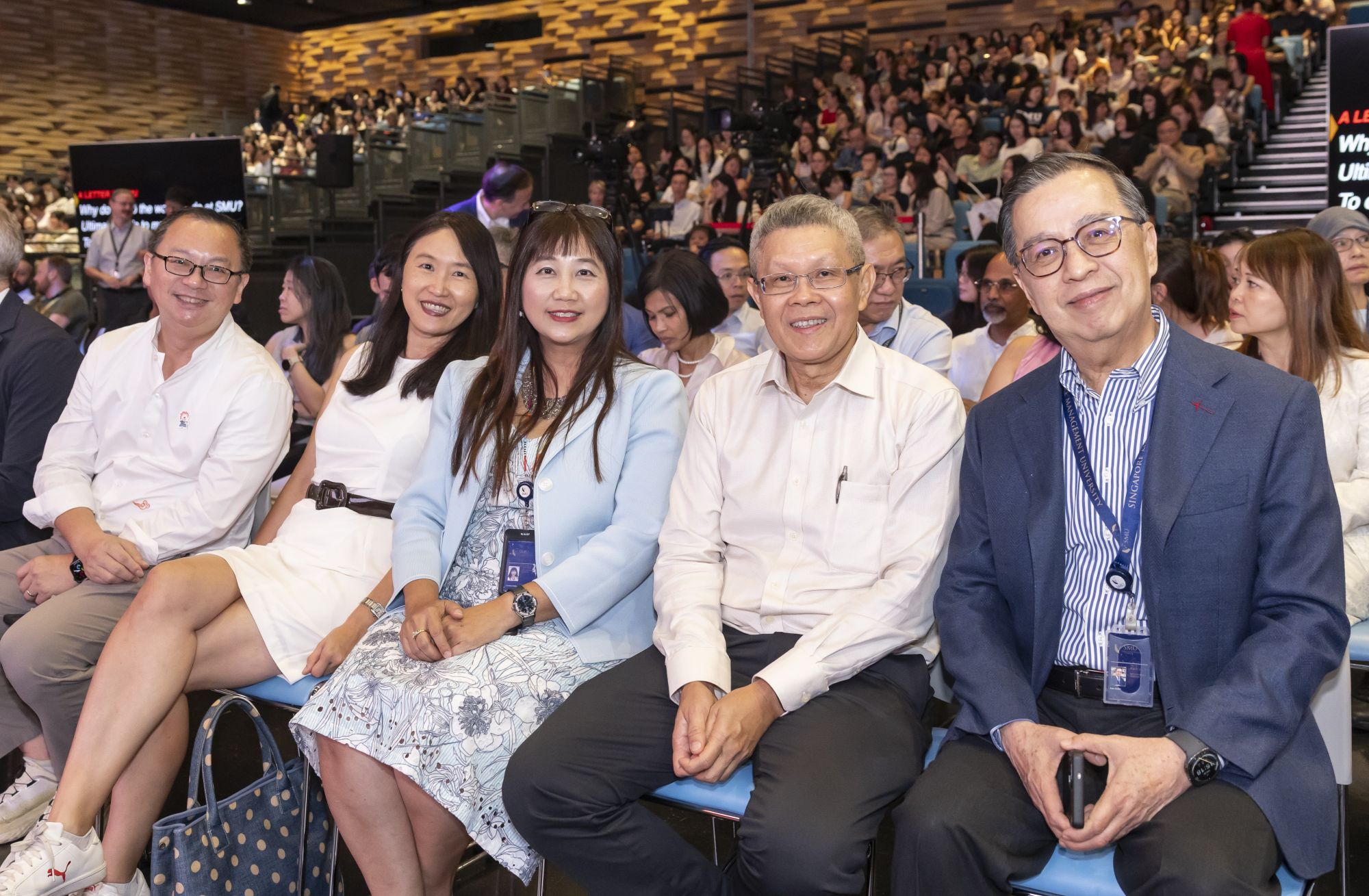
(L-R) Associate Provost (Postgraduate Professional Programmes) Assoc Prof Themin Suwardy, Vice President (Partnerships and Engagement) Prof Lim Sun Sun, Chief Financial Officer and Vice President Office of Finance Yvonne Chan, Senior Vice President (Administration) Lim Boon Wee, and Provost Prof Alan Chan.
Building momentum in education, research and partnerships
SMU will prepare graduates for an AI-shaped world through its AI-in-Education Strategy, an Enhanced Core Curriculum and the next evolution of SMU-X. It will also offer more personalised guidance, expand opportunities across Asia, and strengthen postgraduate, executive and professional education through new programmes and stackable lifelong-learning pathways.
Yuehan Zhuo, Associate Director at the College of Integrative Studies, said Prof Kong’s question, “What if learning is not for a single career, but for a lifetime of learning?”, captured the heart of undergraduate education. “Equipping students with skills for a job is important, but preparing them to unlearn, learn, relearn and synthesise for life is essential,” he said.
In research, SMU will build capacity and strengthen how knowledge informs policy, practice and public understanding. Its three university-level research institutes – the Longevity Societies and Economies Institute, Resilient Workforces Institute and Urban Institute – will deepen work on societal challenges, alongside research in sustainability, urbanisation, workforce transformation, cybersecurity, trade, finance and dispute resolution.
Professor Shantanu Bhattacharya, Professor of Operations Management and Deputy Dean (Education) at the Lee Kong Chian School of Business, welcomed this holistic approach. “The University is rightly focused on measuring and communicating the impact of its work across research, education and service,” he said. “SMU moved from a set of values for SMU2030 – commitment – to a set of tangible actions – momentum – that stakeholders across the University can understand and contribute to.”
Partnerships will remain central. SMU will expand its Asian presence, including through opening a new SMU China overseas centre in Shenzhen, and deepening ties with universities, industry, government, community partners, and regional and international organisations. The Office of Impact will work with Schools, Colleges, Institutes and administrative units to document evidence, develop case studies and share good practices.
A shared journey, set to music
Faculty and staff also chose songs reflecting how they felt about SMU and the journey ahead, co-creating the SMU Shaping Impact Spotify Playlist. From Unstoppable, Roar and Bridge Over Troubled Water to Seasons of Love, The Climb and A Million Dreams, the selections conveyed confidence, resilience, ambition and collective purpose.
“The unity reflected in the songs colleagues chose really stood out,” said Cassandra Yeo, Assistant Director, Marketing and Communications at SMU Academy. “Despite the variety, the playlist became one story of impact, resilience and shared purpose. It showed that SMU2030 had resonated beyond words and slides, shaping how we felt about the journey ahead as One SMU.”
The Address closed with For Good – Prof Kong’s contribution to the playlist – performed by Jimmy Ye, Director of the Office of Student Life, with Lennel Chua and Joy Foo from SMU VOIX.
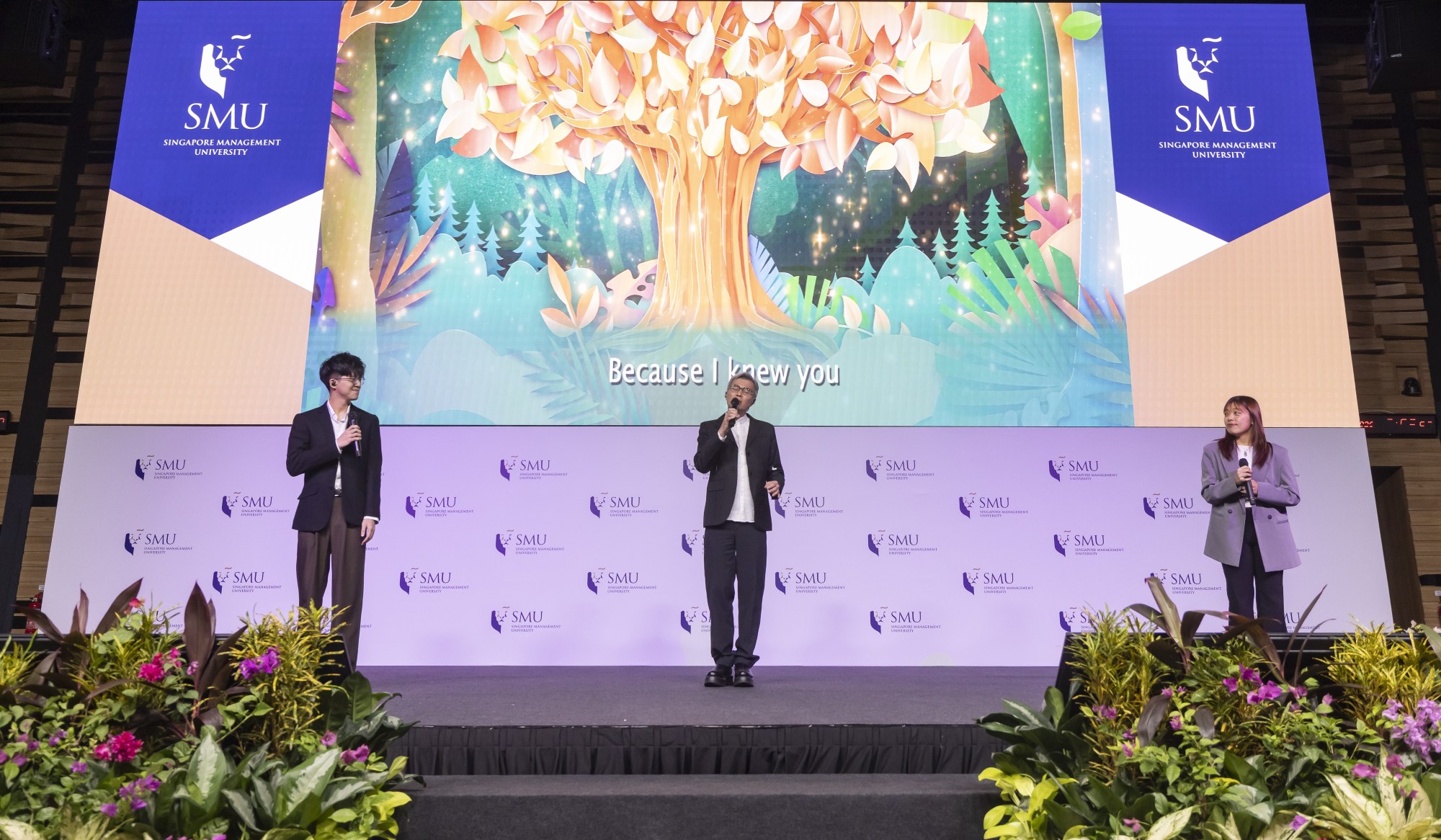
Jimmy Ye, Lennel Chua. And Joy Foo performing For Good, Prof Kong’s contribution to the SMU Shaping Impact Spotify Playlist.
Turning aspiration into lasting impact
The Address also prompted reflection on how impact is recognised and sustained. “The question posed at the very start, ‘What is different because we are here?’, was simple yet powerful,” said Weetz Seah, Head of Arts and Creative Experience at the Office of Student Life. “It prompted me to reflect on the difference our work creates and why it matters.”
Student Bhumika Kukreja from the School of Social Sciences was struck by the many forms impact can take. “One alumni testimonial showed how knowledge and skills gained at SMU can be applied in unconventional settings to help others meaningfully,” she said.
Prof Kong stressed that momentum is built through consistent effort, shared purpose and many contributions over time. Continued investment in people, physical and digital infrastructure, financial sustainability, and brand and reputation will support SMU’s next phase.
“Education can transform lives. Research can shape society. Partnerships can create opportunities that none of us could achieve alone,” she said. “Together, let us continue turning commitment into momentum, and momentum into lasting impact.”
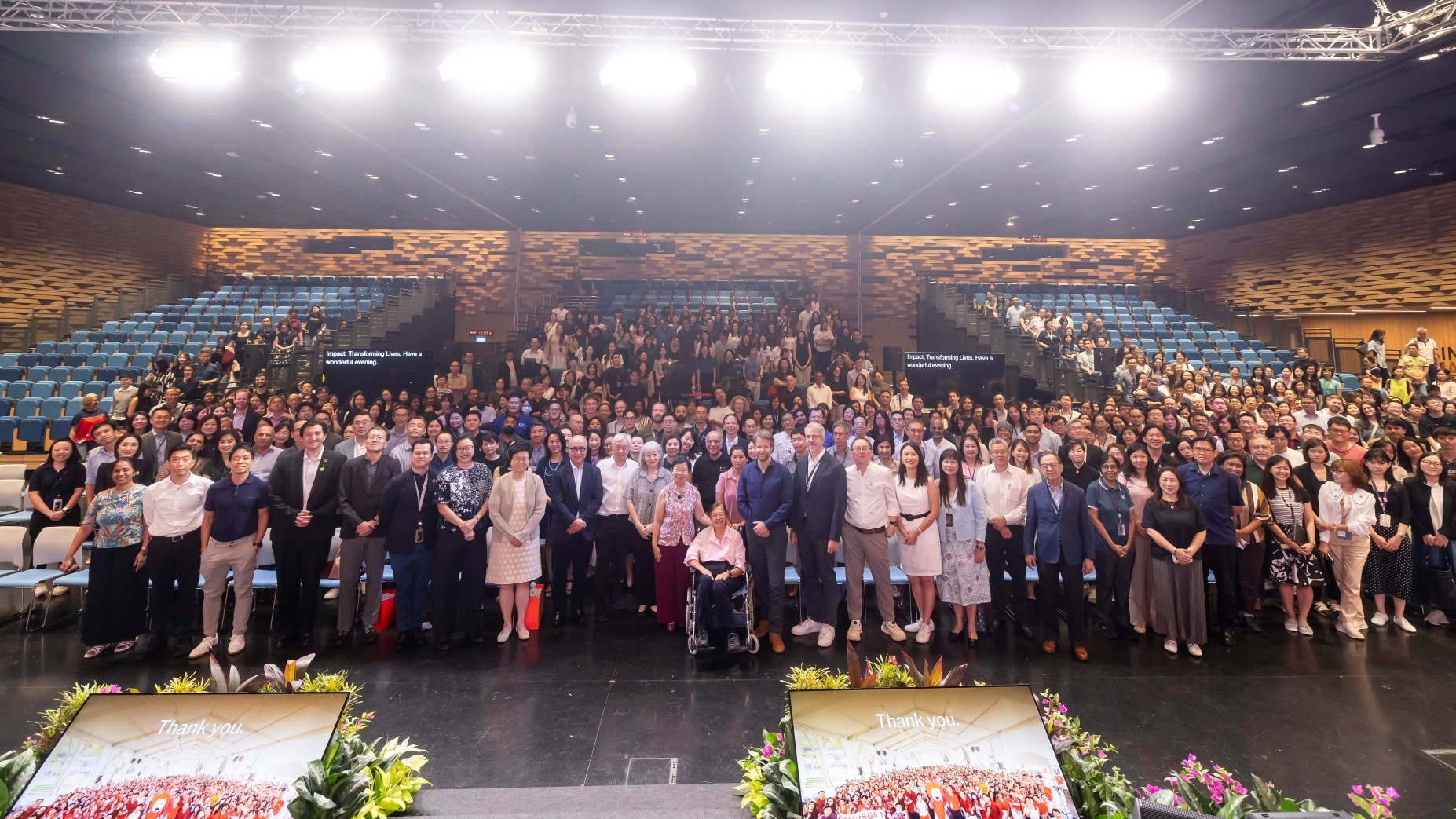
Prof Kong standing with members of the audience for a commemorative photo.
Reflections from the SMU community
“It struck me at PSOUA that a journey which started in 2017 has become a movement, with the potential to transform the discourse on what a university means to the world."
Mark Chong
Dean of Students; Professor of Communication Management (Practice), Lee Kong Chian School of Business
“The emphasis on making a positive impact on society in the President’s Address resonated strongly with me. At a time when anyone can use social media to broadcast information, the world needs credible evidence and expert voices to inform public debate. I look forward to contributing to this strategic goal as LKCSB’s Associate Dean (Impact).”
Sabine Benoit
Professor of Marketing (Practice) and Associate Dean (Impact), Lee Kong Chian School of Business
“Three things struck me about this year’s PSOUA. First, SMU should be more than a four-year university: a 60-year university responsive to evolving workforce needs amid rapid technological and social change. Second, SMU Access+ enables all students to enjoy the full SMU experience, regardless of their financial circumstances – something that makes me proud to be part of SMU. Finally, I was impressed by colleagues’ determination to advance impact through research and teaching, translating ambition into work that makes a real difference.”
Tang Hang Wu
Professor of Law, Yong Pung How School of Law
“The emphasis on intentionally translating vision into impact was particularly compelling. Building on the direction set out in PSOUA 2025, this year's Address provided clear priorities, concrete plans and desired outcomes that demonstrated a strong commitment to turning aspirations into meaningful results.”
Oey Ying Erh
Assistant Dean (Administration), College of Integrative Studies
"The Address was a timely reminder of our purpose. Education can no longer be confined to the degree years; it must support people throughout a 60-year journey. This places a responsibility on us to expand the scale and quality of what we offer individuals and organisations across Singapore and the region. We are here to shape lives and the future, and I left optimistic about what we can build together.
Jack Lim
Executive Director, SMU Academy
“One of my key takeaways from the PSOUA was the central role of the Impact Framework (IOOI) in articulating and measuring research impact. It demonstrated how our faculty's research excellence is connected to meaningful outcomes and real-world impact. I was also struck by the impressive calibre of our faculty and the breadth of their research achievements. The quality of the research outputs presented was truly commendable and reflects the strength of our academic community.”
Harkirat Singh Sidhu
Director, Office of Legal & General Affairs
“What stood out to me most was the way community service and volunteerism are deeply embedded in the SMU culture and experience. It reminded me that SMU's impact is measured not only by academic and professional achievements, but also by how we contribute to society. Seeing our students, faculty and staff united in service reinforces the strength of our OneSMU spirit and our shared commitment to the common good.”
Tan Gak Khiam
Senior Deputy Director, Digital Enterprise Services, Integrated Information Technology Services
“Seeing how SMU2030 has evolved from a strategic plan into a shared movement was especially inspiring. The reminder that ‘activity is not the same as impact, and aspiration is not evidence’ reinforced the importance of staying focused on outcomes as we collectively build towards SMU's future.”
Ang Lay Yong
Associate Director, College of Graduate Research Studies
“Prof Kong’s discussion of applied learning was a reminder that students can build competency by working with organisations on real-world challenges. I am excited by the promise of the next phase of SMU-X. Its challenge-led, interdisciplinary model can give students more opportunities to apply their learning in areas such as sustainability, innovation and the future of work.”
Randall Duran
Senior Lecturer of Information Systems, School of Computing and Information Systems
“The message that ‘Activity is not impact, and aspiration is not achievement’ stayed with me long after the Address. It serves as a reminder that true analytical value is measured not by what we produce, but by the tangible change our insights bring about.”
Allan Tay
Research Assistant, Centre for Research on Successful Ageing
“The reminder that impact is an ongoing process, and that output does not necessarily equate to outcomes, resonated strongly with me. We often celebrate the successful completion of a task or initiative and move on, but we should also ask what happens next: did it create lasting influence, change lives, or move us closer to the outcomes we seek?”
Denise Yong
Assistant Director, Corporate and Digital Communications, School of Accountancy
“This year's PSOUA reinforced the importance of focusing on impact rather than activity. The reminder that ‘activity is not impact; aspiration is not evidence’ challenged me to look beyond programme numbers and ask a deeper question: what lasting difference are we making in people's lives?”
Lim Sze Hui
Senior Manager, Institute of Innovation & Entrepreneurship
“I was particularly encouraged by the implementation of the Input, Output, Outcome and Impact (IOOI) framework. Beyond measuring the effectiveness of SMU's initiatives, it provides a useful guide for ensuring future efforts remain focused on meaningful and lasting impact.”
Zachary David Chua Yi Rong
Student, School of Computing and Information Systems