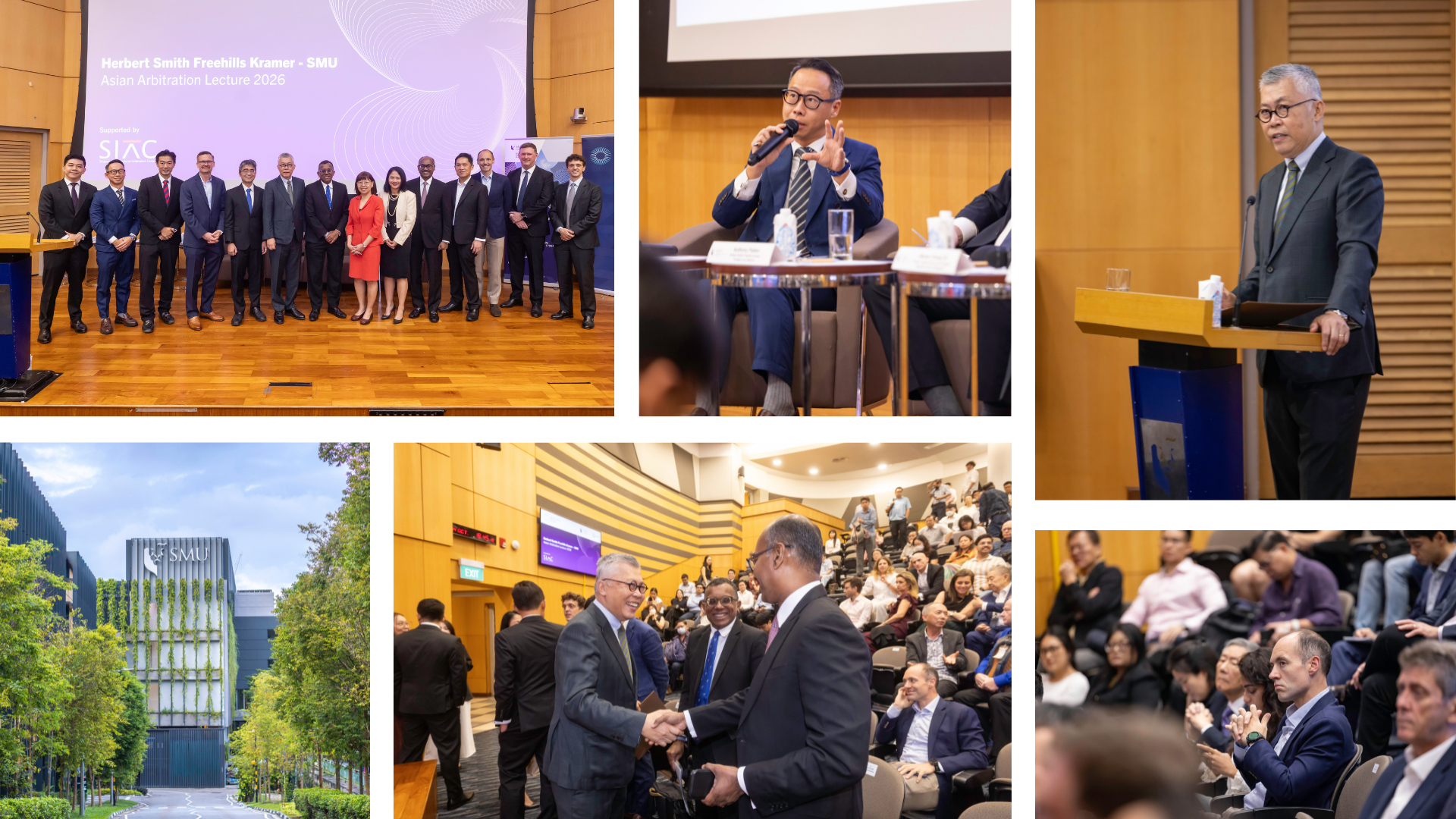
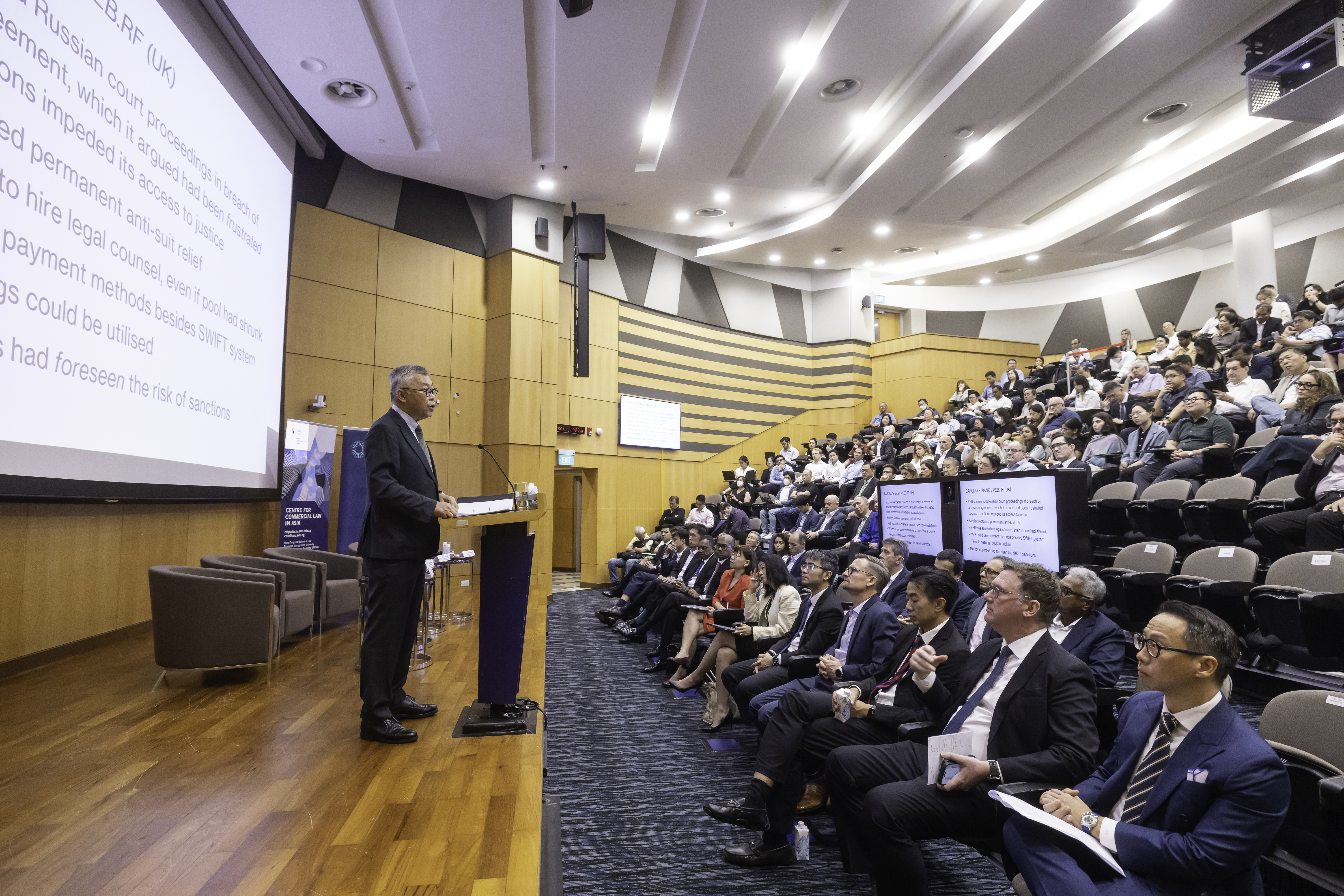
The impact of economic sanctions on international commercial arbitration was the focus of the Herbert Smith Freehills Kramer–SMU Asian Arbitration Lecture 2026. Jointly organised by Herbert Smith Freehills Kramer and the Singapore Management University (SMU) Centre for Commercial Law in Asia (CCLA), the lecture held on 14 October 2026 at SMU’s Yong Pung How School of Law was attended by Judges of the Supreme Court of Singapore, practitioners, academics and students.
The Lecture, which is into its 17th edition, was established in 2010 through a term-fund contribution from Herbert Smith Freehills Kramer to SMU. The keynote address this year was delivered by The Honourable Mr Steven Chong SC, former Justice of the Court of Appeal of the Supreme Court of Singapore, who has played a significant role in shaping Singapore’s jurisprudence on international arbitration and cross-border commercial disputes.
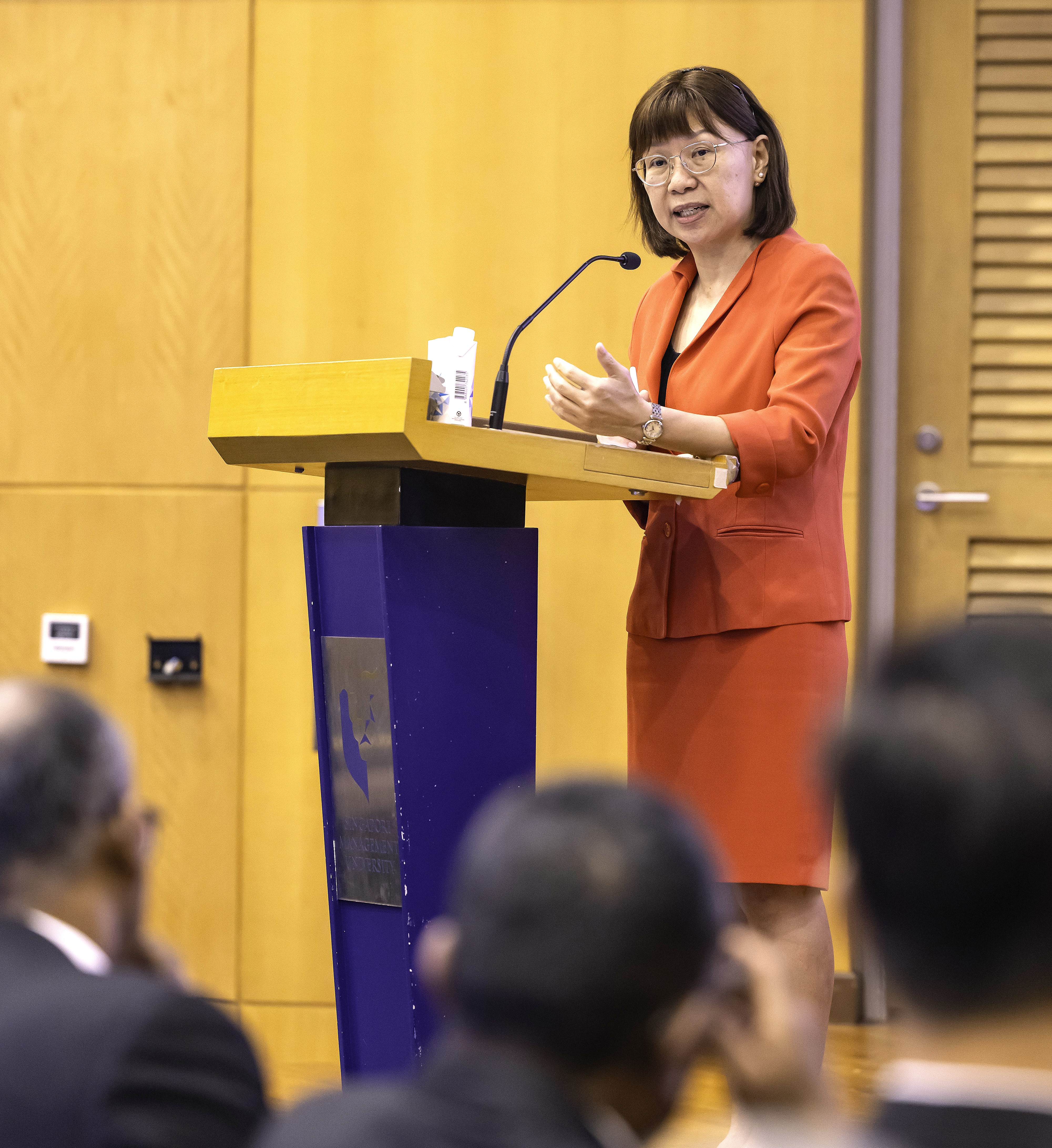
Welcoming participants, Professor Lee Pey Woan, Dean of SMU’s Yong Pung How School of Law, highlighted the importance of the lecture series in advancing discussion on international dispute resolution. She observed that the judiciary has played a central role in establishing Singapore as a trusted seat for international arbitration, and noted that the lecture series has become a signature platform in Singapore and the region, bringing together jurists, practitioners and scholars to examine the developments shaping the field.
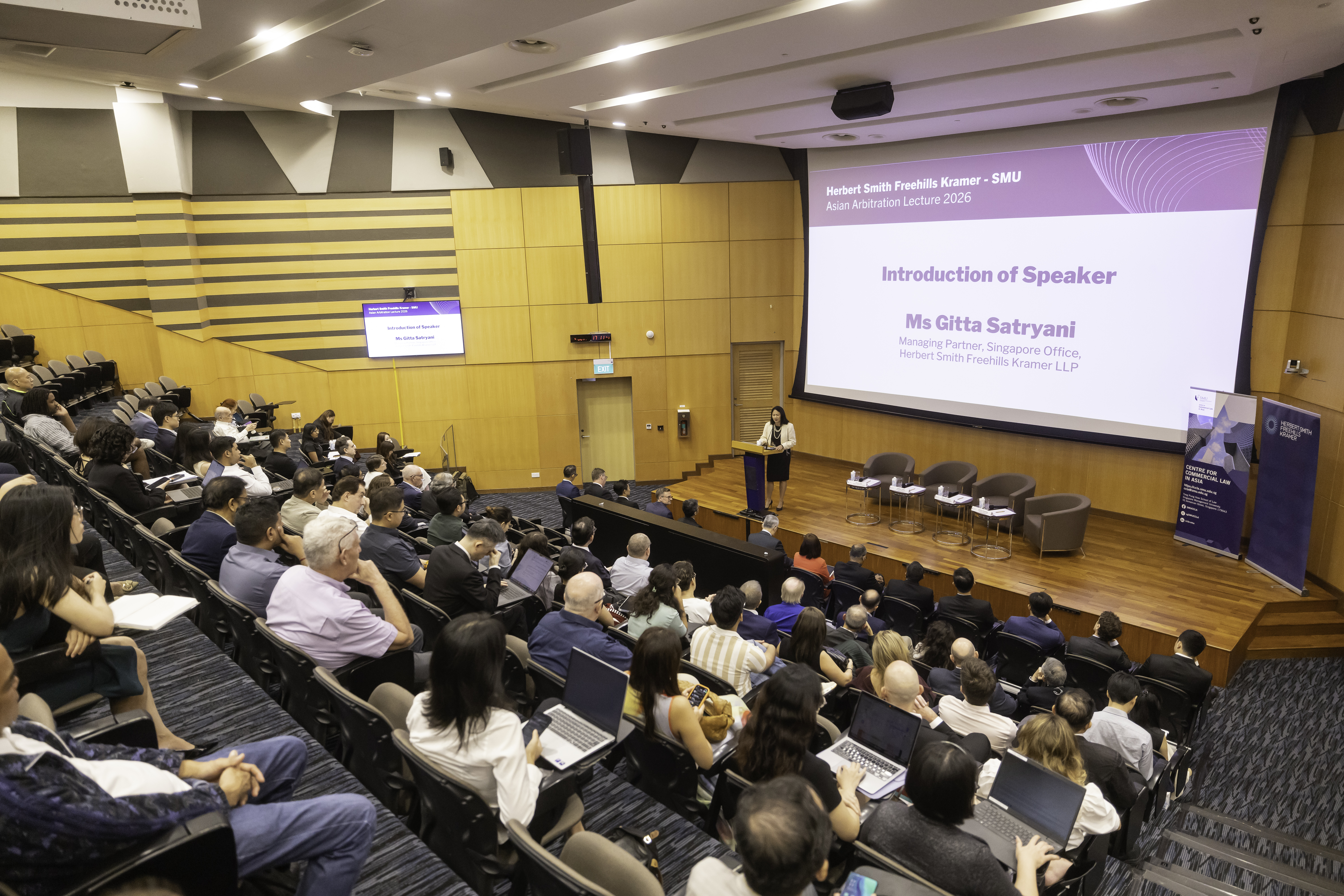
Introducing the keynote speaker, Ms Gitta Satryani, Managing Partner of Herbert Smith Freehills Kramer’s Singapore office, said Mr Chong SC’s intellectual rigour and deep understanding of complex cross-border commercial disputes placed him in a strong position to address the challenges sanctions pose for international arbitration. She also cited his contribution, through a number of significant Court of Appeal decisions, to Singapore’s standing as a leading arbitral seat.
Impact on arbitral proceedings
Delivering his keynote address, “Caught in the Crossfire: Arbitration’s Struggle with Sanctions”, Mr Chong SC examined how economic sanctions imposed amid geopolitical tensions are affecting international commercial arbitration. His lecture was organised around two principal themes: the impact of sanctions on the conduct of arbitral proceedings and their consequences for the recognition, enforcement and setting aside of arbitral awards.
He explained how sanctions can restrict parties’ choice of legal counsel and arbitrators, impede payments to lawyers and arbitral institutions, and prevent parties, witnesses and experts from attending in-person hearings. These practical obstacles can raise significant legal questions, including whether a party has been denied effective access to justice, whether an arbitration agreement has been frustrated, and whether proceedings can continue.
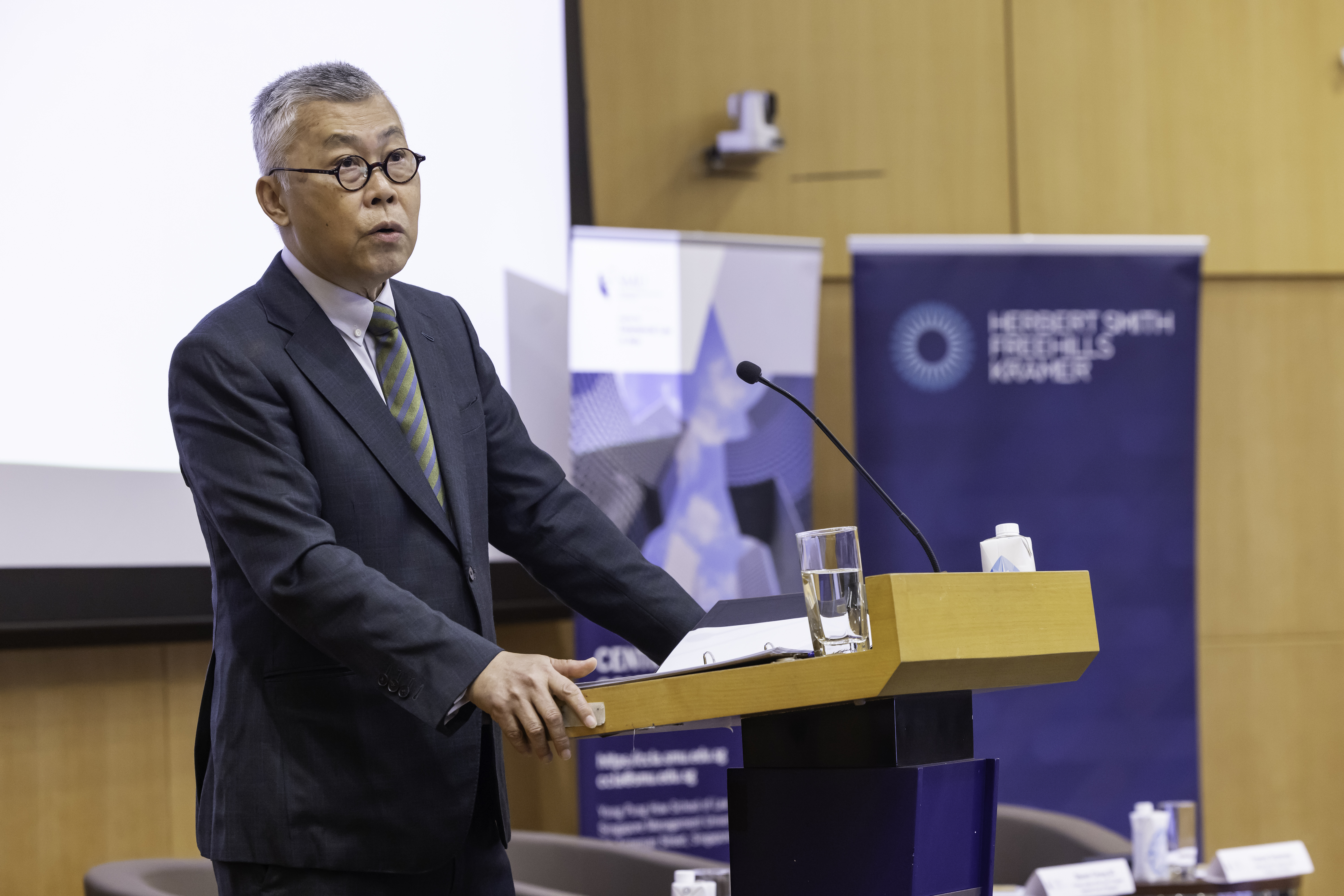
Drawing on decisions from Singapore, the United Kingdom, Hong Kong and other jurisdictions, Mr Chong SC highlighted the fact-sensitive approach courts have taken in assessing whether sanctions genuinely prevent a party from participating in arbitration. He observed that inconvenience, delay or restrictions on the choice of counsel may not, in themselves, amount to a denial of justice, particularly where sanctions were reasonably foreseeable. He also discussed circumstances in which arbitral proceedings may be terminated because their continuation has become impossible.
Impact on arbitral awards
Turning to the consequences of sanctions after an award has been rendered, Mr Chong SC explained that sanctions may prevent successful parties from receiving payment, complicate the enforcement of awards, or give rise to challenges based on public policy. His analysis highlighted the unresolved legal questions that arise when sanctions intersect with the recognition and enforcement of arbitral awards, including whether awards can be enforced through third parties and whether the assignment of award rights may circumvent sanctions restrictions.
Implications for the transnational system of commercial justice
In his concluding remarks, Mr Chong SC considered the implications of these developments for what Chief Justice Sundaresh Menon has described as the transnational system of commercial justice, of which international arbitration is an essential component. He warned that sanctions create uncertainty for arbitration users, may undermine confidence in arbitration as an effective means of resolving disputes, and have prompted countermeasures that risk fragmenting the international dispute-resolution framework.
Referring to Russia’s “Lugovoy Law”, which confers exclusive jurisdiction on Russian courts over disputes involving sanctioned Russian parties, and the resulting conflicts between national courts, he cautioned that competing jurisdictional claims can prolong disputes, increase legal costs and expose parties to conflicting court orders.
Implications for commercial parties - perspectives from practice
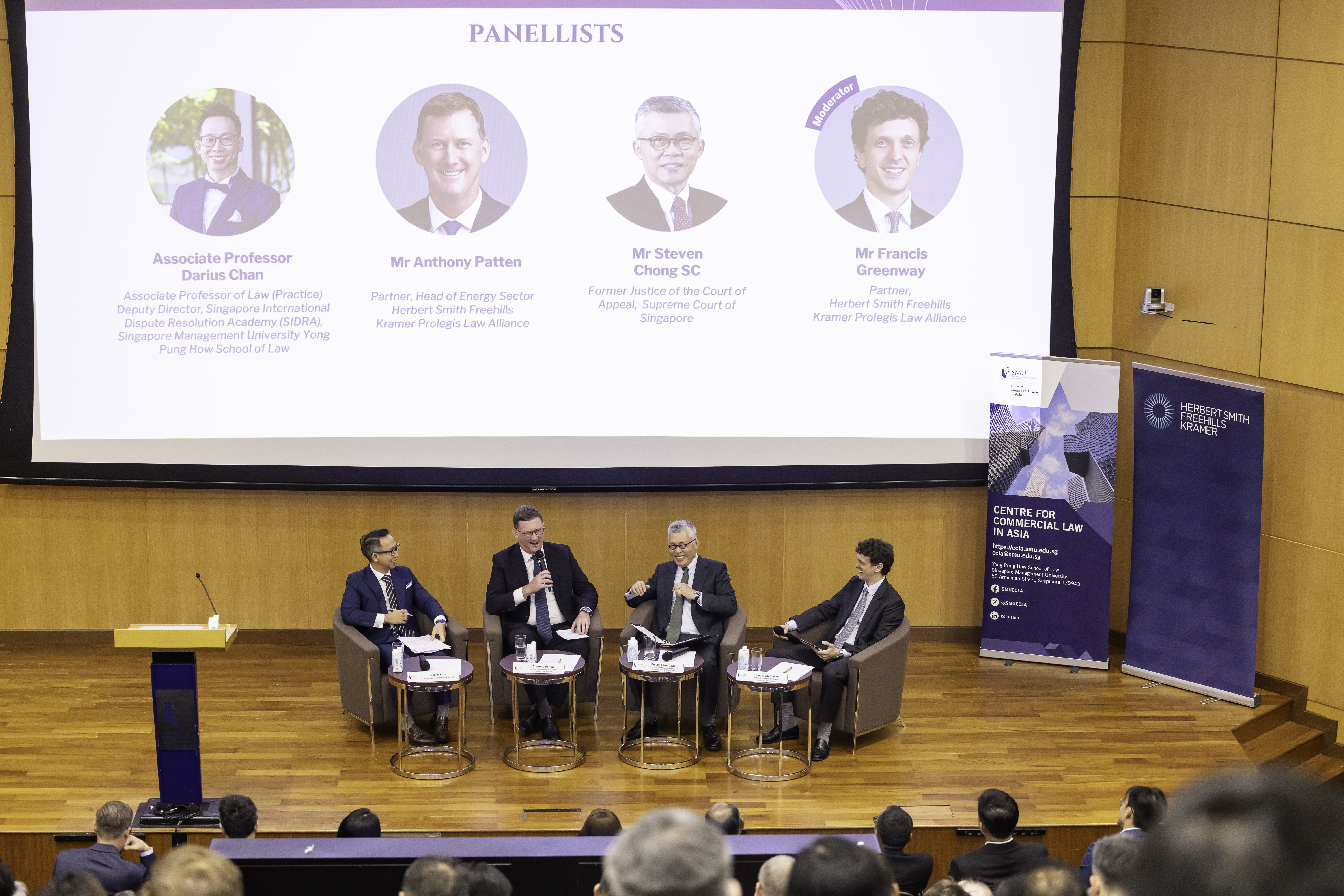
The keynote was followed by a panel discussion featuring Mr Chong SC; Associate Professor Darius Chan, Deputy Director of the Singapore International Dispute Resolution Academy (SIDRA) at SMU; and Mr Anthony Patten, Partner and Head of Energy Sector at Herbert Smith Freehills Kramer Prolegis Law Alliance. The session was moderated by Mr Francis Greenway, Partner at Herbert Smith Freehills Kramer Prolegis Law Alliance.
The panel discussion explored the practical implications of sanctions for commercial parties and the resilience of international arbitration as a dispute-resolution mechanism. Building on Mr Chong SC’s observations, the panellists discussed how businesses, particularly in the energy sector, are increasingly considering sanctions-related risks when structuring cross-border transactions and negotiating long-term contracts.
They highlighted the importance of express contractual provisions to allocate these risks, especially where sanctions may be reasonably foreseeable, rather than relying solely on general force majeure clauses. The discussion also considered the continued role of the Singapore International Arbitration Centre (SIAC) as a trusted forum for resolving commercial disputes in the region, including those affected by sanctions.
They also examined how countermeasures to foreign sanctions, including blocking statutes, can create additional legal uncertainty and give rise to further litigation. Returning to the relationship between sanctions and public policy, Mr Chong SC emphasised the importance of distinguishing a state’s national policy from the public policy applied by its courts. The discussion underscored the complex and evolving challenges that sanctions present for international arbitration, from contractual risk allocation to the recognition and enforcement of arbitral awards.
The lecture reflects the continuing efforts of SMU and its law school in fostering dialogue on emerging challenges in international commercial law and dispute resolution, bringing together judicial, policy, academic and industry perspectives.
- End -
Note: A recording of the lecture is available on the Lecture website here.