

Thailand will need an estimated US$220 billion in additional climate-related investment. But mobilising that capital presents a difficult question for policymakers and financial institutions: how can money be channelled towards climate adaptation when the returns often come in the form of losses avoided rather than profits earned?
For businesses exposed to increasingly severe floods and extreme heat, the question is equally pressing. Who pays for adaptation, who benefits from it, and how can smaller enterprises finance measures to protect their operations?
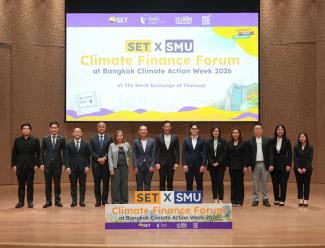
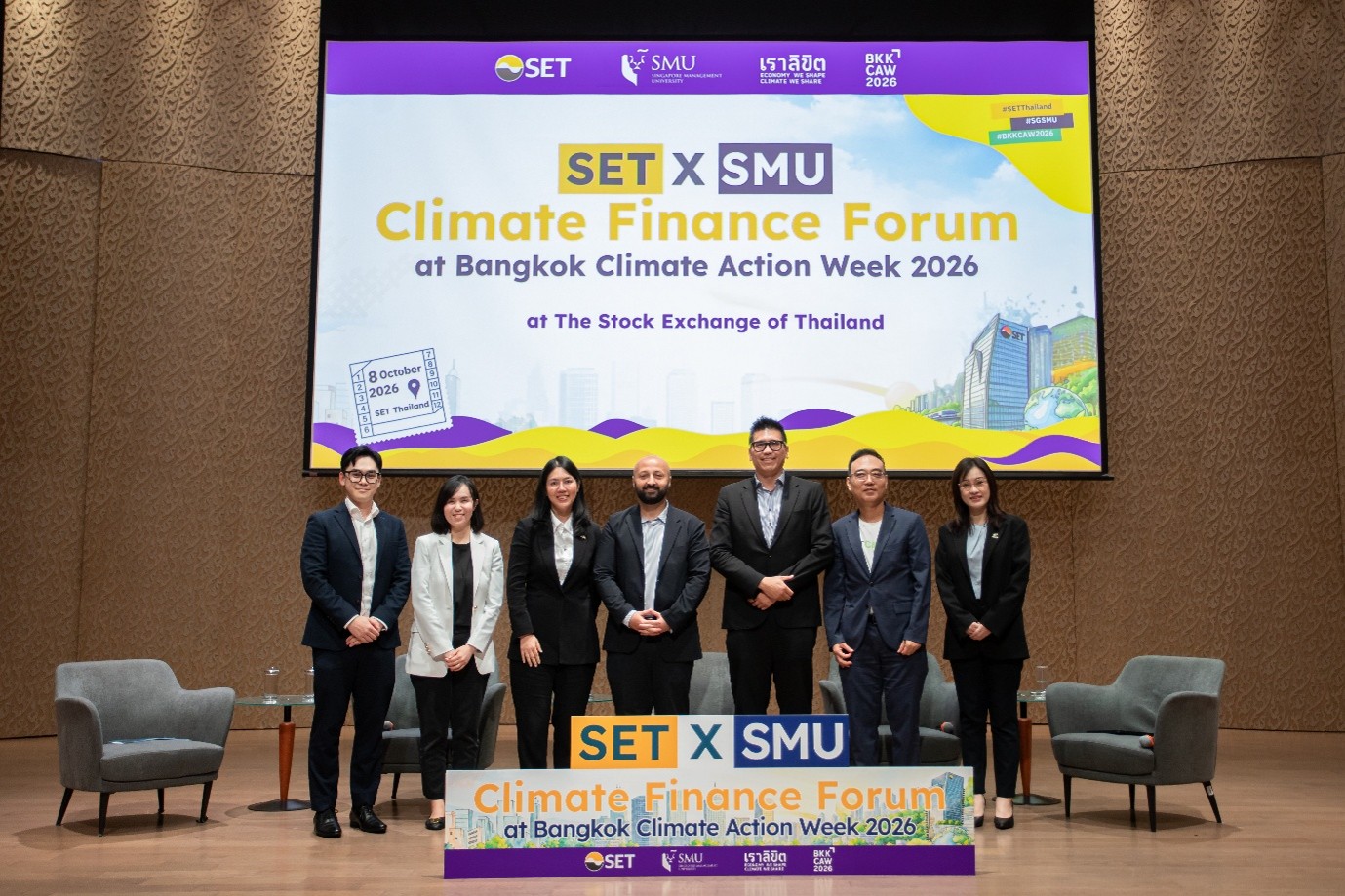
These questions brought policymakers, financial institutions, industry leaders and researchers together at the SET x SMU Climate Finance Forum on 8 October 2026, jointly organised by Singapore Management University (SMU) and the Stock Exchange of Thailand (SET).
Held during Bangkok Climate Action Week 2026, the full-day forum placed SMU alongside Thailand's key financial-market institution in discussions on the country's climate-finance priorities. It also brought together expertise spanning climate science, economics and sustainable finance to examine how policy and financial innovation could translate into practical responses to climate risks.
The forum took place just days before Bangkok hosted the International Monetary Fund and World Bank Group Annual Meetings, as climate financing and economic resilience feature increasingly prominently in regional policy and business discussions.
Financing Thailand's climate transition
The scale of Thailand's financing needs was outlined by Dr. Ornsaran Manuamorn, Senior Financial Sector Specialist at the World Bank. Drawing on the World Bank's Thailand Country Climate and Development Report, she said the country would require approximately US$220 billion in additional climate-related investment between 2025 and 2050, spanning emissions reduction, climate adaptation and sustainable agriculture and forestry.
Opening the forum, Dr. Benjarong Suwankiri, Senior Executive Vice President of SET, highlighted Thailand's mounting climate risks, while timely transition efforts could unlock a new economic growth engine. He also stressed the need for credible and bankable projects supported by reliable climate data and financial innovation to attract sustainable finance. With traditional approaches no longer enough, SET, for instance, has expanded from a capital-raising platform into a "transition enabler”.
The morning discussions examined how financial markets and policy frameworks could help bridge this financing gap. Speakers explored the World Bank-supported Low Carbon Cities and Carbon Market Development initiative, the expansion of Thailand's carbon market, comprehensive climate data, and the role of the Thailand Taxonomy in creating capital opportunities towards sustainable economic activities.
They also considered emerging financial instruments and mechanisms, including total solutions packages under the Financing the Transition programme, Transition bonds and Thailand amber bonds, and how these could support businesses —particularly supply chain partners and smaller enterprises—moving towards a lower-carbon economy. Together, these efforts can help create an effective climate finance ecosystem for Thailand.
Making climate adaptation a business and financial priority
While financing the transition to a lower-carbon economy remains important, recent flooding in Thailand has brought another challenge into sharper focus: paying for adaptation to climate impacts that are already being felt.
For businesses, this is no longer simply an environmental concern. It has implications for operational continuity, financial stability and long-term competitiveness.
"Climate adaptation is not just an environmental issue: it's also an issue of economic competitiveness, financial stability, and how business navigates risk," said SMU Presidential Assistant Professor of Anthropology Al Lim, who opened the afternoon session.
He raised three questions central to the financing challenge: How can adaptation become visible and investable? Who should pay for it? And who stands to benefit?
The questions are particularly pertinent for small and medium-sized enterprises (SMEs), which can be highly exposed to climate disruptions but may lack the resources and financing options available to larger companies. Measures such as flood protection and urban cooling can reduce future losses, but their benefits are often difficult to quantify in ways that attract conventional private investment.
SMU Lee Kong Chian Professor of Urban Climate Winston Chow, who is also Co-Chair of Working Group II of the Intergovernmental Panel on Climate Change, explained that different adaptation projects require different financing approaches. While some can attract private capital through operational savings, others deliver wider public benefits and may require government funding or concessional finance.
"Thailand and ASEAN must turn talk about climate finance into urgent action that protects communities, businesses, and economies from an increasingly disrupted future, " said Dr Chow.
The financing gap was further illustrated by Associate Professor Theodor Cojoianu, Academic Director of SMU's Singapore Green Finance Centre. Presenting research that tracked US$2.62 trillion in bond allocations, he noted that only 2 per cent was explicitly directed towards climate adaptation.
He highlighted the need to integrate climate resilience into urban planning and infrastructure development, and to consider how financial markets could support the development of more resilient infrastructure.
Reflecting on the collaboration with SET, he said: "I am delighted to see the deep engagement of Thailand and SET in particular around understanding how adaptation and resilience relates to financial market outcomes, and how these can help finance new resilient infrastructure."
These issues were taken up in the concluding panel, "Resilient by Design", moderated by Assistant Professor Al Lim. Panellists included Professor Winston Chow, Associate Professor Theodor Cojoianu, Dr Kannika Thampanishvong of the Puey Ungphakorn Institute for Economic Research and Ms Swisa Pongpech of the University of Oxford.
They examined the financing barriers facing businesses, particularly SMEs, and the difficulty of securing capital for adaptation measures whose financial benefits may only materialise through losses avoided in the future.
The contributions of Assistant Professor Al Lim, Professor Winston Chow and Associate Professor Theodor Cojoianu, all faculty members of SMU’s College of Integrative Studies (CIS), to global conversations on challenges such as climate change and sustainable finance, reflect CIS’s integral role in advancing SMU’s global engagement and impact. Through interdisciplinary research and engagement with international partners and stakeholders, CIS contributes to the University’s SMU2030 ambitions of transformative education, impactful research and strategic partnerships.
Connecting climate expertise with regional decision-making
The forum reflects SMU's growing engagement in Thailand through its Bangkok Overseas Centre, SMU Thailand, which serves as a platform for connecting the University's academic expertise with regional policymakers, financial institutions and businesses.
Its collaboration with SET demonstrates how the centre is contributing to important national conversations, bringing together perspectives from research, financial markets and public policy on issues with direct implications for Thailand's economy and business community.
The engagement continued the following day, when SMU convened a session at Samyan Mitrtown titled "Financing Urban Resilience in Southeast Asia: The Do's, Don'ts and Possibilities". The discussion dove deeper into how climate science and financial innovation could support more resilient urban development across the region.
As Thailand confronts the mounting economic costs of climate change, financing resilience will require closer collaboration between governments, financial institutions and businesses.
For companies facing growing exposure to floods and heat, the cost of adaptation is becoming a question of economic survival as much as environmental responsibility.