

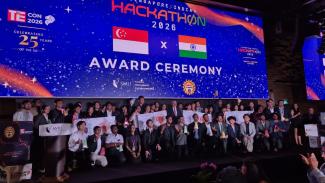
SINGAPORE, 18 November 2026 (Wednesday) - From protecting hawkers and delivery riders against income lost to bad weather, to helping sales teams spot their next customer and farmers plan crops around buyer demand, youths from Singapore and India at the Singapore-India Hackathon (SIH) 2026 came up with practical solutions to everyday problems.
Built over 36 hours, the winning ideas emerged from 20 mixed-country teams comprising 120 tertiary students from Singapore and India yesterday evening (17 November). Each team tackled a real-world challenge set by Singtel; Income Insurance; Singapore’s Ministry of Energy, Trade and Industry (METI); or the Singapore Centre for Social Enterprise (raiSE).
Their work brought the Hackathon’s theme, ‘Build a Better Future’, to life through practical ideas addressing the needs of businesses and communities in both countries. The three-day programme held at Singapore Management University (SMU) from 15 to 17 November also connected participants with employers, entrepreneurs and investors, while a new scholarship created a pathway for eligible participants to continue their education at SMU.
Organised by SMU’s Institute of Innovation and Entrepreneurship (IIE), the All India Council for Technical Education (AICTE) and the India Ministry of Education’s Innovation Cell, in collaboration with TiE Singapore, the fourth edition of SIH was held in consultation with Singapore’s Ministry of Education, India’s Ministry of Education and the High Commission of India in Singapore.
In his welcome remarks at the Gala Dinner where the winners were announced, Piyush Gupta, Chairman of the SMU Board of Trustees, said, "Economic corridors are not built by agreements alone – they are ultimately built by people. That is what makes the SIH so compelling. By bringing young innovators from Singapore and India together to combine different disciplines, cultures and ways of thinking around shared challenges, we are fostering the exact relationships on which the next chapter of the Singapore-India corridor can be built.”
The four winning teams received a total of S$88,000 in prizes, comprising S$13,750 for the winner of each track and an S$8,350 merit award for each runner-up.
Four winning ideas for a better future
Income Insurance challenged teams in the 'FinTech and InsurTech’ track to explore how data and AI could make protection against climate risks more accessible and affordable for vulnerable households and SMEs in Singapore. Track winner, POINT BLANK, developed Payung, which offers bad-weather income cover for Singapore’s hawkers and automatically pays out when haze, heavy rain or extreme heat disrupts business, with no claim form required. (Please refer to the Annex for details of the winning teams)
"For a challenge completed in just 36hours, the quality of the submissions was highly encouraging. Many teams demonstrated a strong grasp of the problem they were solving, backed by well-structured pitches and thoughtful execution. It was equally inspiring to see students from Singapore and India collaborate so effectively. The blend of different perspectives and experiences strengthened the ideas presented and showed how innovation thrives when diverse minds work towards a common goal," said Dhiren Amin, Chief Customer Officer, Income Insurance.
Singtel challenged teams in the ‘Emerging Technologies’ track to explore how AI could help enterprise sales teams better understand and serve their customers. Track winner, Owlgorithims, developed an AI lead-qualification tool that brings together public and internal data to rank and explain sales opportunities, helping account managers win new business and support existing clients.
“AI is changing the nature of work and redefining the capabilities businesses need. The emerging workforce must come prepared to analyse complex problems, think critically, and exercise the judgement to succeed in an AI era. Hackathons like these give students an opportunity to tackle real business challenges, appreciate the thinking required to solve them, and develop essential skills for their future work environment. Singtel is pleased to share our experience and help these students bridge the gap between academic learning and business realities,” said Gaurav Kathpalia, Head, Enterprise and Consumer, AIDA, Singtel Singapore.
METI challenged teams in the ‘Sustainability and Climate Action’ track to help Indian smallholder farmers improve the quality, consistency and reliability of their produce, enabling them to meet the needs of larger buyers, including Singapore importers. Track winner, Catalyst, developed a digital platform that helps Farmer Producer Organisations turn buyer demand into coordinated crop plans, matching farmers and farmland to suitable crops while giving exporters greater visibility of expected supply.
raiSE challenged teams in the ‘Social Innovation and Inclusive Development’ track to find ways of supporting disadvantaged and lower-income seniors in Singapore and India to age well, improve their wellbeing, and remain active and engaged in their communities. Track winner, Holy Crop, developed a digital platform that connects seniors with meaningful, flexible work opportunities, helping them remain economically active and socially engaged.
“It was truly heartening to see the quality of submissions in the social innovation and inclusive development track. These teams brought together insights and context from both Singapore and India by working together online, and still produced solutions that understood local realities on both sides," said Albert Ho, Head of Venture Building at raiSE. "What impressed us most was that many of them went out onto the streets to test their ideas with the communities they hope to serve. That instinct to validate with real people, not just in theory, is what turns a good idea into real world impact. We’re proud to support this generation of young innovators, and we hope to see many of these ideas carried forward.”
Each team brought together students from different institutions, disciplines and countries, many of whom were meeting for the first time. In a 36-hour sprint meant they had to test not only their ideas but also their assumptions about the people and problems they hoped to serve.
Professor Yogesh Singh, Chairman of the All India Council for Technical Education (AICTE), said, “Over four editions, the Singapore-India Hackathon has grown into an important platform for young people from our two countries to learn from one another while working together on challenges that matter to both our societies. Each edition creates new connections between our students, institutions and partners. That is the real value of this collaboration: not only the solutions developed during the Hackathon, but the relationships, understanding and opportunities it continues to build between India and Singapore.”
Beyond the final pitch
The Awards Ceremony concluded the competition, but participants’ engagement with industry and the wider entrepreneurial ecosystem began before the prizes were announced.
Participants met representatives from more than 10 companies operating across Singapore and India, including GIC, Singapore Airlines, Singtel and Temasek, to explore project, internship and career opportunities. They also attended TiECon 2026 at SMU, where founders, investors and business leaders shared lessons from building and scaling technology companies across Asia and beyond. Teams that decide to continue developing their ideas may explore mentoring, industry validation or support through SMU IIE, including its Business Innovations Generator (BIG), an award-winning equity-free incubator for early-stage start-ups.
"Bringing the SIH and TiECon together was about giving young innovators a window into what comes next. At the Hackathon they built and tested ideas; at TiECon they could hear directly from entrepreneurs and investors who know what it takes to turn an idea into a company and scale it. We hope those conversations give students the networks, confidence and perspective to keep building,” said Prantik Mazumdar, President of TiE Singapore.
The pathways created around this year’s Hackathon also extend into postgraduate education. At the opening ceremony on 15 November, Nupur Agarwala Bahadur and Amrish Bahadur, Patrons of the Singapore-India Hackathon 2026, launched the Nupur A. & Amrish Bahadur Scholarship.
Open to participants from the 2026 Hackathon and the two previous editions, regardless of nationality, the scholarship will support four outstanding members of the SIH community to pursue postgraduate studies at SMU. Eligible programmes include SMU’s Master of IT in Business, Master of Science in Business AI, and Master of Science in Entrepreneurship and Innovation.
SIH was first proposed in 2018 by Indian Prime Minister Narendra Modi to Singapore’s then-Prime Minister Lee Hsien Loong. After its inaugural edition in Singapore, SIH moved to India for subsequent editions before returning to Singapore this year.
- End -
Enclosure:
Annex: Singapore-India Hackathon 2026 Winners and Runners-Up (PDF enclosed)