

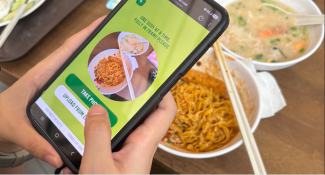
A decade-long research project at SMU has helped Singaporeans better understand what's on their plate. FoodAI, an AI-powered food recognition system developed at the School of Computing and Information Systems, recently powered the Zespri Meal Decoder, a web app that gave users an estimated nutritional breakdown of their meals simply by snapping a photo.
Zespri, the world’s largest the kiwi fruit distributor, featured the app in a campaign that ran from 7 September to 4 October. This campaign addressed a gap highlighted by a Zespri survey: while most Singaporeans consider whether a meal will keep them full, appears healthy, or contains food they should limit, only around one in 10 feel clear about the nutrition that their everyday meals provide.
FoodAI’s journey
The research on FoodAI began at SMU in 2016, when Professor of Computer Science Steven Hoi led a team that developed a machine-learning system capable of recognising more than 100 types of food, including Singapore favourites such as chilli crab and chicken rice. Initially based at the former Living Analytics Research Centre, led by Professor of Computer Science Lim Ee Peng, the team aimed to make food recognition as simple as taking a photograph, with potential applications such as easier calorie and food tracking.
SMU’s research in food recognition has since expanded into the broader field of food computing, led by Lee Kong Chian Professor of Computer Science Ngo Chong Wah.
Prof Ngo’s work uses machine learning to train AI on large collections of food images, helping it recognise different dishes and ingredients from visual patterns. This connects photographs of food with useful information such as ingredients, recipes and nutrition.
It is comparatively rare for FoodAI to be used in a consumer context, said Prof Ngo. “The partnership with Uncanny allows us to better understand how to fine-tune the technology to estimate nutritional information from food images, particularly images of new dishes, captured in dynamic, living environments like hawker centres in real life.”
From lab to market through a licensing agreement
The Meal Decoder opportunity emerged when Uncanny, the creative agency developing Zespri’s consumer engagement campaign, approached SMU. What followed was a series of technical discussions between Uncanny, Zespri and SMU researchers, facilitated by SMU’s Knowledge Transfer & Commercialisation (KTC) team at SMU’s Institute of Innovation and Research (IIE). These discussions led to a licensing agreement enabling Uncanny to integrate FoodAI into the web app they were building for Zespri for the month-long Meal Decoder campaign.
Said Dr Sze Tiam Lin, Senior Licensing Advisor: "This collaboration with Zespri demonstrates how SMU research can move beyond the laboratory to create meaningful impact in the marketplace. Seeing a global brand adopt SMU-developed technology affirms the practical relevance of our research relevance and the important role of university-industry partnerships in bringing innovation to consumers.”
FoodAI’s path from lab to app illustrates how academia and industry can partner to translate research into real-world use. It also underscores the importance of strong commercialisation pathways.
“Successful commercialisation requires more than invention. It involves identifying promising research outputs, protecting intellectual property, building industry relationships and creating pathways for adoption. Together, these efforts strengthen the University's innovation ecosystem and give researchers confidence that their work can make a meaningful difference beyond the laboratory,” Dr Sze said.