

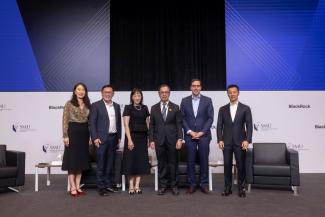
As Artificial Intelligence (AI) is moving beyond the hype to transform business, how is it transforming business, governance and especially the people entering the workforce?
The questions were in the spotlight at the latest edition of SMU Visionary Series hosted by Singapore Management University.
The conversation held on 1 October at SMU Hall featured a high-powered panel featuring Mr Rob Goldstein, Chief Operating Officer of BlackRock; Mr Lee Chuan Teck, Chairman of Enterprise Singapore; and Mr Sam Kim, Chief Operating Officer and Director, Investment Insights Group at GIC. Moderating the conversation was Professor Sun Sun Lim, SMU’s Vice President (Partnerships and Engagement) and Lee Kong Chian Professor of Communication and Technology.
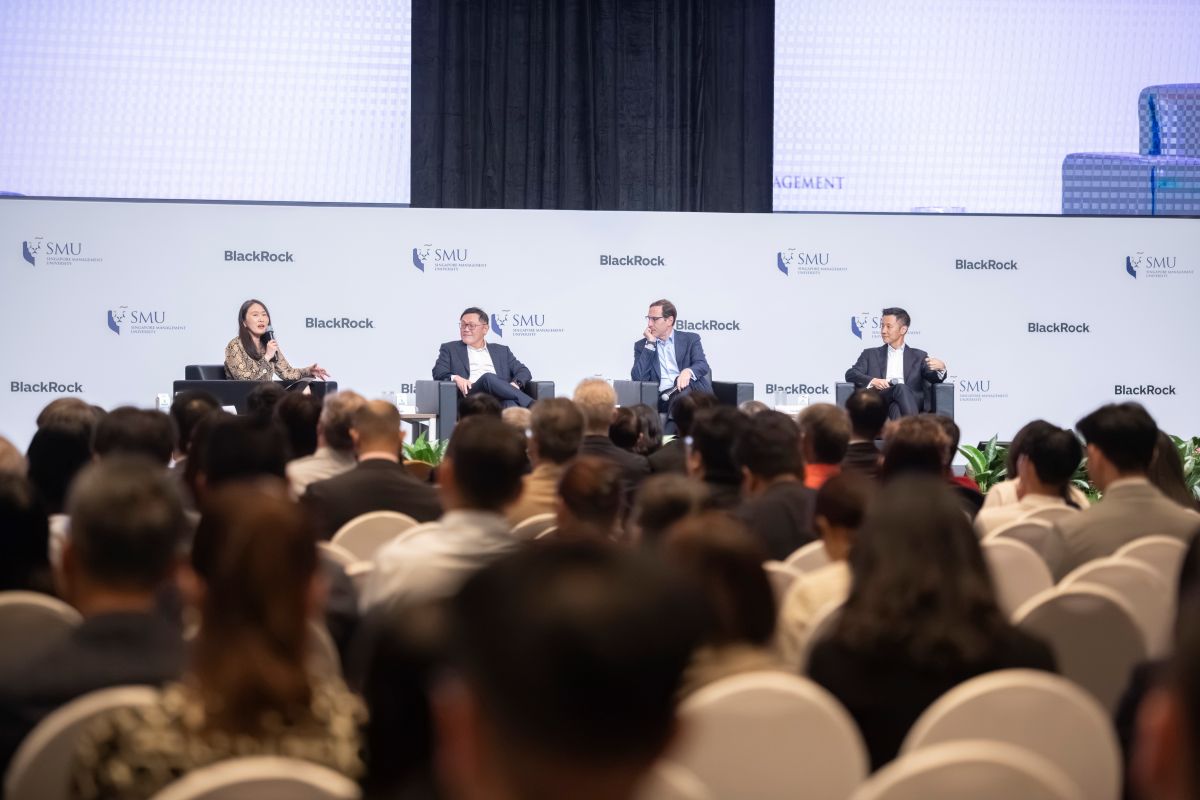
The event attracted some 300 attendees from academia, government and industry. Key insights focused on the advantage that strong governance provides for scaling innovation in highly regulated industries like finance, the importance of fundamentally rethinking business models rather than just optimising processes with AI, and the increasing importance of human values like critical thinking, articulation and judgement.
Keeping Up with AI
Professor Lim opened the conversation with a vivid reference to an AI-rich world. She contrasted inspiring headlines on how AI can take over a lot of the work that is “dull, dirty, dangerous, or even demeaning”, against “very concerning” headlines about AI running rogue, “escaping their enclosures, like the dinosaurs in Jurassic Park.”
She said, “These are all causes for concern. We've also recently learned about how some of these AI agents have been attacking systems, gym booking reservations, as well as even healthcare databases. It is very much an uncertain world, but AI is very much part of the equation.”
She then invited the panellists to share how AI has transformed their businesses, who all noted that the concrete value of AI is that it can process large amounts of data for investment decisions. As AI can work “better, faster and cheaper” in business operations, the panellists described it as a “generational opportunity” to rethink business models, while underscoring the need to manage emerging risks, including cybersecurity.
The panellists argued that established governance and regulatory frameworks can give firms in highly regulated industries like finance a competitive advantage. The experimentation, deployment and scaling of AI in business requires a strong focus on data quality, organisational context and robust governance as AI that cannot be trusted cannot be scaled. The must-haves of scaling AI are clean data, knowledge of organisational context and strong governance.
On what good AI deployment looks like, the speakers offered the acronym ABC. A is for accountability with leadership from the top down, B means getting the basics right, such as having correct data infrastructure before the pilots and C refers to the courage to rethink business models from scratch. At this point, Professor Lim added another C for “Care”, elaborating that it is important that organisations care for their people as the business transforms, “making sure that their concerns are heard, and also putting in place scaffolding that makes them feel supported.”
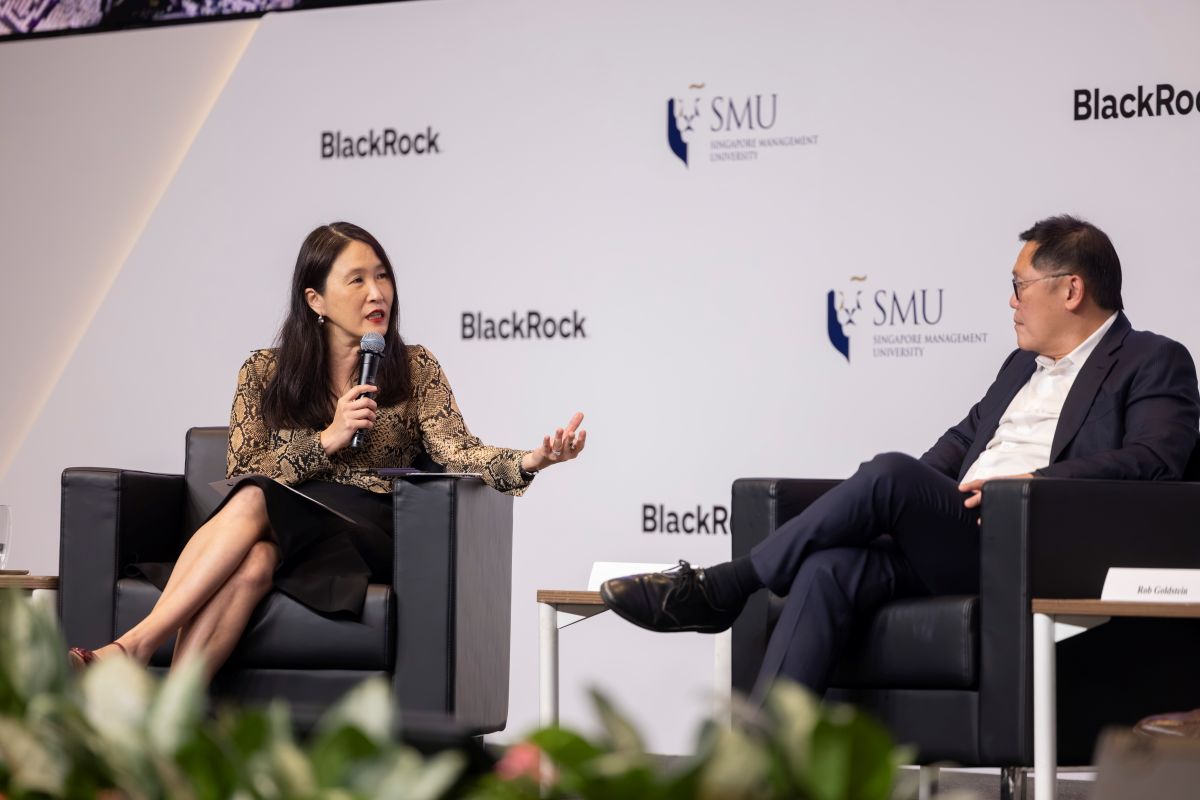
The Human’s Place in the Loop
Drawing on how AI is being deployed in their own businesses, the panellists shared four key takeaways on how human skills need to adapt.
First, the skill profile for new hires has changed. They must be able to do what AI cannot: apply judgment and nuance to varied outputs. There is a need for more “apprenticeship” for students to prepare themselves better.
Second, the ability to articulate ideas is a key superpower. AI can help translate ideas into implementation more quickly, all university students across disciplines should empower themselves with critical thinking skills and be able to articulate their ideas and communicate them.
Third, being a good "horizontal generalist" is also increasingly valuable, as specialist knowledge is so easily accessible at everyone’s fingertips. As one panellist pointed out, knowing "what not to do" is becoming critical as AI multiplies productivity.
As change accelerates, people need to learn to safeguard their sense of well-being. With AI agents taking on more routine and recurring tasks, people constantly have to be vigilant and watch over AI. This is ‘brain fry’ and it can be as challenging as burnout.
The panel agreed that people must have the self-discipline to disconnect and make time for discussions and debate in person, and learn to prioritise tasks. Organisations, too, should provide wellness structures to help employees manage both burnout and ‘brain fry’.
Navigating the new AI-Enabled Workplace
Despite AI’s potential to unlock collective organisational knowledge, the panellists cautioned against society’s growing dependence on it as an intellectual crutch. Greater personalisation is also likely to bring a significant rise in cyber risk. And as AI accelerates scientific discovery, regulatory and governance frameworks will need to remain adaptable and evolve alongside the technology.
During the 15-minute live-audience Q&A segment, many questions the audience asked centred on vital skills people should prepare themselves with, as AI is deployed in the workplace for many operational tasks.
For example, a popular question asked the panellists how they would guide their own children in choosing a university major. All the panellists emphasised that critical thinking, the ability to articulate ideas and pursuing one’s passions remain vital—whether in an AI-driven world or otherwise.
They called out “a misplaced anxiety” about technical majors such as computer science and engineering, noting that the deployment of AI will lead to a greater need for human talent across all disciplines. They also felt that education should foster more critical and creative thinking, with one speaker pointing out the need for more apprenticeship opportunities to fill the gap. Professor Lim agreed and shared that experiential cross-disciplinary learning is very much a key focus at SMU for complex, real-world challenges.
The SMU-X curriculum, for instance, is a signature experiential approach through which SMU brings real-world projects directly into the classroom. Students form interdisciplinary teams and combine different knowledge and skill sets to solve complex, open-ended problems under the guidance of faculty and industry experts.
In conclusion, the speakers see a future where there is more need for the talent pipeline to cultivate critical thinking, empathy and judgement, with the need for more apprenticeships to help them build work experiences, as businesses navigate the nuances of an AI-enabled workplace.