

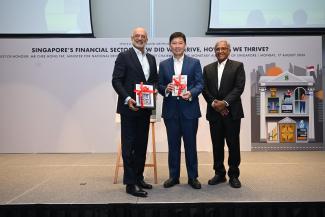
“Trust is not a soft virtue in this business; trust is the product,” stated SMU Chairman Piyush Gupta at the launch of Singapore’s Financial Sector: How Did We Arrive, How Do We Thrive?, which brings together the three IPS–S R Nathan Lectures he delivered last year as the 17th S R Nathan Fellow for the Study of Singapore, along with highlights from the Q&A sessions. Held at the National University of Singapore Guild House on 17 August, the event also featured addresses by Guest-of-Honour Mr Chee Hong Tat, Minister for National Development and Deputy Chairman of the Monetary Authority of Singapore (MAS), and Mr Janadas Devan, Director of the Institute of Policy Studies (IPS).
Mr Gupta said that Singapore’s success as a financial hub has always rested on a fine balance — pushing the boundaries of innovation while protecting confidence in the system. As finance accelerates, digitises and becomes more contested, he said the next phase will require the same combination of institutional trust, sound judgement and purposeful risk-taking that helped Singapore’s financial centre take off in its early decades.
Yet, he cautioned that safeguarding trust cannot become an excuse for standing still. “This is the time that we have to be as bold as we were in the 1960s and 70s,” he said, urging Singapore to keep making calculated moves even as technology, geopolitics and global competition reshape the rules of finance.
Fostering Reinvention and Enterprise
In his welcome remarks, Mr Janadas highlighted the book’s central themes and Mr Gupta’s contributions to Singapore’s financial sector. Following that, Minister Chee paid tribute to Mr Gupta’s public- and private-sector leadership, citing his key roles on the Singapore Emerging Stronger Taskforce during the post-COVID recovery and MAS’ Financial Centre Advisory Panel.
Minister Chee added that Singapore must keep innovating, noting that a truly dynamic financial ecosystem requires deeper enterprise and risk-taking across government agencies and industry partners. “Sometimes, we need to be willing to test new ideas and approaches, and accept some failures along the way. We may not always succeed when we try, as some of the ideas may not work as intended. But what we are quite clear is that if we don’t try, then our chance of success will be zero,” he said.
Trust, innovation and Singapore’s next financial chapter
While many people experience banking primarily through apps and everyday transactions, Mr Gupta noted that the financial sector remains the economy’s “connective tissue” — channelling savings into mortgages, enabling long-term planning, and funding entrepreneurs and businesses.
Looking ahead, he said that protecting trust is becoming more complex as risks can spread faster in an increasingly digital financial system. That reality, he argued, makes judgement and resilience more important as Singapore continues to pursue growth and innovation. He also highlighted emerging technologies including artificial intelligence, blockchains, tokenised assets and new forms of digital money, and urged Singapore to consider next-generation infrastructure.
Drawing inspiration from the late President S R Nathan’s ability to combine foresight with grounded humility, Mr Gupta stressed that Singapore thrives by pairing agility with institutional consistency. “Singapore’s edge has always been our ability to walk the tightrope better than anyone else. We are big enough to build world-class depth yet small and nimble enough to pivot quickly,” he said.
He concluded by thanking Minister Chee, Mr Devan, IPS, moderators for the lectures — Ms Teo Swee Lian, Mr Vikram Khanna and Mr Caesar Sengupta — and the teams who supported the fellowship lectures and publication.
Singapore’s Financial Sector: How Did We Arrive, How Do We Thrive? is available at major bookstores and the World Scientific Publishing website.