

SINGAPORE, 21 Jul 2026 (Tuesday) - These are the research findings of the 60th round of the DBS-SKBI Singapore Index of Inflation Expectations (SInDEx) Survey at the Sim Kee Boon Institute for Financial Economics (SKBI), Singapore Management University (SMU), conducted between 22 June and 30 June 2026.
- In the June 2026 survey based on 536 respondents a large majority — 87.7% of those surveyed — believe that inflation will rise over the medium term or next one year, down from 88.3% in March 2026. Only 4.3% of Singaporeans polled think that inflation will go down in the next year, which is a slight drop from 5.0% in March 2026. The results of this quarterly online survey suggest that many expect inflation to increase in the next year, due mainly to geopolitical instability due to conflicts, supply chain disruptions and global trade policies like tariffs.
- In June 2026, for the respondents expecting inflation to increase over the next 12 months, the most common reason cited was geopolitical uncertainties and the conflicts involving Hamas and Israel, Ukraine and Russia, and Iran and Israel (57.8%). This is followed by supply chain disruptions (14.3%) and higher trade policy uncertainty, like tariffs (9.4%). Those expecting inflation to decrease only constitute less than 5% of the respondents. In this small sample among those who expect decline in inflation expectations over next one year, respondents cited major reasons as decline in global commodity prices (30.4%), a slowdown in global growth (26%), followed by more competition leading to reduced prices and central banks slow in reducing interest rates.
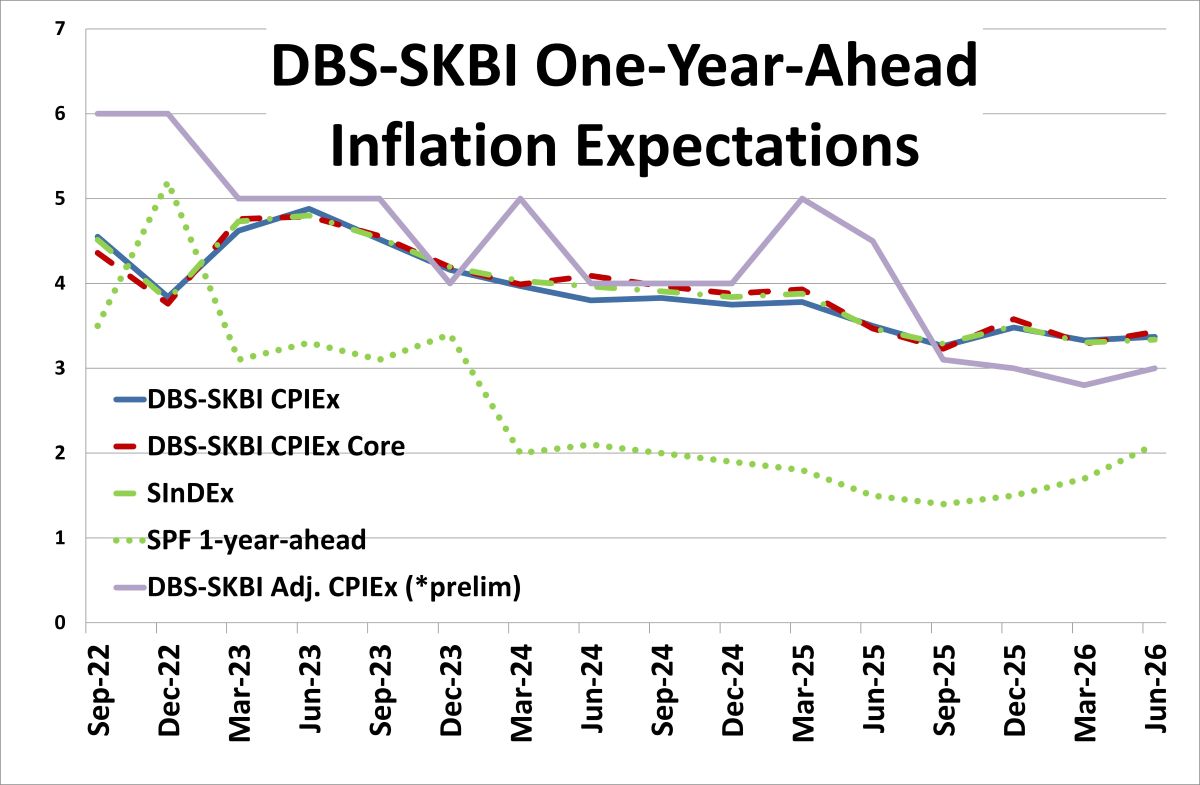
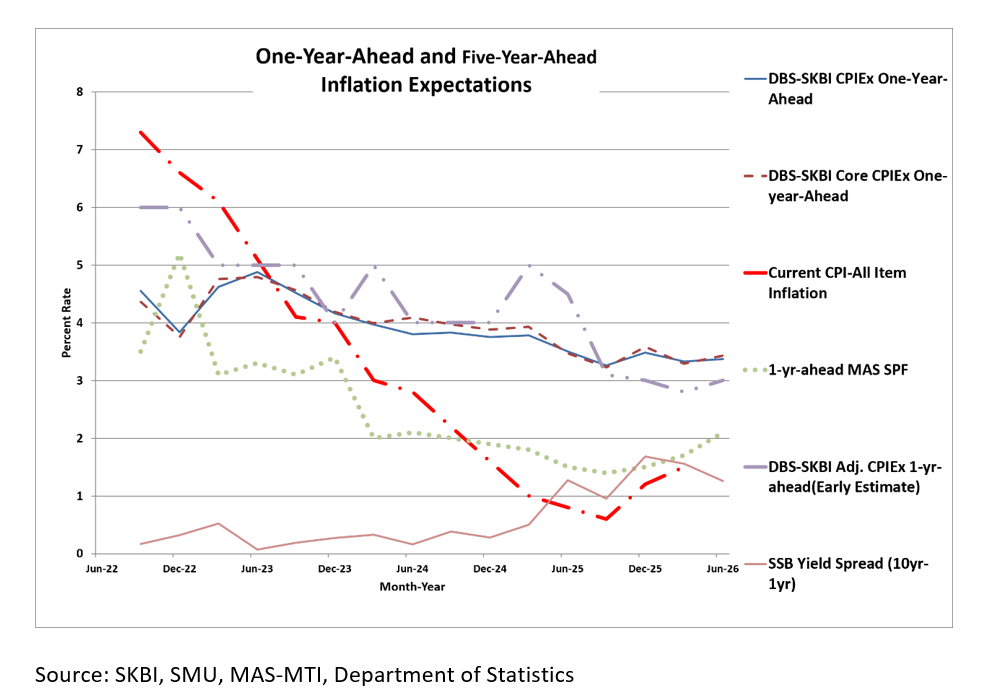
One-year-Ahead headline inflation expectations inched up to 3.4% in June 2026 from 3.3% in March 2026 on average. The second quarter One-year-Ahead inflation expectations remained slightly below the average second quarter One-year-Ahead headline inflation expectations of 3.5% recorded since the inception of this index in the third quarter of 2011.
As a comparison, data from the Monetary Authority of Singapore’s Survey of Professional Forecasters (MAS SPF) released in June 2026 (based on May 2026 data) showed that the median forecast of the Consumer Price Index (CPI)-All Items inflation for 2026 was 2.3% (2.1% for 2027), while MAS Core Inflation median forecast was 2.0% (2.0 % for 2027) (MAS SPF June 2026, Table A.3 and Table A.5). The latest CPI data released by the Department of Statistics (DOS) showed that CPI-All Items rose by 1.6% between January and May 2026, compared to the same period in 2025. The latest May 2026 monthly headline or all-items inflation print came at 2.3% year-on-year, while the MAS Core Inflation Measure was 1.4% (DOS CPI, June 2026). The base year was changed to 2024 with the adjustment of the consumption baskets based on the Household Expenditure Survey 2023. In their first two quarterly reviews of 2025, MAS reduced the rate of appreciation of the Singapore Dollar Nominal Effective Exchange Rate (S$NEER) policy band slightly, implementing two consecutive loosening moves after having kept the policy stance unchanged since October 2022. In April 2026, MAS tightened monetary policy by slightly increasing the slope of the S$NEER policy band, in response to higher projected inflation driven mainly by imported cost pressures (MAS Monetary Policy Statements, July and October 2025, April 2026). The next monetary policy statement will be released by July 2026.
- The overall aggregated Consumer Price Index Inflation Expectations, re-combining across components after addressing potential component-wise behavioural biases, inched up to 3.2% in June 2026 from 3.0% in March 2026. One-year-Ahead inflation expectations of major components of CPI held unchanged in some components, namely Food (unchanged at 3.0%), Housing & Utilities (unchanged at 3.0%), Healthcare (unchanged at 4.0%), Clothing and Footwear (unchanged at 2.0%) and Miscellaneous Goods & Services including Personal Care (unchanged at 3.0%) while there was a slight increase in Transport (3.5% to 3.8%), Education (2.8% to 3.0%), Household Durables & Services (2.9% to 3.0%), Recreation, Sport & Culture (2.0% to 3.0%) and Information & Communication (2.2% to 2.5%). Flattening or slight decline in inflation expectations across most categories, except for direct oil price-related components like transportation, signals that consumers expect some price increases.
- The survey team also polled free-response overall inflation expectations, after reducing potential behavioural biases by informing respondents of current aggregated economic data. The team found that the One-year-Ahead headline inflation expectations inched up to 3.0% in June 2026 from 2.8% in March 2026. These free-response polls help the research team to gauge perceptions of inflation expectations and consumer sentiments in an aggregated sense, letting respondents choose their personal consumption basket and expenditure.
- In the June 2026 survey, continuing since June 2022, we took a more forward-looking approach in analysing the impact of global economic developments on Singapore’s economic growth and inflation.
- Overall, in response to increasing geopolitical uncertainties and fragilities in the global order, including ongoing and emerging conflicts, and strategic policy uncertainty affecting global trade, Singaporean consumers surveyed in June 2026 expected a slight negative impact on the country’s economic growth over the next 12 months.
- In addition, Singaporean consumers also opined in the June 2026 survey that over the next 12 months, their overall expenses are expected to increase slightly. Nonetheless, in response to new questions added since the September 2025 survey, respondents believe that their household situation is expected to remain unchanged economically and financially in the next 12 months. They expect business conditions in the next 12 months to slightly worsen compared to last year. Respondents also found that conditions for buying bigger ticket items like household appliances or furniture are expected to slightly worsen in the next 12 months. Over the next five years, however, business situations are expected to be unchanged. All these responses indicate stable consumer financial conditions, although there are signs of slightly worse business sentiment in the short run. Consumers expect business conditions in the long run to be more stable.
- In the June 2026 survey, respondents opined that under current economic conditions, they expect only a slight increase in the One-year-Ahead headline inflation rate. However, respondents expect a moderate increase in Five-year-Ahead overall inflation expectations. Because of current geopolitical uncertainties, respondents expect one-year-ahead inflation to increase slightly for all components like Food, Transport, Housing & Utilities, Healthcare, Education, Household Durables & Services, Recreation, Sport & Culture, Information & Communication, Clothing & Footwear, and Miscellaneous Goods & Services, corroborating the general findings.
- Alberto Cavallo of Harvard Business School (Cavallo, 2020) and European Central Bank (Kouvavas et al., 2020) highlighted potential biases in CPI calculations with fixed baskets as respondents made substantive changes to their consumption baskets owing mainly to the COVID-19 pandemic. In the June 2026 survey, Singaporean consumers opined that in the next 12 months, they expect no change in the budget share of majority of components like Food, Education, Recreation, Sport & Culture, Clothes & Footwear, Information & Communications and Miscellaneous Goods & Services, while there is slightly higher budget share for Transport, Housing & Utilities, Healthcare, Household Durables & Services. These expected changes are more recent as the base year was changed to 2024 since 2025 with the consumption baskets taken from the five-yearly Household Expenditure Survey last released in 2023.
- Excluding the volatile components of Accommodation and Private Transportation, the One-year-Ahead Consumer Price Index Core Inflation Expectations (CPIEx) increased to 3.4% in June 2026 from 3.3% in March 2026. For a subgroup of the population who owns their accommodation and uses public transport, the One-year-Ahead CPIEx core inflation expectations also inched up to 3.4% in June 2026 from 3.3% in March 2026, corroborating the findings. This sub-sample measurement is potentially more representative of the population experiencing the core inflation and hence more accurate than the full sample measurement, due to their home ownership and public transport ridership.
- Unlike the fixed radio-button response, which might be susceptible to various behavioural biases, the free-response core CPIEx Core Inflation Expectations (excluding Accommodation and Private Transportation expenses) also reflected similar trends. After accommodating for potential component-wise behavioural biases and re-combining across components, the CPIEx Core Inflation Expectations (excluding Accommodation and Private Transportation expenses) inched up to 3.2% in June 2026 from 2.9% in March 2026. The free-response core CPIEx Core Inflation Expectations remained unchanged at 3% in June 2026 compared to March 2026. The slightly higher inflation expectations obtained from the fixed response (radio button) compared to the behavioural adjusted free response suggest that there are still some cognitive biases in the fixed response that are partially offset by the behavioural adjusted methods (Clark, Ghosh and Hanes, 2018).
- The One-year-Ahead composite index SInDEx1 that has less weight on more volatile components like Accommodation, Private Road Transport, Food and Energy-related expenses remained unchanged at 3.3% in June 2026 compared to March 2026. It is slightly lower than the second quarter’s average of 3.5% since the inception of the survey in September 2011.
On the employment expectations front, about 8.5% of respondents in June 2026 expect more than a 10% reduction in salary in the next 12 months, this has moderately declined compared to 6.9% in the March 2026 survey. The expectation of median salary increments in June 2026 of between 1% to 5% remained unchanged, compared to the March 2026 survey.
DBS Bank Chief Economist and Managing Director of Group Research, Dr Taimur Baig, commented, “2026 has seen a rebound in global inflation, driven by supply side constraints of energy products due to conflicts in the Middle-East and demand-side pull from the Artificial Intelligence (AI) cycle. Taking clues from global developments, Singapore’s headline and core inflation rates have risen, although only modestly, keeping inflation expectations in check. The survey results show rising price pressures are noted by consumers, but there are no signs of a disorderly or adverse shift in sentiments with respect to the cost of living.”
Dr Aurobindo Ghosh, Assistant Professor of Finance at SMU, the creator and founding Principal Investigator of the Quarterly DBS-SKBI SInDEx Project, observed, “The ongoing conflict in the Middle East has had significant impact, particularly through increased geopolitical tensions and heightened oil price volatility. In its June 2026 Global Economic Prospects (GEP 2026), the World Bank Group highlighted the prospect of a major shock and slowdown in global growth to 2.5% in 2026 from 2.9% in 2025, noting it was ‘…the lowest rate since the COVID-19-pandemic…amid weaker prospects for economies dependent on energy imports...’. Singapore, as a small open trade-dependent economy, is susceptible to these global fragilities particularly through higher inflation. It’s not surprising that in their April 2026 policy review, the Monetary Authority of Singapore tightened its monetary policy for the first time since October 2022 to address the prospect of imported inflation. The results of the 60th Quarterly DBS-SKBI Singapore Index of Inflation Expectations (SInDEx) show that One-year-Ahead inflation expectations have marginally increased in the June 2026 survey compared to March 2026, suggesting the preemptive tightening might have had the desired effect.”
“Here are some salient findings. First, an overwhelming majority of 87.7% respondents opined that they expect inflation in the medium term to slightly increase, compared to less than 5.0% who expect it to go down. Most attribute the increase in inflation to geopolitical instability from multiple ongoing conflicts and consequent supply chain disruptions. Second, even after adjusting for potential behavioural bias like Recency Bias which over-emphasises recent events, the slight increase in One-year-Ahead inflation expectations, both headline and core, seems to emanate from sectors vulnerable to certain supply and demand shocks. For example, Transportation sector is sensitive to conflict driven supply shocks causing higher oil prices while the Information & Communication sector is sensitive to AI-driven demand shocks causing higher prices in computer chips. Third, over the next 12 months, households expect to allocate a higher budget-share in energy-intensive sectors like transportation, housing and utilities, household durables and services (Cavallo, 2020, Kouvavas et. al.,2020, Weber et. al., 2022). Finally, the respondents opined they expect financial and economic conditions of the household in the medium term to be unchanged even though business conditions might worsen in the short-run, owing to external conditions. They, however, view Five-year-Ahead business conditions will remain unchanged,” Assistant Professor Ghosh noted.
For the longer horizon, the Five-year-Ahead CPIEx inflation expectations increased to 4.3% in June 2026 compared to 4.1% in March 2026 – slightly above the second-quarter average of 4.2% polled since the survey’s inception in September 2011.
The Five-year-Ahead CPIEx core inflation expectations (excluding costs related to Accommodation and Private Transportation) remained unchanged at 3.8% in June 2026 compared to March 2026. Overall, the composite Five-year-Ahead SInDEx5 also remained unchanged in June 2026 at 4.0% compared to March 2026. In comparison, the second-quarter average value of the composite Five-year-Ahead SInDEx5 is 4.1%, since the survey’s inception in September 2011.
After accommodating for potential behavioural biases, the free-response Five-year-Ahead Headline Inflation Expectations dropped from 3.5% in March 2026 to 3.4% in June 2026. Five-year-Ahead Singapore Core Inflation Expectations also pared to 3.6% in June 2026 from 3.7% in March 2026.
Assistant Professor Ghosh added, “In June 2026, we observe that Five-year-Ahead headline inflation expectations seem to have inched up although the Five-year-Ahead core inflation expectations seem to be unchanged. Despite short-term fluctuations due to the Middle East conflict and policy uncertainty on trade, this reflects some element of anchoring of longer-term inflation expectations and corroborates the importance and accuracy of survey-based measures (Ang, Baekert and Wei, 2007). In fact, after accommodating for behavioural bias, the Five-year-Ahead headline and core inflation expectations have eased slightly. The results of this survey indicate that, although there are potential geopolitical risks in the short-run, longer-term inflation expectations in Singapore seem to be more anchored.”
Methodology
DBS-SKBI SInDEx survey yields CPIEx Inflation Expectations (estimating headline inflation expectations) and related indices are products of the online quarterly survey of around 500 randomly selected individuals representing a cross section of Singaporean households. The survey is led by Principal Investigator Dr Aurobindo Ghosh, Assistant Professor of Finance (Education) at Lee Kong Chian School of Business of the Singapore management University. The online survey, administered by YouGov, helps researchers understand the behaviour and sentiments of decision makers in Singaporean households. DBS Group Research is a co-sponsor and research partner with the Sim Kee Boon Institute for Financial Economics (SKBI) at SMU.
The quarterly DBS-SKBI SInDEx survey has also yielded two composite indices, SInDEx1 and SInDEx5. SInDEx1 and SInDEx5 measure the One-year inflation expectations and the Five-year inflation expectations, respectively. The sampling was done using a quota sample over gender, age and residency status to ensure representativeness of the sample. Employees in some sectors like journalism and marketing were excluded as that might have an effect on their responses to questions on consumption behaviour and expectations.
The DBS-SKBI SInDEx survey was augmented in June 2018, based on a joint research study conducted by SMU researchers in collaboration with MAS and the Behavioural Insights Team, where respondents were polled on their perceptions of components of the Consumers Price Index (CPI) and adjusted for possible behavioural biases prevalent in online surveys.
Based on the recommendations of the joint study, since March 2019 the research team has polled the One-year-Ahead inflation expectations of all of the major components of CPI-All Items inflation. For the June 2026 survey, DBS-SKBI CPIEx One-year-Ahead headline inflation expectations indices inched up from March 2026. The core inflation expectations also increased in June 2026 compared March 2026. Consistently, the behaviourally adjusted component-wise and recombined inflation expectations held steady or increased slightly in June 2026 compared to March 2026. In free-response answers, compared to March 2026 survey, responses in the June 2026 survey polled for One-year-Ahead Headline and Singapore Core increased or held steady. Overall, the results indicate for medium-term (One-year-Ahead) inflation expectations increased slightly even after adjusting for behavioural bias prevalent in consumer surveys. However, for the longer term, Five-Year-Ahead headline inflation expectations increased while the Five-Year ahead core inflation expectations remained unchanged. However, adjusting for behavioral bias, both the Five-year-ahead headline and core inflation expectations dipped slightly in June 2026.
References:
- Ang, A., G. Bekaert, and M. Wei., 2007, “Do Macro Variables, Asset Markets, or Surveys Forecast Inflation Better?” Journal of Monetary Economics, 54:4, pp. 1163–212.
- Cavallo, A., 2020, "Inflation with COVID Consumption Baskets." NBER Working Paper Series, No. 27352, June 2020 (Harvard Business School Working Paper, No. 20-124, May 2020). (https://www.hbs.edu/faculty/Pages/item.aspx?num=58253, accessed on July 14, 2020)
- Clark, A., A. Ghosh and S. Hanes, 2018, “Inflation Expectations In Singapore:
- A Behavioural Approach,” Macroeconomic Review, Vol 17:1, pp. 89-98.
- Global Economic Prospects , June 2026 (GEP 2026): (https://thedocs.worldbank.org/en/doc/2b672b3b0415d6b66c45b66579db4ef5-0050012026/original/GEP-Jun-2026.pdf, Accessed on Jul 16, 2026)
- Household Expenditure Survey (2023): (https://www.singstat.gov.sg/-/media/files/publications/households/hes20…, accessed on July 17, 2025)
- Kouvavas, O., R. Trezzi, M. Eiglsperger, B. Goldhammer and E. Goncalves, 2020, “Consumption patterns and inflation measurement issues during the COVID-19 pandemic,” ECB Economic Bulletin, Issue 7/2020. (https://www.ecb.europa.eu/pub/economic-bulletin/html/eb202007.en.html#toc6, accessed on July 14, 2020)
- MAS Monetary Policy Statement- January 2025, April 2025, April 2026 (https://www.mas.gov.sg/news/monetary-policy-statements/2025/mas-monetar…, accessed on Oct 17 2025; https://www.mas.gov.sg/news?date=2025-01-01T00:00:00Z,2025-12-31T23:59:…, accessed Oct 17, 2025, https://www.mas.gov.sg/news/monetary-policy-statements/2026/mas-monetary-policy-statement-14apr26, accessed on April 16, 2026)
- MAS Survey of Professional Forecasters (MAS SPF), (https://www.mas.gov.sg/-/media/mas-media-library/monetary-policy/mas-su…, accessed on Jul 16, 2026)
- Singapore Consumer Price Index Press Release (DOS CPI), Singapore Department of Statistics (https://www.singstat.gov.sg/files/190ca70b-2d16-41a5-9298-fee401cb0cfe…, accessed on Jul 16, 2026)
- Weber, M., F. D’Acunto, Y. Gorodnichenko and O. Coibion, 2022, “The Subjective Inflation Expectations of Households and Firms: Measurement, Determinants, and Implications,” Journal of Economic Perspectives, 36:3, pp. 157–184.