

In an era defined by rapid technological leaps and monolithic skylines, what truly breathes life into a city?
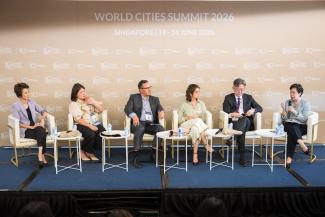
At the 10th edition of the World Cities Summit (WCS) in June, the National Heritage Board (NHB) launched its inaugural panel session titled "Championing Heritage for Loveable Cities” as part of the summit’s Cities for People track. The standing-room-only event was moderated by SMU President Professor Lily Kong.
Bringing together a diverse array of global municipal leaders, the session shifted the traditional urban planning narrative from concrete metrics to emotional anchors. As Professor Kong stated, “Cities are not merely collections of steel, glass, and concrete — indeed, not even of algorithms. A city is a repository of human stories, of collective memories, and of shared identities. When we have rapid transformation without cultural preservation, we risk creating sterile cities. If we want to build cities that are truly resilient, we must remember that liveability is a technical metric, but loveability is an emotional reality."
The Hardware and Heartware of Heritage
The panel kicked off with Ms Low Yen Ling, Singapore's Senior Minister of State, Ministry of Culture, Community and Youth, & Ministry of Trade and Industry, and Mayor, South West District. Echoing Professor Kong's sentiment, SMS Low emphasised that while infrastructure and connectivity are vital, they do not speak entirely to a city's soul.
Singapore, despite its small size, boasts over 7,000 conserved buildings and 77 national monuments. To ensure that heritage remains a "present tense" experience rather than confined to museums, Singapore has leaned on community engagement and cultural placemaking. SMS Low highlighted the work of the government’s inter-agency task force, which actively supports heritage businesses operating with digitalisation grants and placemaking initiatives to merge economic resilience with cultural preservation.
"We want to excel in terms of hardware, but we also want to do well in terms of heartware," noted SMS Low. She added, "A city really becomes loveable when it evokes the intangible that we can't quite measure with any yardstick: memory, identity, history, culture, and when people connect over food, and connect emotionally with the spaces that we live in."
Global Perspectives on Revitalisation and Adaptive Reuse
The panel illuminated how cities worldwide confront the friction between preservation and modernity, showcasing diverse strategies across continents. Mayor of Iloilo City, Philippines, Ms Raisa Treñas-Chu shared how the "City of Love" leveraged its 19th-century economic golden age architecture to spark tangible economic benefits in revitalising the downtown area. Through tax incentives, public-private partnerships, and a firm stance against unauthorised demolitions, decaying spaces were transformed into vibrant, pedestrian-friendly commercial hubs.
Looking to Europe, Vice-Mayor of the Municipality of Coimbra, Portugal, Mr Miguel Antunes discussed managing the footprints of a historic university city that welcomes a million tourists a year. Coimbra has proactively deployed tools to tackle building vacancy, establishing a €50 million public fund for structural rehabilitation and successfully incentivising top tech and innovation companies to set up offices inside UNESCO Heritage buildings rather than corporate business parks.
Turning the attention to South America, Ms Maria Claudia Lopez, Former Secretary of Culture for Bogotá, Colombia, explained how her city integrated cultural heritage into its foundational urban planning by introducing an integrative structure of heritage that unites tangible, intangible, and natural assets. By utilising community-based mapping across its 33 planning units, Bogotá treats the diverse cultural practices of its residents — ranging from traditional market networks to its celebrated Graffiti District — not as static history, but as dynamic infrastructure.
Finally, representing Hong Kong, Mr Sunny Lo, Chief Assistant Secretary, Commissioner for Heritage's Office, Government of the HKSAR, detailed the city’s innovative public-private partnerships. A prime example shared was the transformation of the historic Mei Ho House — an H-shaped resettlement block from the 1950s — into a bustling, modern youth hostel that houses an underground local history museum while remaining a functional community hub.
A Dynamic Dialogue on Navigating Tensions
Following the presentations, Professor Kong highlighted the themes that emerged from the presentations such as the fluid nature of intangible culture, the parameters of adaptive reuse, and the necessity of multi-sector collaboration. Next, she engaged the panellists in a nuanced discussion on the distinct friction points that modern cities must carefully balance.
First, urban centres face the challenge of managing traditions, such as traditional clog or stove-making, which risk becoming obsolete within highly modernised economies. Second, they must navigate the complexities of repurposing historic spaces, ensuring that adaptive reuse does not erase original cultural sensitivities or incite community backlash.
Another point of discussion was that cities must also strike a delicate balance between fostering the artistic freedom of community movements and protecting shared public decorum. Finally, policymakers must determine the right threshold between providing continuous financial support to heritage projects and building resilient, self-sustaining heritage ecosystems.
Anchoring Tomorrow’s Loveable Cities
The dialogue underscored the notion that culture is inherently dynamic. As noted by Ms Lopez, the survival of heritage relies heavily on "transmission"— fostering an ongoing intergenerational dialogue to pass down skills while engaging youth through digital tools.
As the panel concluded, the insights generated proved that cultural heritage is not a static luxury or an impediment to growth; it is a vital economic asset and a critical social anchor. By framing urban development through the lens of human stories and collective memory, Professor Kong and the global panel reinforced an important truth — for a city to truly accelerate, collaborate, and transform, it must keep its heart beating in tandem with its progress.