
Singapore, 14 June 2026 (Sunday) – Singapore Management University (SMU) today opens its participation as Patron Sponsor for the sixth year at the World Cities Summit (WCS) 2026, running from 14 to 16 June at Suntec Singapore Convention & Exhibition Centre. Convened under the theme “Liveable and Sustainable Cities: ACT Now! Accelerate, Collaborate, Transform”, WCS 2026 is a key global platform for policymakers, city leaders and urban practitioners to exchange ideas and forge partnerships on the most pressing urban issues of our time.
SMU’s participation reflects a university-wide commitment to impact, spanning faculty contributions at plenaries and symposia, and an exhibition booth showcasing research, innovations, startups and educational programmes. These efforts are in line with the SMU2030 Strategic Plan, which charts the University’s path for the next five years, driven by a purposeful impact agenda focused on four domains vital to national and regional advancement: Human Capital Development, Knowledge Creation, Economic Development, and Social and Community Life.
At the World Cities Summit 2026, SMU brings together research, innovation and talent to contribute to global conversations on how cities can adapt, thrive and remain liveable in an increasingly complex world.
SMU leaders and faculty across the Summit programme
On the opening day, two SMU faculty members participated in the invitation-only Mayors Forum (MF). Associate Professor of Sustainable Finance Theodor Cojoianu, who is also Academic Director of Singapore Green Finance Centre and Urban Fellow (Urban Growth) at SMU Urban Institute (UI), spoke at the Re-thinking Urban Energy Transition Plenary; and Lee Kong Chian Professor of Urban Climate Winston Chow, who is concurrently Pillar Lead (Urban Systems) of SMU UI, as well as Co-Chair of IPCC Working Group II, moderated at the Managing Urban Water for Resilience Plenary.
Professor of Geography Orlando Woods, Director of the SMU UI and Associate Dean (Research and Postgraduate Programmes), moderated the Young Leaders Symposium (YLS) on urban transitions, while Assistant Professor of Urban Studies Aidan Wong, who is also Urban Fellow (Urban Experiences) of SMU UI, moderated a workshop at the YLS on navigating demographic and technological transitions in cities.
Across the Summit programme, SMU leaders and faculty are contributing expertise on urban policy, climate resilience, sustainable finance, heritage, smart cities and AI-enabled urban futures.
On 15 June, SMU President, Professor Lily Kong, will speak at the WCS Opening Plenary on the topic From Aspiration to Acceleration: Implementing National Policies in Urban Contexts; Lee Kong Chian Professor of Communication & Technology Lim Sun Sun, who is also Vice President (Partnerships and Engagement), will moderate a Smart Cities plenary on AI-enabled urban futures. Ms Nikki Kemp, Centre Director at the Singapore Green Finance Centre, will speak on unlocking private capital for cities.
On 16 June, Professor Kong will also moderate a National Heritage Board panel discussion on Championing Heritage for Loveable Cities, and Associate Professor Theodor Cojoianu, will deliver a keynote on financing new urban infrastructure.
Research and innovation at the exhibition booth
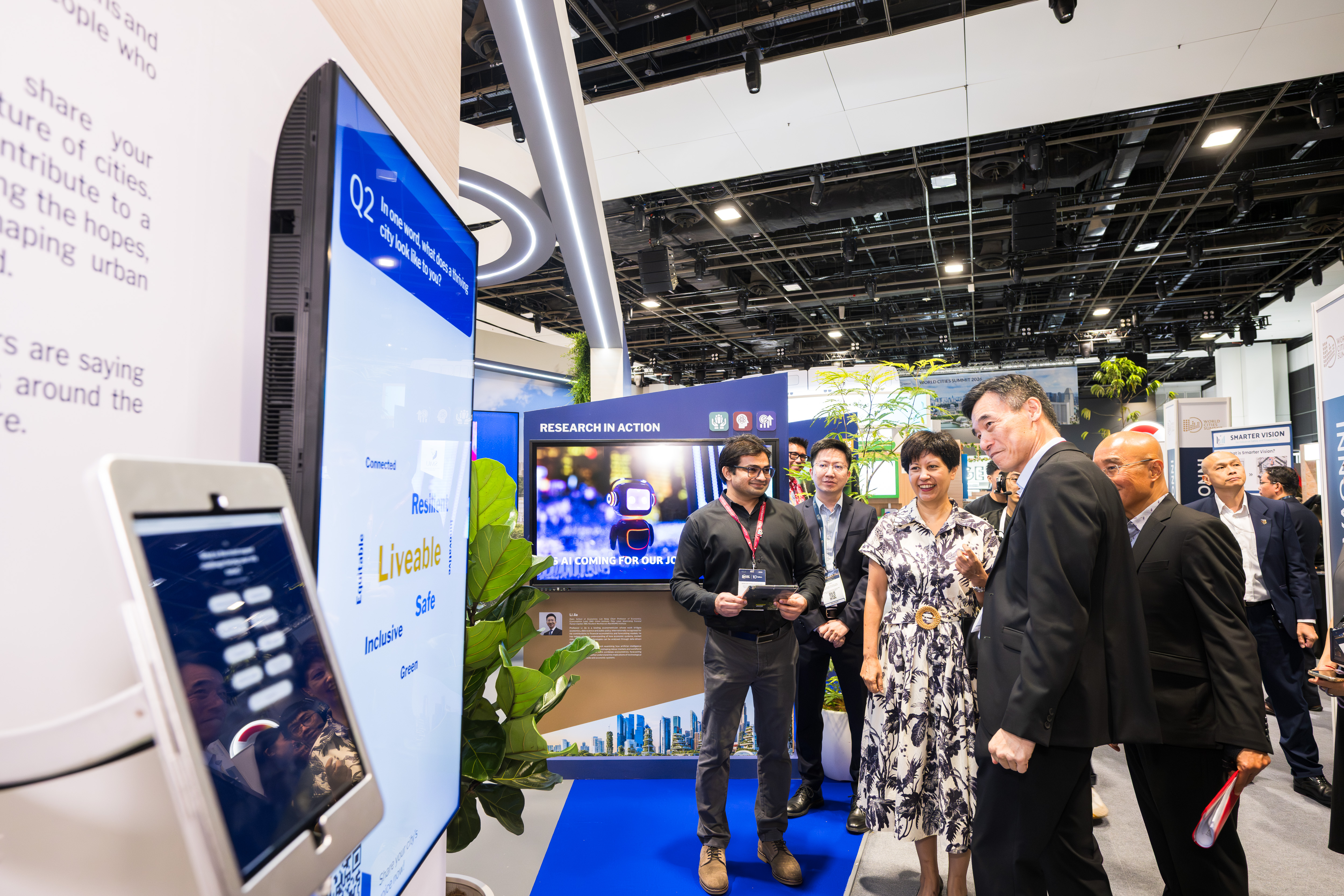
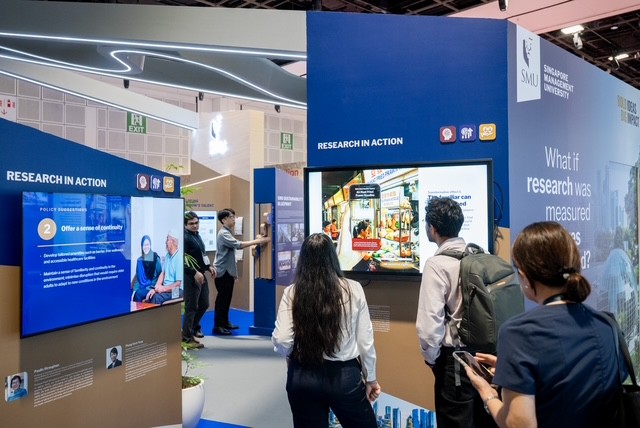
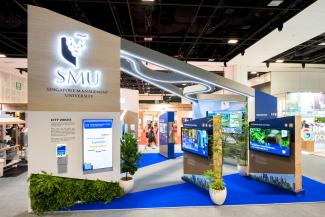
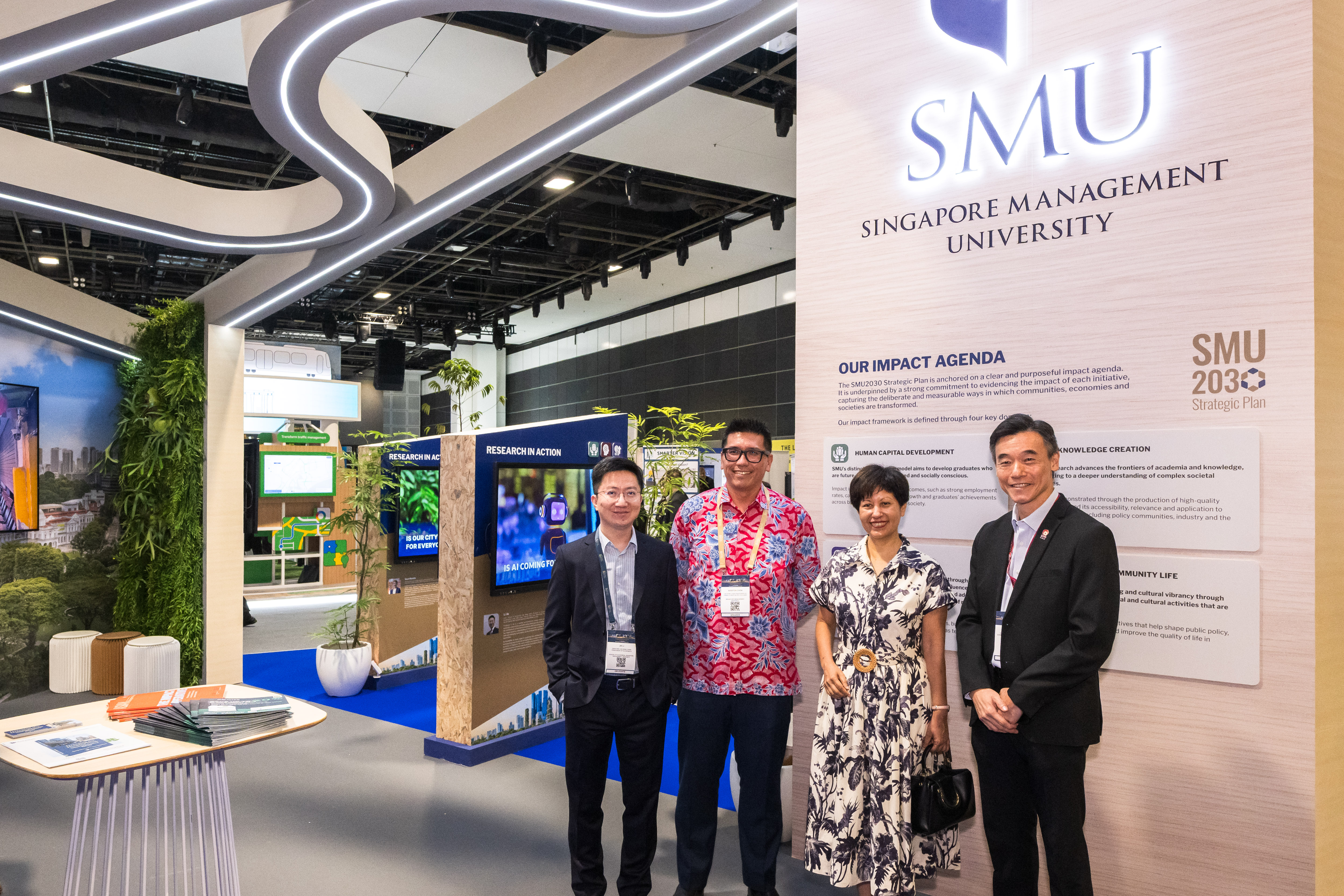
SMU’s exhibition booth at Level 4 of the convention hall is themed Bold Ideas, Big Impact – In Action – a reference to SMU2030’s commitment to research that goes beyond academia to address societal challenges. Each exhibit is mapped to SMU’s four Impact Agenda domains, drawing on an interdisciplinary mix of scholars from the SMU Urban Institute, and two new research entities launched in early 2026 – Resilient Workforces Institute and the Longevity Societies and Economies Institute.
The research featured at the booth explores three broad themes shaping the future of cities: the future of work and economic opportunity, the future of communities and urban experiences, and the future of resilient urban systems. Among the research on display are:
- Measuring AI’s Impact on Jobs: A Study on Singapore and China: Singapore’s first AI-LLM Exposure Index, developed by Professor Li Jia, finds that higher-skilled white-collar jobs – not low-skilled roles – are most exposed to AI disruption in both Singapore and China.
- Cooling Singapore: Solutions for a Heat-resilient City: Through Cooling Singapore 2.0, Professor Winston Chow’s team has developed a Heat Risk Index mapping heat vulnerability across Singapore, alongside an open-source model that quantifies how trees and green spaces help cool cities.
- Greening Data Centres in Singapore: A Value Chain Approach: Also by Professor Winston Chow, this research argues that the environmental cost of data centres can only be addressed through a value chain-wide approach spanning technology, policy, finance, infrastructure and workforce.
- Affordable Housing: An Integrated Framework: Professor Phang Sock Yong’s work shows that Singapore’s housing affordability rests on the continuous coordination of land control, supply, finance and market regulation, and proposes ‘budgetary recycling’ as a lesson for other cities.
- Ageing in Place: Anchoring a Super-aged Society: Professor Paulin Straughan’s research finds that place identity and community continuity – not living arrangements – are the strongest predictors of wellbeing for older adults in a super-aged society.
- Gamifying Place: Reimagining the City with AR: Professor Orlando Woods examines how AR powered mobile games such as Pokémon Go reshape how people interact with public spaces, fostering exploration and community around shared locations.
- Pigs in the City: Can Humans Coexist with the Wild?: Assistant Professor Sayd Randle’s research across Singapore, Texas, Barcelona and Hong Kong finds that wild boars in cities are unintended products of the green corridors cities built, calling for multispecies thinking in urban planning.
Further information on each research project is provided in Annex A.
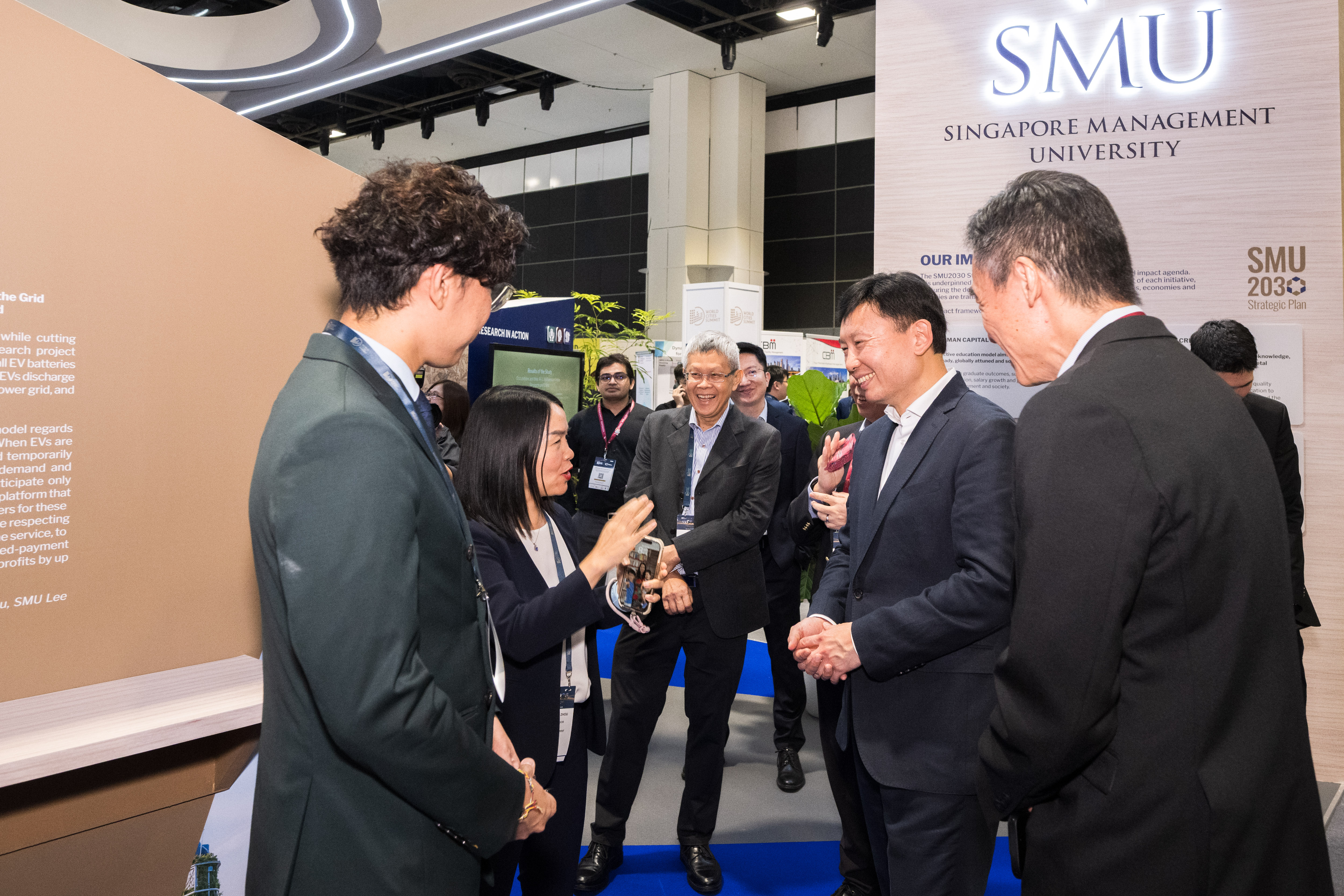
Complementing the research are four innovations incubated by the Business Innovations Generator (BIG) and the Urban SustaInnovator (USI) programmes under SMU’s Institute of Innovation and Entrepreneurship (IIE), demonstrating how ideas can be translated into practical solutions for urban challenges. These include:
- Magorium, founded by SMU alumna Oh Shu Xian, which converts plastic waste into a lowcarbon road material already deployed across Singapore. Magorium is also a BIG alumnus.
- Ecoflow, co-founded by three SMU alumni, which delivers solutions that reduce water and
energy use by up to 30 per cent across more than 200 properties in four countries. It is also a BIG alumnus. - Qarbotech, which addresses food security challenges by using nanotechnology to boost crop yields by 20 to 30 per cent. Qarbotech is one of the inaugural batch of startups selected for the Urban SustaInnovator (USI) programme. The USI is Singapore’s first global accelerator programme dedicated to scaling breakthrough solutions in the urban and sustainability space. Qarbotech was one of seven startups picked for USI, out of 1,500 startups from 91 countries taking part in SMU’s signature Lee Kuan Yew Global Business Plan Competition last year.
- A vehicle-to-grid business model by SMU Associate Professor Yangfang (Helen) Zhou that
enables EV batteries to supply electricity to the grid during peak demand, coordinated by an aggregator platform that incentives drivers while limiting how often EVs can supply electricity to protect battery life Assoc Prof Zhou is in the process of commercialising this model through IIE’s Knowledge Transfer and Commercialisation unit.
Talks, interactive experiences and city voices
Throughout the Summit, delegates can engage directly with SMU researchers, entrepreneurs, and students through a series of short talks and interactive experiences at the booth.
At the heart of the booth experience is City Voices, an interactive polling experience inviting
delegates to share their perspectives on the future of cities through four questions: the most urgent challenge facing their city, what a thriving city looks like, which technology could most transform cities in the next decade, and who should lead the future of cities. Visitors may choose to receive a report on the voices gathered from across the Summit. Through City Voices, SMU seeks to bring together diverse perspectives from across the Summit, convening ideas and contributing to the global discourse on the future of cities.
Visitors are also invited to weigh in, via an interactive polling wall, on one of the defining questions for future cities: Will smart innovation or wider inclusion make the bigger difference?
More information / enclosures:
- SMU's full talk schedule and research articles are available here.
- Images of the SMU Booth at World Cities Summit 2026
- Annex A – Research at the SMU Exhibition Booth
- END -