

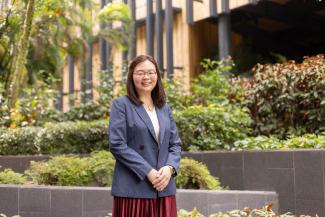
Sarah Shi Hui Wong, Assistant Professor of Psychology at Singapore Management University (SMU), has been named a 2026 APS Rising Star by the Association for Psychological Science.
The prestigious APS Rising Star designation recognises outstanding early-career researchers whose innovative work has already advanced the field of psychological science and signals great potential for their continued high-impact contributions. Asst Prof Wong’s selection places her among a globally distinguished group of scholars shaping the next frontier of the discipline.
APS Rising Star nominees are evaluated for their promise of excellence in research based on: significant publications; significant recognitions; significant discoveries, methodological innovations, or theoretical or empirical contributions; work with potentially broad impact; commitment to diversity in science; demonstrated independence from mentors.
This year, SMU is the only university from Singapore successfully represented on the APS Rising Stars stage, underscoring the University’s fast-growing research profile and international standing in psychology and the social sciences.
The recognition highlights both the quality of Asst Prof Wong’s research and SMU’s continued investment in advancing impactful, globally relevant scholarship.
Asst Prof Wong’s work redefines effective learning strategies, focusing on improving higher-order learning processes and outcomes. Poised at the intersection of education and cognitive science, her research has developed counterintuitive strategies such as learning by making deliberate errors and by teaching others, which she has found to benefit learning significantly.
How she got this achievement
Reflecting on this international accolade, Asst Prof Wong said, “It is a great honour to receive the APS Rising Star award. It recognises my research on potentially transforming educational processes and outcomes by engaging learners to deliberately make errors or teach others.
This recognition is not just a personal milestone; it is a celebration of all the people who have generously supported me in my academic journey. I am incredibly blessed to be able to do what I love as a psychological scientist—pursuing innovative ideas with strong applied relevance, discovering intriguing phenomena in human learning and cognition, and understanding their psychological mechanisms.”
How her research impacts society and its implications
Asst Prof Wong’s research is driven by the goal of empowering people with the skills to learn deeply, so that they can fulfil their potential and thrive in our complex world.
In particular, learning from errors is crucial for success, yet people tend to avoid them. To tackle this problem, Asst Prof Wong pioneered the learning approach of deliberate erring, where people are guided to systematically commit and correct intentional errors when the stakes are low. Across a plethora of studies, she has found compelling evidence for what she has called the “derring effect”, where deliberate erring enhances diverse learning outcomes more than avoiding errors or even observing others’ errors. This work has received multiple awards, including the prestigious APA Paul R. Pintrich Outstanding Dissertation Award by the American Psychological Association.
She explained, “These findings could potentially reshape educational practice and policy. For instance, instead of avoiding errors or passively allowing them to occur, positioning errors as intentional events could in fact maximise learning opportunities and outcomes in education and work.”
Her research has further uncovered that learning can be catalysed by harnessing not only its cognitive but also its social nature—when we teach others, we learn better ourselves. Asst Prof Wong has found that students ask more creative research questions and reason better after they have taken on the role of a teacher to teach. Moreover, the learning benefits of teaching last durably not only in the lab but also in real-world classrooms.
She said, “Learners who step up as teachers are empowered to excel in a range of complex educational goals.”
Other research areas she is working on
Besides educational outcomes, she has recently been testing how effective learning strategies can be applied to promote human flourishing. She has also been examining design principles to enable synergies between education and technology. For instance, how can human–AI collaboration be guided to achieve sustained learning gains?
Asst Prof Wong shared, “My lab recently developed a novel approach that we called “think first, ChatGPT later”. We have found that this approach holds promise in enhancing independent human creativity. Moving forward, we intend to apply such design principles to boost and scale up effective learning strategies such as deliberate erring and learning-by-teaching, so that more people around the world can benefit from them.”
Congratulations, Assistant Professor Sarah Shi Hui Wong, on being named our 2026 APS Rising Star!