
In a world marked by rapid change, one constant remains: trust. To maintain Singapore’s status as a premier financial hub, the government is taking bold steps to create pathways that empower tertiary students to seize the tremendous growth opportunities presented by AI.
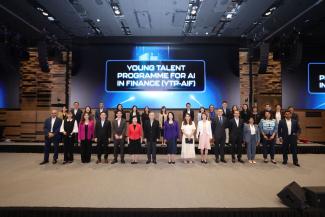
This was a key point emphasised by DPM Gan Kim Yong when he graced the launch of The Young Talent Programme for AI in Finance (YTP-AIF) at Singapore Management University on 19 May.
During his keynote, he explained that as companies navigate a more complex world, they will look for places that are trusted, places where they can manage risk, access talent, deploy technology, and serve regional and global markets.
“Singapore is well-positioned to play this role. The financial sector is a good example. Today, it contributes about 14% of our GDP, and employs around 200,000 professionals, more than 80% of whom are locals. Many of these are good jobs in areas such as analysis, complex problem-solving, risk management, and client management,” he explained.
By helping to strengthen the pathway between education and work, the YTP-AIF is designed to equip students with both applied AI and financial sector skills that are in demand, he said.
A taste of ‘real’ work from internships to job placements
The YTP-AIF is a groundbreaking multi-stage programme that includes an AI bootcamp, masterclasses, experiential hands-on projects, and internship placements in financial institutions. It offers students exposure to work in financial institutions even before they graduate, and these students need not be in IT degree programs when they apply to join from their second year at any of Singapore’s autonomous universities.
Launched by the Institute of Banking and Finance (IBF), with support from the Monetary Authority of Singapore (MAS) and Singapore Management University (SMU) at the Financial Industry Fiesta 2026, YTP-AIF is essentially a national talent pipeline initiative aimed at preparing university students for AI-related roles in Singapore’s financial sector.
Open to all university students in Singapore, this programme offers industry projects and an internship pipeline for students to get AI-related jobs at many financial institutions, including JPMorgan, DBS, OCBC, UBS, Standard Chartered Bank and Prudential. In particular, SMU and NTU will recognise the YTP-AIF curriculum for academic credits, allowing students to gain valuable applied experience while progressing in their studies.
The pilot begins in August 2026 with 20 financial institutions on board. Interested students can start applying through the IBF website until 15 June 2026. The IBF is targeting to attract 100 students for the pilot run, with plans to scale up in two or three years.
SMU’s Use of Applied Learning
The YTP-AIF programme comprises a one-week masterclass bootcamp open to eligible students from all universities. This is followed by course and project work during term time and an internship for students who meet the criteria.
This is a 1CU SMU-X course; and the coursework will be delivered by faculty from SMU, NTU, Bloomberg, and industry speakers from financial institutions who will provide relevant use cases.
SMU, supported by SMU-X and the School of Computing and Information Systems (SCIS), has had a key role in the development and design of the YTP-AIF programme and will lead the teaching of its courses.
Professor Pang Hwee Hwa, the Dean of SCIS, said: “SCIS has been a leader in applied learning that prepares students to meet industry demands for technically proficient professionals, and its role in the YTP-AIF is a strong validation of this. SCIS will work with SMU-X to deliver this ground-breaking programme.”
“Students from multiple disciplines will come together in this course to tackle real-world problems encountered by financial institutions, using Bloomberg data and deploying the solution on AWS cloud, which offers them an industry-ready outlook from Day One,” he added.
The coursework covers three pillars. The first includes Foundations of AI and Financial Data Literacy and prompt engineering. The second covers Responsible AI, namely AI risk management, data governance, security and auditability. The third pillar involves applications of AI in areas such as risk management, technology and operations, regulatory compliance, and investment research.
In addition to the coursework, the experiential project component will be led by participating financial institutions using their organisations’ case studies. Each FI is expected to host about 20 students divided into teams.
The Value of Experiential Learning
Professor Lily Kong, President of SMU, said in her speech at the YTP-AIF launch that SMU is proud to work alongside IBF, MAS and others to develop the YTP-AIF. She said she believes firmly in the value of experiential learning through initiatives such as SMU-X, where students work together to address work projects of partner organisations – not just here in Singapore, but also regionally to help them learn to navigate cross-culturally.
She said that SMU hopes to deepen opportunities for students to collaborate across sectors, and engage with real-world complexity before they graduate. She also advised them to engage in continuous learning, to return to university for continuous learning” so that we might be able to work with you on your next career pivot.”
Encouraging the students in the audience to be agile and resilient, she added: “(The) graduates who will thrive are not simply those who use technology the fastest. They are those who can question what technology produces, exercise sound judgement under pressure, and keep learning across a career that will span decades alongside disruptions we cannot yet predict.”
Interested students can start applying through the IBF website until 15 June 2026.