
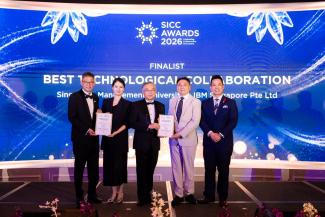
A research collaboration between Singapore Management University (SMU) and IBM that began with a question posed by the COVID-19 supply-chain crisis has won the Most Scalable Collaboration award at the Singapore International Chamber of Commerce (SICC) Awards 2026. The award recognises SMU's ability to deliver STEM-driven industry collaborations that produce significant, measurable business savings and commercially viable technology, with the model now integrated into an enterprise IBM solution.
The recognition comes after the collaboration developed and deployed a data-driven optimisation model that helped IBM make procurement decisions under unprecedented supply-chain uncertainty, generating US$1.8 million in hard annual savings within its first year. When scaled across IBM Infrastructure globally, the model was projected to generate US$35 million in annual savings.
Launched in 2015, the SICC Awards recognise collaborations between organisations across sectors that demonstrate innovation and contribute to growth. The SMU-IBM collaboration was shortlisted in two categories this year, including Best Technological Collaboration, before taking home the award for Most Scalable Collaboration.
When the risk has never happened before
The collaboration began in 2021, following the severe supply-chain disruptions caused by COVID-19 lockdowns.
For procurement planners, the pandemic illuminated the vulnerabilities of supply chain processes. Traditional risks such as natural disasters, labour disputes and government policy changes could be assessed using years of historical data. COVID-19 presented entirely new variables, from factory closures and border restrictions to health and safety measures and trade disruptions.
For organisations assembling complex products from hundreds or thousands of components, the consequences could be significant. A disruption affecting one supplier could ripple through an entire production network, while avoiding risky suppliers altogether could increase procurement costs.
Led by SMU Professor Lau Hoong Chuin, the collaboration brought together SMU's expertise in AI, optimisation and supply-chain logistics with IBM's real-world operational data and procurement expertise from its global infrastructure supply chain.
“This collaboration with IBM was distinctive in its depth and urgency. For decades, supply chain risk models looked to the past to prepare for the future. But when COVID-19 hit, there was no real precedent to work from,” said Professor Lau. “I saw an opportunity to apply our optimisation research to a problem unfolding in real time. And we wanted to test it at scale, against one of the world's most complex supply chains: IBM's.”
The teams developed a data-driven optimisation model that could assess supplier risk across multiple factors and scenarios, giving procurement planners a more systematic way to evaluate the trade-offs between cost and resilience.
From research to measurable business impact
The model was first deployed for IBM's hard disk drive commodity category, generating US$1.8 million in hard annual savings within its first year.
Beyond the savings, the model changed the way procurement risk could be managed. Instead of relying primarily on manual assessments and broad risk-avoidance approaches, planners could assess different sourcing strategies against multiple scenarios and make more proactive, risk-tolerant allocation decisions.
For IBM, the value of the research lay in being able to test it against the realities of its operations.
“We put that research to work using real orders, inventory data, and supplier commitments. IBM's procurement teams calibrated the model against the decisions they were making every day,” said Liu Lu, Digital Supply Chain Transformation Manager, IBM. “SMU's AI-driven approach gave our planners greater visibility into the trade-offs, helping us protect supply continuity without simply avoiding every supplier that appeared risky.”
The approach supported supply continuity, reduced expediting costs and helped strengthen customer delivery commitments during periods of global uncertainty.
“The initial deployment delivered US$1.8 million in savings within a year, with projected annual savings of US$35 million across IBM Infrastructure,” Liu added. “More importantly, it gave our teams the confidence and precision to respond more effectively when disruption occurred.”
Following validation, the source code developed by SMU's School of Computing and Information Systems was integrated into IBM's watsonx Supply Chain 360 solution. This moved the work beyond a single research deployment and created potential for the methodology to be applied more broadly.
The project has also generated research outputs, including a paper presented at the International Conference on Computational Logistics 2022 and an article published in Asian Management Insights in March 2024.
A partnership with room to scale
For IBM, the collaboration provided a validated technology capability that could be incorporated into an existing supply-chain solution. For SMU, it provided an opportunity to take research expertise in AI and optimisation into a complex operational environment and generate research with direct industry application.
The benefits also extended to the teams involved. IBM's supply-chain professionals worked with researchers in advanced optimisation and AI, while SMU researchers gained exposure to real-world operational data and the complexities of a global supply chain.
The work has already received recognition beyond the SICC Awards, winning the 2023 Manufacturing Leadership Council Award in the Digital Supply Chains category.
The model's relevance also extends beyond the pandemic. Global supply chains continue to face disruption from geopolitical tensions, changes in trade policy and climate-related pressures. The methodology could potentially be applied in other industries where organisations must balance procurement costs against disruption risks across complex global supplier networks.
The teams are also exploring quantum optimisation techniques as a next phase of research, with the aim of examining whether emerging computational approaches can address increasingly complex optimisation problems.
The Most Scalable Collaboration award provides a timely marker of how far the partnership has progressed. What began as a response to an unprecedented pandemic-era problem has moved from research, to deployment, to measurable savings and integration into an enterprise solution.
For SMU, the recognition reflects the growing breadth of its engagement with industry and its ability to translate research into solutions with value beyond the university. For both partners, however, the stronger measure of the collaboration is what happened between the research idea and the award: it was tested against a real business problem, demonstrated measurable value, and created a pathway towards wider application.