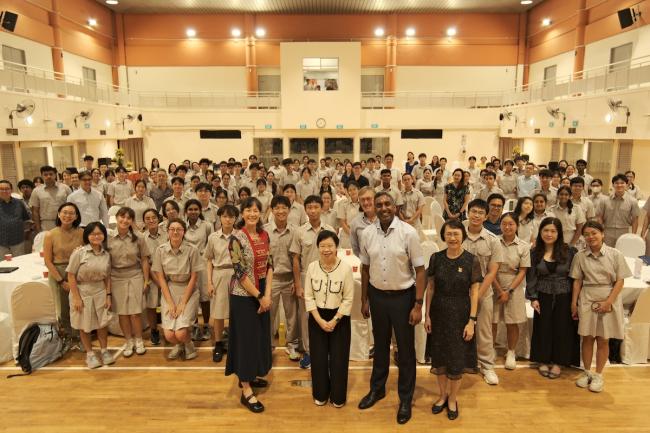

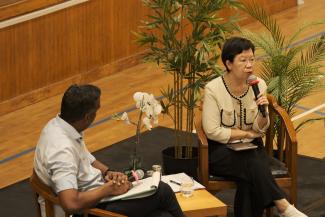
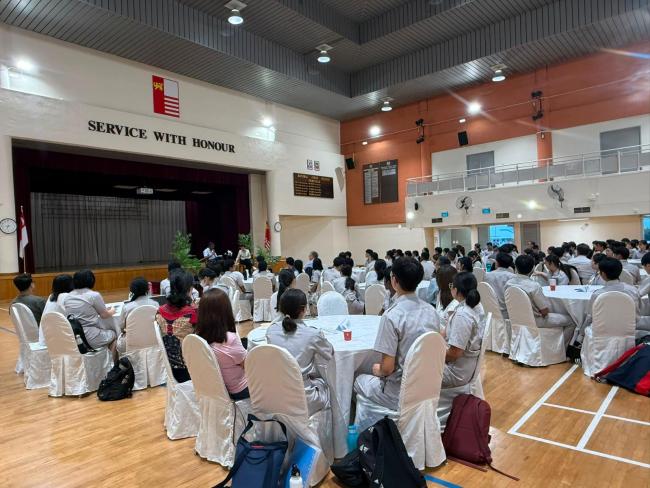
Professor Lily Kong returned to National Junior College on 31 July as the keynote speaker at the college's 2026 Service with Honour Conversation. The annual platform brought together NJC students, including ASEAN scholars, alongside alumni, parents, educators and members of the wider college community. This year's theme: Becoming a Generation of Hope for Southeast Asia drew on Prof Kong's scholarship as a social and cultural geographer of Asian cities and her leadership of a university that has made engagement with Asia a graduation requirement.
An NJC alumna from the college's Linden Drive days, Prof Kong opened on values, urging students to see the college motto not as words on the page, but as values that we live.
Southeast Asia, not ASEAN
Prof Kong began by drawing a distinction she maintains carefully. ASEAN is a political construct. Southeast Asia is a geographical and cultural one, built on proximity, shared history and lived affinity; and it was the latter that interested her.
The pragmatic case for taking the region seriously is considerable and often under-appreciated. The pandemic exposed how vulnerable globally dispersed supply chains can be, prompting a rethink about whether more regionalised networks might prove easier to navigate. Beyond logistics lies demography: Southeast Asia is home to roughly 670 to 690 million people, with a median age of around 30 — markedly younger than China's or Europe's. It is a region with a growing middle class, rising investment in education, and a long runway before the ageing challenges facing much of the developed world arrive in earnest. Recalling a panel where European speakers described a pessimistic future for their young people, Prof Kong noted how different a tone she found herself striking.
The case is not only economic. Drawing on political scientist Benedict Anderson's notion of the imagined community, she described the flicker of recognition between Southeast Asians meeting abroad, the sense, in a university dining hall in London, of encountering someone from the same neck of the woods.
The uncomfortable mirror
Prof Kong then turned the lens back on Singapore. She recounted being handed a blank map of Southeast Asia as an undergraduate and asked to identify prominent places on it. She could not do it. Neither could most of her classmates. Geography alone, she noted, is not the point, but it was a way into a larger problem: how little Singaporeans often know about the region they inhabit. A second observation sharpened it. A friend who holidays regularly in Southeast Asia answers questions about her travels with a faint note of apology, as though a trip to Malaysia required more justification than a trip to London. The sense of superiority is there, Prof Kong said, along with an assumption that the region has little to teach.
She was clear this is a misreading. A student interested in digital inclusion might learn more in Indonesia or the Philippines, where connecting thousands of dispersed islands is a genuinely different problem, than in a classroom elsewhere. While she was not suggesting that every student pursue a full degree within the region, she urged them to consider semester exchanges, summer programmes, internships and other opportunities that would allow them to learn alongside their Southeast Asian peers.
From service trips to study missions
Asked how young people might engage more meaningfully, Prof Kong offered a pointed reframing of the overseas service trip. She was careful not to dismiss community work, praising SMU student groups whose projects have run for a decade or more, handed from seniors to juniors, precisely because continuity builds real relationships rather than brief disruption. Her concern is with the imbalance: when engagement with the region is overwhelmingly charitable in character, it quietly reinforces a narrative in which Singaporeans arrive as helpers and neighbours are cast as beneficiaries.
The remedy is diversification. Internships. Study missions to government agencies, businesses and start-up ecosystems. Time spent alongside peers rather than above them. Prof Kong described walking into rooms of university students in Vietnam and finding them curious, hungry and willing to try, undeterred by language barriers. In Jakarta's entrepreneurial ecosystem, the ideas and energy are formidable.
At SMU, this conviction is built into the degree itself. Every student completes a period of global exposure before graduating, with a substantial share taking place in Asia, and the core curriculum carries an Asia requirement.
Adapt, don't adopt
The evening's most portable idea came in response to a student question about whether a region as diverse as Southeast Asia can meaningfully act together.
Prof Kong drew on her research into the ASEAN Smart Cities Network, launched during Singapore's 2018 chairmanship. Her initial instinct had been scepticism: what could a global city and a third-tier provincial town possibly share? Her fieldwork revealed that the commonality lies in the vision of using technology to improve people's lives, while execution must be specific to context.
Her illustration was vivid. Smart traffic lights are an excellent idea, unless the roads are so pitted with potholes that vehicles cannot move regardless. Deploying drones to locate potholes so crews can repair them may be the better use of the same technology. A shared regional identity is entirely possible, she concluded, but one of shared ambition, not identical method. Learn to adapt rather than adopt, and the learning runs both ways.
What the students took away
The fireside chat, moderated by NJC Vice-Principal Mr Haresh Sivaram, drew questions from JC1 students on structural inequality within ASEAN, obstacles to a shared regional identity, Singapore's demographic position, the saviour mindset in service work, and how the region might position itself amid the global race in AI and semiconductors. Prof Kong's refrain throughout was context: comparative advantage lies in playing to a region's actual strengths, not in chasing whatever is fashionable elsewhere.
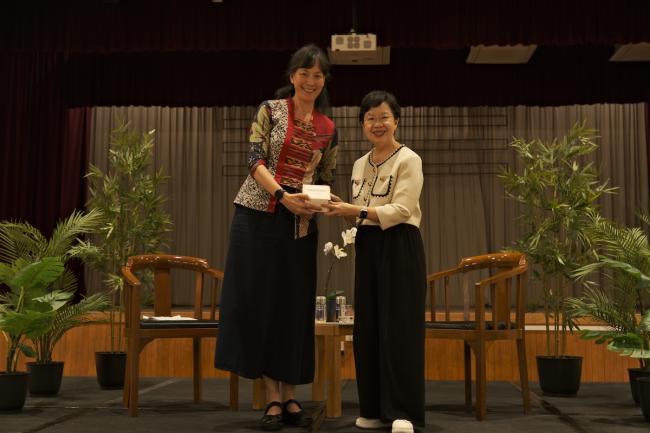
Students had read a selection of Prof Kong's commentaries on the region in advance of the evening. NJC Principal Mrs Lucy Toh shared that students' written reflections returned repeatedly to letting go of a quiet sense of “superiority” they had not realised they carried, and to wanting to engage the region as equals with much to learn from. Others said they felt more prepared to “galumph”, which is to explore without demanding that every step follow a predetermined path. At one table, students debating whether it mattered to be known as a region concluded that soft power and intrinsic identity were not an either/or proposition. They were, Mrs Toh observed, beginning to identify as Southeast Asian.