

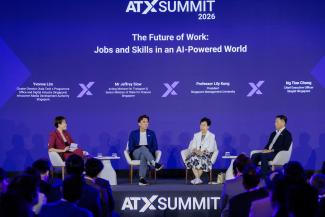
Singapore — Universities can no longer assume that knowledge acquired early in life will remain relevant throughout a person’s career. SMU President Professor Lily Kong made a compelling case at the ATxSummit 2026 on for universities to become more adaptable, human-centred and responsive in the age of artificial intelligence (AI).
Prof Kong joined Jeffrey Siow, Acting Minister for Transport & Senior Minister of State for Finance, and Ng Tian Chong, CEO of Singtel, for a panel discussion on The Future of Work: Jobs and Skills in an AI-powered World. The discussion explored how governments, businesses and educational institutions can respond to workforce transformation driven by AI. To watch the session, visit the ATx site.
Asia Tech x Singapore (ATxSG) is Asia’s flagship technology event jointly organised by the Infocomm Media Development Authority (IMDA) and Informa, supported by the Singapore Tourism Board. It brings together leaders from business, technology and government to discuss issues at the intersection of technology, society and the digital economy. ATxSummit is the event's invitation-only apex conference.
Rethinking education for the AI-powered world
During the discussion, Prof Kong reflected on how traditional models of higher education are being challenged as AI transforms entry-level work and accelerates shifts in skills demand.
“Curriculum needs to change very quickly today to keep up with changes beyond the university,” she said. “But universities need to change not only in curriculum; reforms in pedagogy are critical too. As information is ubiquitous, didactic approaches that emphasise content knowledge need to be changed. Basically, universities need to be highly responsive to a rapidly changing world.”
She shared that SMU has introduced initiatives such as individualised majors through the College of Integrative Studies that allow students to shape learning pathways around evolving interests and emerging fields. But she noted that navigating constant change requires students to develop qualities beyond technical knowledge, including resilience, adaptability and the ability to work effectively with others.
Drawing on Howard Gardner's theory of multiple intelligences, Prof Kong argued that universities have long over-invested in cognitive development while systematically underinvesting in interpersonal and intrapersonal capabilities — the very qualities that AI cannot replicate.
"Education, traditionally, has focused very much on the cognitive. But there are so many other intelligences. There is interpersonal intelligence, refering, for example, the ability to work with others. Then there is intrapersonal intelligence, including a sense of resilience, self-awareness, a certain independence. Those are things that are not systematically and intentionally cultivated in educational institutions."
She pointed to experiences beyond the classroom — co-curricular activities, community service, internships and global exposure — as critical dimensions of student development, and highlighted SMU's Co-Curricular Transcript as a formal mechanism to document not just what students did, but what they learned: the qualities and characteristics grown through experience, including interpersonal effectiveness, leadership and what she called "essential skills" rather than soft skills.
The third-year job
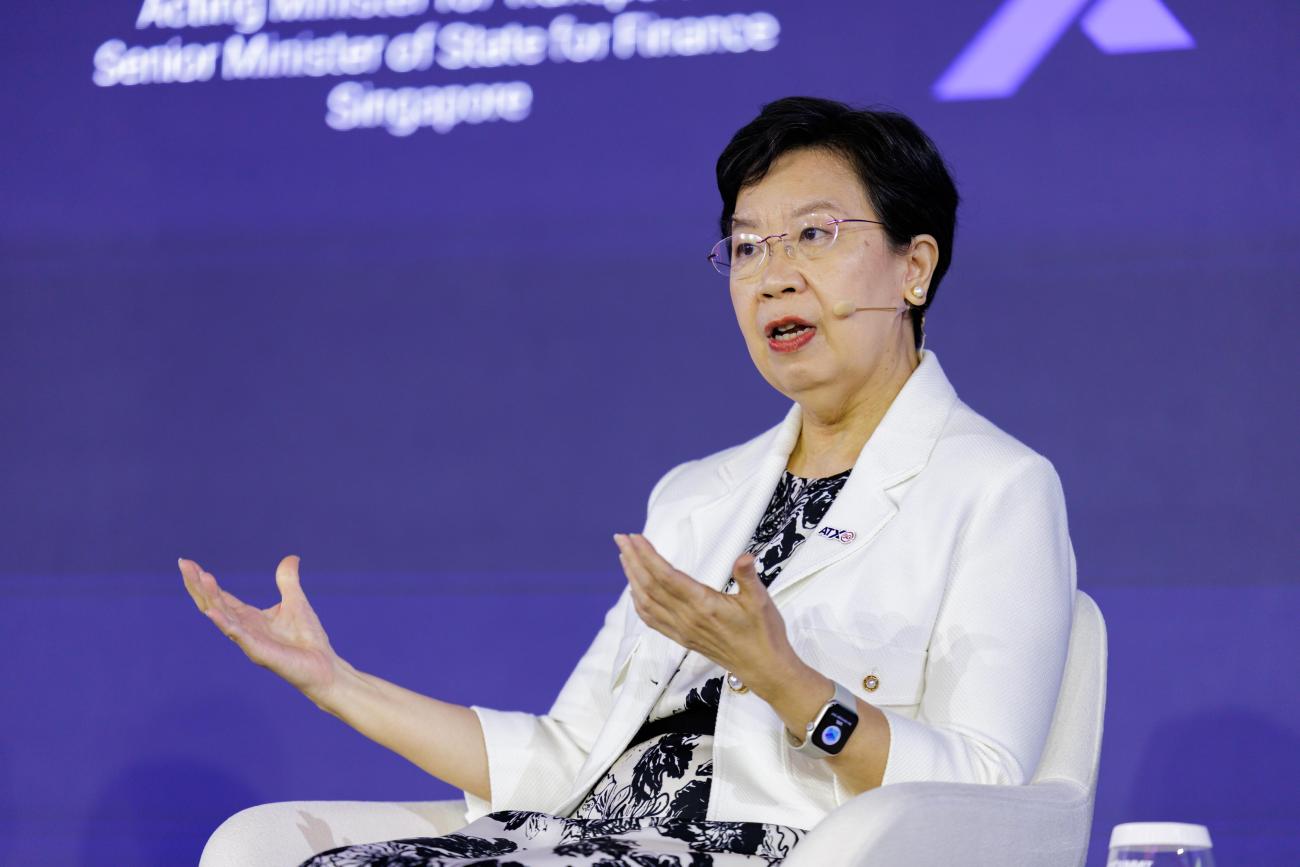
Addressing growing public anxiety about graduate employment, Prof Kong offered a candid and measured response. "As with everybody else in the room, we were a little bit anxious as we awaited the outcomes of this year's Graduate Employment Survey, but the results gave us much comfort." She noted that while there has been a slight decline across universities in the proportion securing jobs within six months of graduation, SMU's outcomes have remained resilient.
Rather than dwelling on the decline, she reframed the challenge: "We should be turning our attention to helping young people prepare themselves for what I call the third-year job." With agentic AI absorbing many entry-level tasks, she argued, the baseline expectation of employers has shifted — and universities must prepare graduates accordingly, through thoughtful internships, work-study programmes and a combination of domain knowledge and essential human skills.
The 60-year university
Responding to questions about Singapore's ageing workforce and shrinking population base, Prof Kong made the case for a fundamental reimagining of the university's role in society.
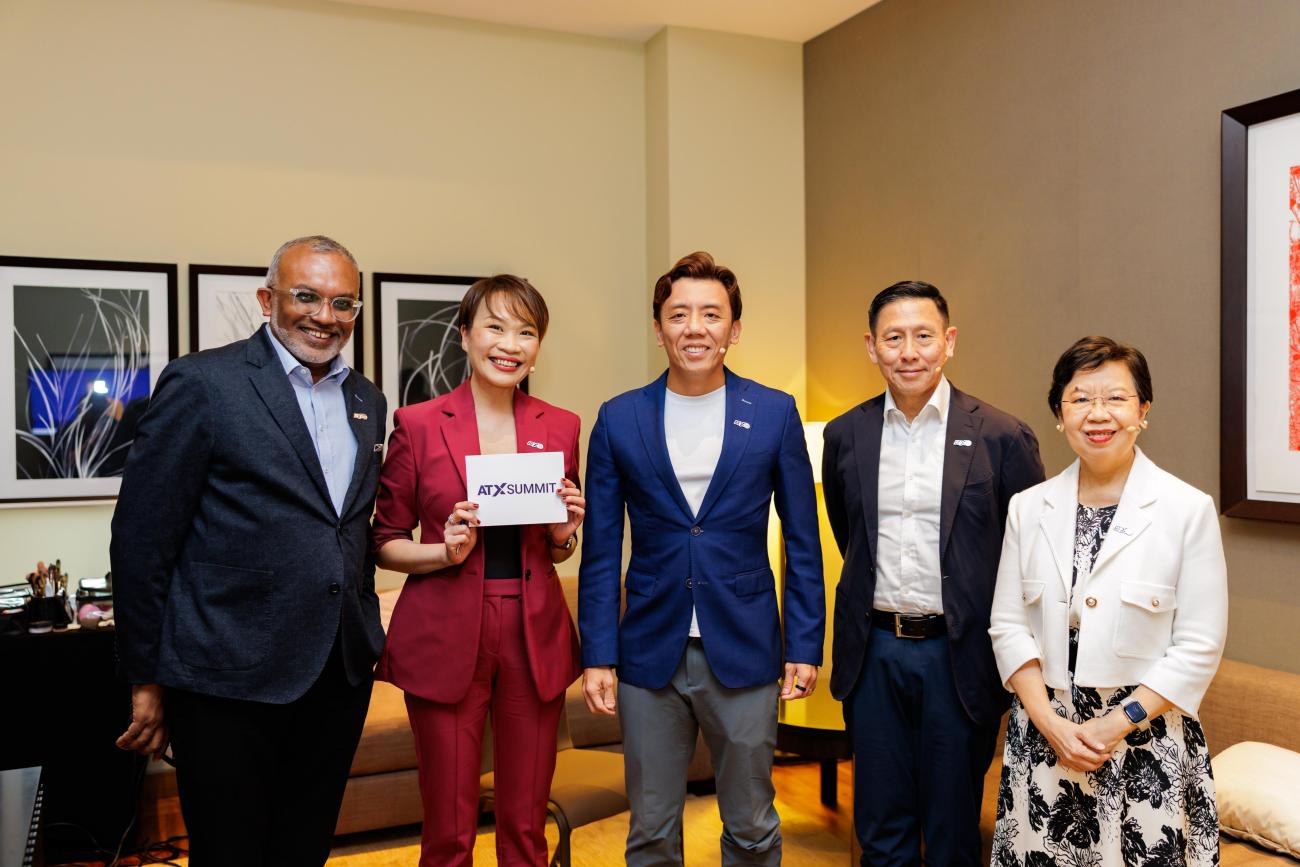
"Typically, we think of the university as a four-year course, then the students become alumni. Living to 80 or 100 years old, do you think what you learnt at 24 will last you your lifetime?" she asked. "We want to think of ourselves as a 60-year university, walking the journey with the individual for that length of time."
Drawing on Lynda Gratton and Andrew Scott's work on the 100-year life, she argued that with life expectancy in Singapore already at 83 to 84 years, the traditional three-stage model of study, work and retirement no longer holds. Universities must rethink how they deliver upskilling and reskilling to working adults, recognising that andragogy, the practice of adult learning, demands different content and different methods from undergraduate pedagogy.
She pointed to SMU's Resilient Workforces Institute (ResWORK), launched in early 2026, as part of the university's broader efforts to study and support resilient workforces in an AI-driven economy. She also noted that SMU currently delivers approximately 45 to 48 per cent of SkillsFuture training courses run through universities, a signal of the institution's existing commitment to workforce-wide learning beyond its undergraduate population.
Her closing message to the audience was personal and direct: "Build a sense of resilience. It's so important not to feel beaten and defeated because things are changing so rapidly. That sense of resilience is going to see you through a lot."
Also at AtxSummit
Also representing SMU at ATxSummit was Professor Annie Koh, who returned to moderate a separate panel discussion on AI's role in expanding access and opportunity through responsible and inclusive innovation. In her concluding remarks, Prof Koh offered a reminder that anchored the day's conversations: "To be human, you care. If you care, the technology will be aligned towards that mission."
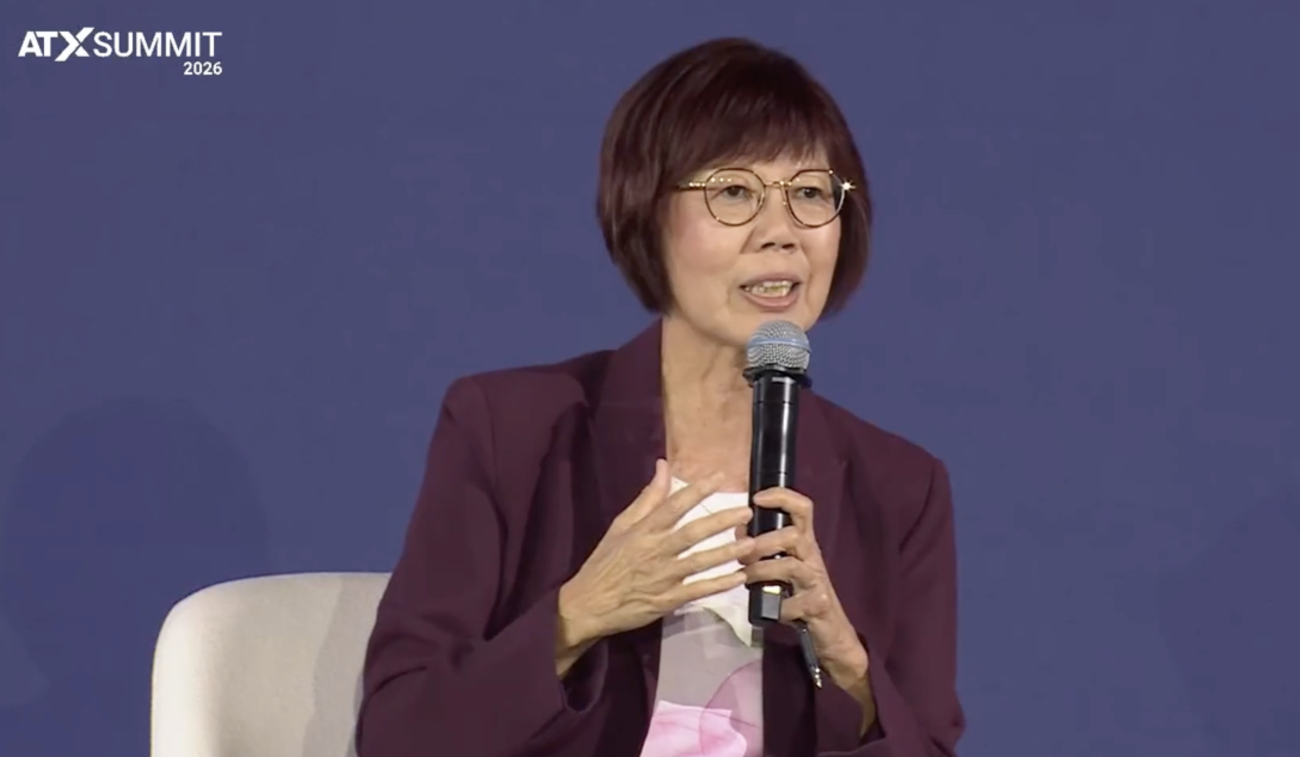
SMU's participation at ATxSummit 2026 reflects the university's continued engagement with conversations shaping the future of work, lifelong learning and responsible innovation in Singapore and the region.