

Although Europe has strong positions in clean tech, circular innovation and sustainable business models, it fails to capitalise on them, according to a new report by the IEF, developed in collaboration with Singapore Management University (SMU). The key to unlocking this advantage, according to the report, is pricing impact into the market.
This report argues that many big companies can appear profitable only because some real costs of doing business—such as carbon emissions, pollution, and social harm—are not fully accounted for in their accounts. It uses a ’True Profit’ approach that factors in these hidden costs alongside positive contributions such as customer value and employee well-being.
The Impact Economy Foundation (IEF), based in the Netherlands, advances the transition toward an economy where entrepreneurship and innovation address societal challenges, by creating tools, movements, and incentives such as True Profits measurements. IEF collaborates with leading academic institutions and global networks, including Harvard Business School and the Impact Institute, which has also collaborated on the development of the paper.
What ‘True Profit’ means
This approach calculates what the financial profit is after accounting for key social and environmental externalities. It calculates each company’s True Profit — financial earnings adjusted for quantified social and environmental costs and benefits. The methodology builds on the Impact-Weighted Accounts Framework (IWAF), an earlier collaboration between IEF and SGFC covering impacts including climate, air quality, biodiversity, material use, employee wellbeing and consumer value. The IWAF was led by Ho Bee Professor in Sustainability Management and Professor of Finance at SMU, Professor Liang Hao.
The research team studied the 20 largest European companies by market capitalisation, and found that reported profits of €209 billion would turn into a net loss of €19 billion once major environmental and social costs are included, with climate costs alone accounting for 60% of the reported profits. The report argues that better disclosure is not enough on its own, and that tax, lending and accounting systems should better reward companies that create real value without shifting costs to society. These findings have important implications for companies in Asia, which are navigating the same tension between profitability and environmental and social responsibility.
Key findings show:
On the one hand, total annual positive contributions to society of the 20 companies analysed amount to approximately €427 billion (S$632.68 billion). These benefits include customer value, employee well-being and financial returns to investors.
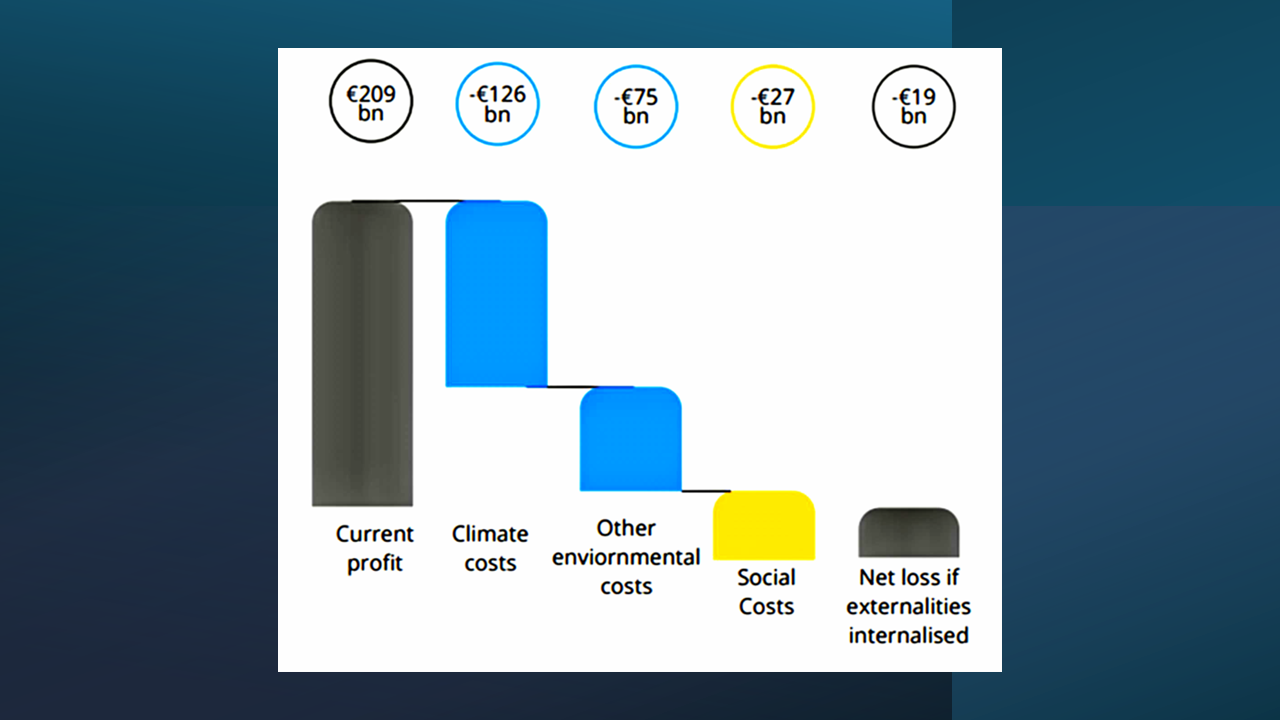
On the other hand, for every euro of revenue generated, companies generate €0.16 in social and environmental costs, which are not reflected in profits.
These findings underscore the fact that Europe’s current economic model is heavily dependent on business models that shift costs to society, while disadvantaging companies that invest in cleaner, more resilient solutions. The picture is stark: Europe’s current market rules reward companies for externalising harm while leaving those that lead on sustainability at a competitive disadvantage.
The Profitability Gap
“By translating a company’s material social and environmental effects into the language of finance, ‘True Profit’ integrates financial profit with monetised positive and negative impacts to reveal a company’s net value creation for society,” said Prof Liang. “This research matters because it shows that profit alone may not tell us whether a company is genuinely benefiting society. By revealing hidden environmental and social costs, this research can sharpen decision-making by investors, firms, and policymakers. In sustainable finance, it offers a more complete way to assess value creation and encourages markets to reward businesses that generate real long-term benefits rather than externalising costs to others.”
Mr Werner Schouten, Director of the IEF, said that there are advantages to the use of impact-weighted assessment.
“Europe does not lack sustainable solutions. It lacks a market that rewards them,” said Mr Schouten. “Companies that want to lead on sustainability face a clear Profitability Gap. As long as societal costs remain unpriced, sustainable technologies and business models will struggle to scale.”
At a time when Europe is grappling with high energy prices, geopolitical pressure and global competition, the report reframes the competitiveness debate. China’s clean tech sector now accounts for more than 11% of its GDP and over a third of its economic growth. Europe has the innovation, the industrial base and the regulatory infrastructure to compete, but only if markets start rewarding the right things.
According to IEF, examples of this gap appear in various sectors. For instance, currently, circular production models struggle against linear ones. For example, recent analysis shows that advanced plastic recyclers – despite generating measurable climate benefits through avoided CO₂ emissions – cannot compete with cheaper virgin plastic. The same pattern holds elsewhere. Green ammonia cannot compete with grey. Sustainable food companies lose out to conventional ones. Not because they are worse businesses, but because markets do not yet price real costs. As a result, the innovations Europe needs for long-term competitiveness remain financially constrained.
Prof Liang, who has applied the IWAF methodology to study true profits and social returns across organisations and investments in Asia, including in Singapore and China, elaborated, “This study can inform tax and policy incentives, capital allocation, and corporate strategy, while also improving how we judge whether a business is truly creating value. The main opportunity is to move from sustainability reporting to sustainability-based decision-making, although better data and standardisation will be needed for wider adoption.”.
From reporting to rewards: Making impact profitable
The IEF notes that the EU has already built the world’s most advanced corporate sustainability reporting system, through CSRD, the EU Taxonomy and related frameworks. But transparency alone is not enough to transform markets. The report calls for a shift from reporting to rewards: use impact data to reshape market incentives and make impact profitable. Three possible levers are:
- Tax harm, reward positive impact. A True Profit Tax would link corporate tax rates to a company’s net social and environmental impact, using the sustainability data companies are already required to report. Companies creating real value for society pay less. Those generating harm pay more. Alongside this, extending the EU’s carbon border tax (CBAM) beyond carbon, to cover biodiversity damage, pollution and material extraction, would stop European companies being undercut by importers who face no such costs.
- Make sustainable investments cheaper. Impact-adjusted interest rates would lower borrowing costs for companies and projects that generate positive social and environmental returns. Building on existing green finance frameworks, this would channel capital toward the business models Europe needs to compete in the long term.
- Count sustainability investments as assets, not costs. Activate expenses for climate and biodiversity on the balance sheet to recognise them as long-term assets.
“Together we can build an economy in which the most impactful technologies and solutions are also the competitive and profitable ones. That is the only durable definition of competitiveness,” said Mr Schouten.
The report is especially relevant for Asia. “The region is simultaneously a major engine of growth, manufacturing, and value-chain activity. Asia is also where many social and environmental externalities remain underpriced. The True Profit approach gives companies, investors, and policymakers a practical way to make these hidden impacts visible in financial terms, so that capital can be directed not only toward growth that is more sustainable and equitable,” said Prof Liang.