
Thai universities are stepping up efforts to develop Thai and Asia-focused business case studies, as educators warn that over-reliance on Western materials is leaving graduates underprepared for local and regional realities.
For decades, business education in Thailand has leaned heavily on Western case studies. While globally relevant, educators say this has created a disconnect between classroom learning and the challenges Thai leaders face in practice.
SMU is working with Thai institutions to address this gap by supporting the development of locally grounded teaching cases based on real-world Asian business scenarios.
This same case-based approach underpins SMU’s postgraduate education, where emerging professionals engage directly with complex, real-world business challenges to develop sharper decision-making capabilities.
"Asian students are prioritising stability, geographic proximity and economic relevance when selecting overseas education destination, driven by tightening visa policies and rising political uncertainty in United States and parts of Europe. This makes Asia-centric case learning not just complementary, but essential as these future leaders need to be trained on the markets, risks and growth engines they will operate in," said, Celine Kuok, Country Director, SMU Thailand.
Building Thai capability in case writing
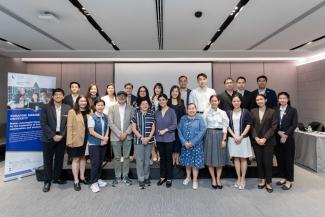
A recent workshop in Bangkok organised by SMU’s Centre for Case Learning Excellence brought together educators and practitioners to develop teaching cases reflecting Thailand’s business environment.
Assoc. Prof. Dr. Olimpia Racela, Mahidol University International College, Program Director of Marketing, observed, "In my experience, teaching cases are not always used to their fullest potential. However, when cases are facilitated effectively to give students room to come up with their own ideas, the classroom environment becomes dynamic, intense, and constructive.”
Dr. Prompt Udomdech, Head of the Department of Architectural and Design Intelligence (ADI), the School of Architecture, Art, and Design (AAD), King Mongkut's Institute of Technology Ladkrabang (KMITL), said, "There is currently a significant gap in business education in Thailand regarding the management of construction and design projects. We lack specific Thai case studies for these sectors, which means this vital knowledge is often missing from business curriculum."
Asia’s growing influence reshapes business education
Educators say the shift towards Asia-focused learning reflects broader economic trends, as the region plays a larger role in global growth.
Currently, SMU is ranked among the top global institutions for case study teaching, according to the Financial Times Research Insights Ranking 2025 and The Case Centre Impact Index 2025, providing a benchmark for regional collaboration in case development.
Balancing technology and storytelling
While artificial intelligence is increasingly used in research and editing, educators caution that human insight remains central to effective case writing.
Dr. Havovi Joshi, Director of SMU’s Centre for Case Learning Excellence, said: “A strong case depends on storytelling and context. AI can support the process, but it cannot yet replace the human perspective needed to bring these stories to life.”
Experts say developing Thai and Asia-focused case studies could play a critical role in strengthening leadership capability and workforce readiness. By embedding local business realities into education, Thailand is better positioned to equip future leaders with the decision-making skills needed in an increasingly complex regional economy.