
Singapore, 14 April 2026 (Tuesday) – Singapore Management University (SMU) today launched the SMU Longevity Societies and Economies Institute (LSEI) which will focus on the economic and societal transitions needed for economies and societies to continue thriving despite an ageing population.
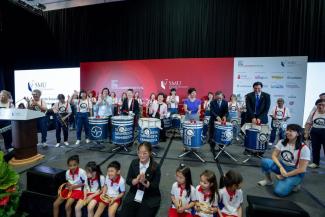
The Institute was launched by Ms Indranee Rajah, Minister in the Prime Minister’s Office, Second Minister for Finance and Second Minister for National Development, at the World Ageing Festival 2026, organised by Ageing Asia with SMU as the Co-host and Academic Pillar Partner.
Singapore is already a super-aged society today. By 2030, one in four Singapore citizens will be aged 65 and above. Across Asia, rising life expectancy and smaller birth cohorts are reshaping labour supply, healthcare demand, retirement adequacy and community support systems. LSEI has been established to examine these shifts systematically and generate evidence to support economically sustainable and socially inclusive responses as part of an integrated systems redesign.
Advancing SMU’s ageing research to real-world impact
SMU LSEI builds on the University’s established track record in ageing research, including the Centre for Research on Successful Ageing (ROSA) and the Singapore Life Panel®, one of the world’s leading high-frequency panel surveys tracking financial and well-being outcomes.
By consolidating existing initiatives into a coordinated, university-level platform, the Institute will also focus on translating deep research into actionable insights for government agencies, employers, financial institutions and community organisations. SMU has committed a multi-year budget of more than S$10 million to seed and sustain LSEI. In addition, the Institute aims to secure external research funding to grow its partnerships and research programmes aligned with national objectives articulated in the recently launched Research, Innovation and Enterprise (RIE) 2030 Plan.
By integrating these strengths with expertise across economics, business, social sciences, law, accountancy and computing, LSEI creates a structured research agenda focused on the social, institutional and economic implications of longer life expectancy.
Noting that institutions need to keep pace with longer lifespans, SMU President Professor Lily Kong pointed out that ‘a three-stage life – learn, earn, retire’ no longer describes how most people actually live. “We have built systems that still treat later life primarily as a phase of care and cost; escalators move a little too fast; digital forms that assume one has an employer; font sizes no one quite asked for; and retirement policies written when 65 was considered a long life indeed,” she observed in her speech.
“Taken together, they communicate something: the designed world could afford to catch up with the lived world. Many of us still adjust to the news that we are living to 90 – and indeed 100 – intending to remain very curious, productive and engaged for much of it. This is the gap that the LSEI that we are establishing today will help to close,” she said.
Growth opportunities of the silver economy
The Interim Co-Directors of the new Institute are Dr Cheong Wei Yang, SMU Vice Provost (Strategic Research Partnerships) and Professor of Sociology (Practice) Paulin Straughan. Dr Cheong served as Deputy Secretary for Technology at the Ministry of Health before joining SMU, and still serves concurrently as their Senior Advisor for Health Economics. Professor Straughan is also the Director of SMU’s Centre for Research on Successful Ageing (ROSA).
Dr Cheong said the establishment of LSEI is vital to tackling the profound impact of population ageing, which has far-reaching economic consequences, from labour supply evolutions to retirement adequacy at the individual level and fiscal sustainability for a country.
“However, it also presents significant growth opportunities via the silver economy,” he said. “We should not see ageing as only a cost, such as healthcare, but instead as an economic and social opportunity if we approach it as an integrated systems redesign. Through LSEI, SMU is taking a more strategic approach to understand these shifts, and work with partners to translate research into innovative solutions, to support a more resilient and inclusive society and economy in Singapore, and across Asian cities.”
The Institute seeks to study longevity, not only from health and care perspectives, but also through the lens of labour productivity, purposeful engagement and economic impact. It also examines how businesses and the marketplace should respond, as well as the importance of mental, social and financial well-being, beyond physical health.
Two research pillars to address economic and social adaptation
LSEI’s research agenda is organised around two core pillars:
- Building Longevity Economies examines how labour, markets, retirement systems and fiscal frameworks adapt to ageing populations. This includes workforce participation among older adults, employer practices and incentive structures, retirement adequacy, and market opportunities for the silver economy.
- Cultivating Holistic Well-being adopts a life-course approach that studies preventive health behaviours, financial preparedness, social participation and mental resilience shaping ageing outcomes. It focuses on how policies and community systems strengthen individual support across different stages of life.
Supporting these pillars are cross-cutting, foundation research efforts that examine legal, regulatory, technological and behavioural dimensions of longevity, including the adoption of digital and assistive technologies and the policy conditions required for their responsible deployment.
New insights into retirement, social connection and quality of life
An example of ageing-related research in SMU is one highlighting the complexity of retirement transitions. Professor Straughan and her team’s recent research on ‘Retirement and its impact on the social connectivity of older adults in Singapore’ finds that retirement reshapes social connections and sense of purpose differently for men and women.
Drawing data from over 10,000 adults aged 50 to 80, the study reveals that while social participation increases after retirement, retired men experience a more pronounced decline in meaning and contribution compared to retired women. The findings point to gaps in policy and community support system design, particularly in supporting male retirees’ transition into later life.
Professor Straughan said that retirement represents a ‘pivotal life course transition’ which may also disrupt one’s sense of identity and purpose, particularly given the centrality of work within the Singapore context. Empirical evidence from ROSA’s Singapore Life Panel shows retirement impacts different dimensions of older adults’ social lives differently.
“While retirees report increased participation in activity and gendered expansions in different aspects of their social networks, they also experience a decline in perceived social contribution,” she observed, adding that this points to an important area for intervention to help retirees find a sense of purpose in later life. (Note: See Annex 2 for full information about the research.)
Partnerships to strengthen policy-practice integration
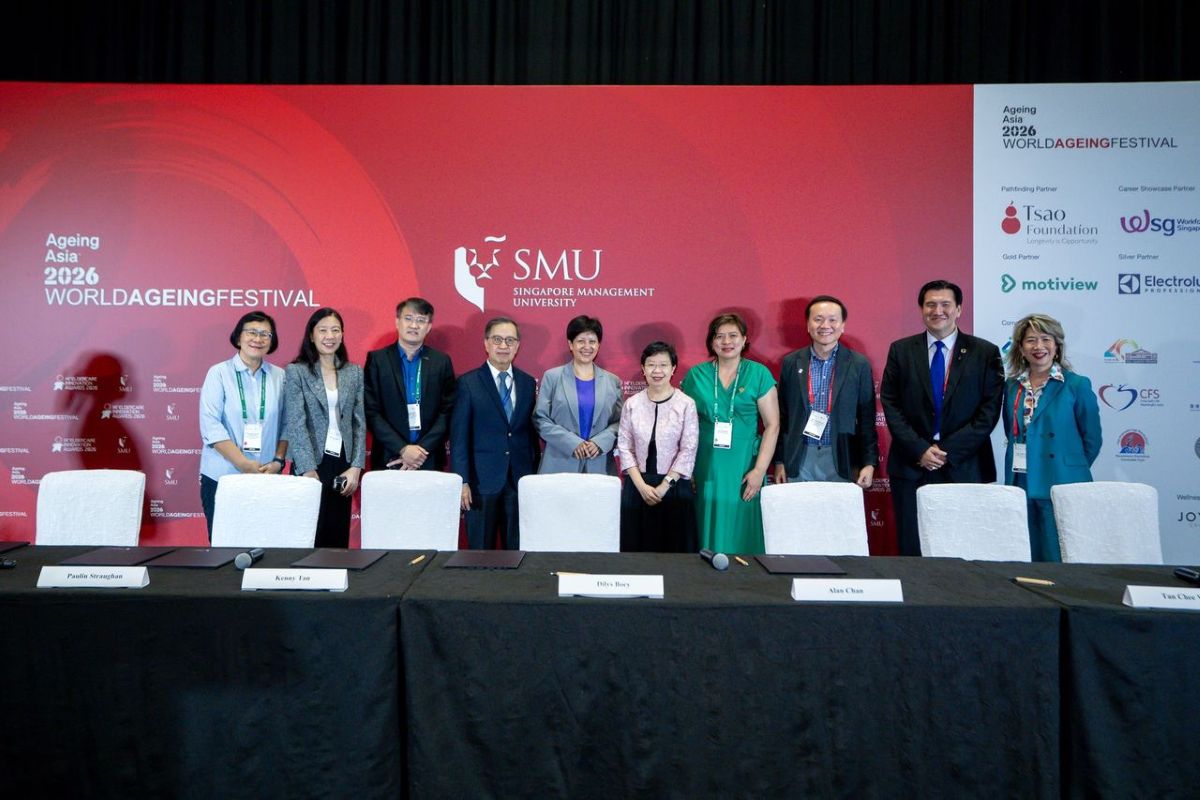
LSEI has also established strategic partnerships with five key stakeholders in government, community and private sectors, guided by our ambition in the SMU2030 Strategic Plan to deepen connections with government and industries to solve complex problems. LSEI will work with:
Agency for Integrated Care (AIC) – To conduct joint research and initiatives supporting community-based care and ageing outcomes, as well as purpose-driven engagements in social settings.
Mr Tan Chee Wee, CEO of AIC, said that it is increasingly important that Singapore’s policies and programmes are guided by a deeper understanding of the economics of longevity. “This partnership with LSEI reflects AIC’s commitment to bridge research and practice,” he said, “and will help to strengthen our care models and communities to better meet the evolving needs and aspirations of our seniors, so that they can live and age well with purpose.”
Lions Befrienders (LB) – To conduct joint research, including on the Integrated Community Care Provider initiative, to examine eldercare services delivery, as well as to understand service gaps and opportunities for on-the-ground implementation.
Ms Karen Wee, Executive Director of LB, said this partnership helps redefine how to empower seniors in Singapore. She observed: “As this partnership with LSEI taps into LB’s deep-rooted expertise and innovation in elder community care, we are uniquely positioned to translate academic insights into impactful, real-world solutions in healthy ageing, championing continued workforce participation, and building greater resilience, for seniors to thrive in a longevity economy truly.”
Singlife – To conduct joint research and develop a white paper relating to retirement readiness, and explore opportunities to develop actuarial science talent at SMU School of Economics through scholarships, internships and other training initiatives.
Ms Debra Soon, Group Head of Brand. Communications, Marketing & Experience, Singlife, noted that this partnership shows how industry and academia can come together to tackle Singapore’s long-term challenges. She said: “SMU’s academic rigour, with Singlife’s real-world data, can deliver insights to close Singaporeans’ protection and retirement gaps, helping them age well with confidence!”
St Luke’s ElderCare (SLEC) - To conduct joint research on holistic well-being, social connection, and mental resilience in the community.
Adjunct Associate Professor (Dr) Kenny Tan, CEO of SLEC, said that the partnership helps to reimagine ageing and redefine longevity. He shared: “This MOU brings together SLEC’s community-based eldercare experience and SMU’s research excellence, bridging practice and academia to drive deeper insights and innovative solutions, to build a society that honours the older person. This is the real mark of its maturity.”
Workforce Singapore (WSG) - To conduct joint research on the economic value of ageing, identify and develop new opportunities for mature workers, and examine how workplaces and employers can better harness experienced talent as a strategic asset, such as through job redesign, career pathways and flexible work models that support career longevity and workforce resilience. Research themes will be co-developed into concrete, policy-relevant proposals that champion human potential for a thriving Singapore.
Ms Dilys Boey, Chief Executive of WSG, noted that this partnership between LSEI and WSG marks a significant step in advancing research on career health and career longevity as lifespans improve. “We are committed to uncovering evidence-based insights to develop innovative approaches that help employers recognise and harness the value of mature workers. This will support longer career journeys and strengthen career health, enabling Singaporeans to thrive throughout their working lives and contribute to a more inclusive and economically sustainable society,” she said.
Through these research partnerships, LSEI will align academic research with policy development and operational practice, strengthening the feedback loop between evidence, implementation and social and economic institutional design.
- End -
- Enclosure:
- Annex 1 – Chinese translations (see PDF file of this press release)
- Annex 2 – Retirement and its impact on the social connectivity of older adults in Singapore (upcoming research brief - see PDF file of this press release)
The media invitation to the launch can be accessed here: WAF2026_MediaKit - Google Drive
LSEI launch photos and the speech by SMU President are available upon request.
Coverage in The Straits Times Lianhe Zaobao