

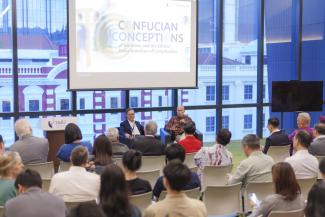
What does “harmony” really mean in a diverse society? Is it the absence of conflict or the ability to navigate difference thoughtfully? As societies across the globe grapple with growing divisions across culture, religion and identity, these questions were explored at the inaugural lecture of the Kwan Im Thong Hood Cho Temple Chair Professorship in Inter-Religious Studies and Harmony, on 18 March 2026 at Singapore Management University (SMU) campus.
Organised by SMU College of Integrative Studies (CIS), the event was attended by more than 90 guests from academia, government, industry and religious communities who gathered to gain insights and to reflect on one enduring idea: harmony. Prof Alan Chan, SMU Provost, delivered the lecture, titled Confucian Conceptions of Harmony and the Ethical Transformation of Complexities.
Addressing the audience in her welcome remarks, Prof Lily Kong, SMU President, said: “The world today is changing at a remarkable pace — in ways that inspire both optimism and concern. On one hand, we are witnessing unprecedented technological advances. Artificial intelligence, for instance, is reshaping how we work, learn, and live.”
“At the same time, we are also seeing growing fractures in societies around the world. These divisions are often fuelled by fear and mistrust — across differences of religion, race, culture, and identity,” said Prof Kong. “Such fractures threaten the social fabric that generations before us worked hard to build and protect. It is precisely in this context that today’s lecture and this Chair Professorship matter so deeply.”
Designed to foster dialogue on inter-religious relations, the lecture was especially timely given how societies around the world are experiencing rapid technological change and shifting geopolitical dynamics. Tensions across lines of faith, race and culture continue to challenge social cohesion. Singapore’s experience of diversity managed through dialogue, mutual respect and shared responsibility served to provide valuable perspectives.
The Kwan Im Thong Hood Cho Temple Chair Professorship in Inter-Religious Studies and Harmony, which was made possible by a S$2.5 million gift from Kwan Im Thong Hood Cho Temple, aims to strengthen constructive discourse by creating a dedicated platform for scholarship, research and community engagement on inter-religious harmony.
“We aspire for SMU to be a place where ideas are shared openly, anchored in rigorous logic and defensible evidence,” commented Prof Kong. “Here, differences are approached with humility, and different individuals feel welcomed and respected. In an age where tribalism can easily take root, universities have a responsibility to chart a different course — one that fosters understanding, empathy, and shared purpose.”
Concept of hé (和)
In his lecture, Prof Chan examined the concept of hé (和), commonly translated as “harmony,” a foundational idea in Chinese philosophical thought.
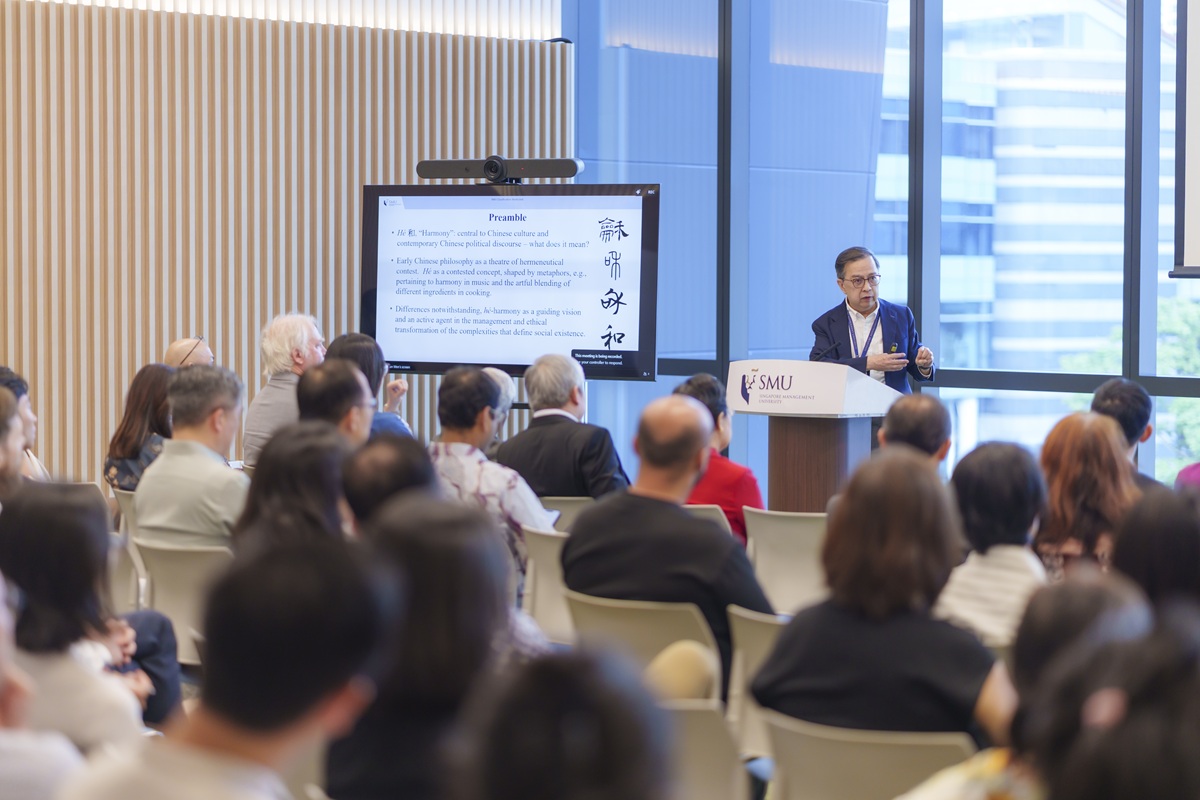
Drawing from early Chinese philosophy, Prof Chan identified two distinct conceptions of harmony. The first was inspired by music, where different notes and instruments combine to produce a balanced and pleasing composition. The other was drawn from the art of cooking, where diverse ingredients, each with its own flavour, are carefully blended to create a rich and balanced dish.
“Harmony is associated with a range of concepts such as rang (让) and shun (顺) that convey compliance or yielding to a higher purpose or direction, though Confucius asked for the song to be performed again, presumably to listen more carefully, which suggests that harmonising comes after discernment,” commented Prof Chan. He was elaborating on the concept of musical harmony and illustrating how traditional tonal harmony involved distinct constituents performing in concert towards realisation of a pre-conceived goal.
While these metaphors had often been seen to be describing the same ideal, they may in fact point to different ways of understanding harmony. In revisiting these philosophical traditions, Prof Chan reflected on harmony not as the absence of difference, but as an active process of engaging complexity and bringing diverse perspectives into balance while preserving their distinctiveness.
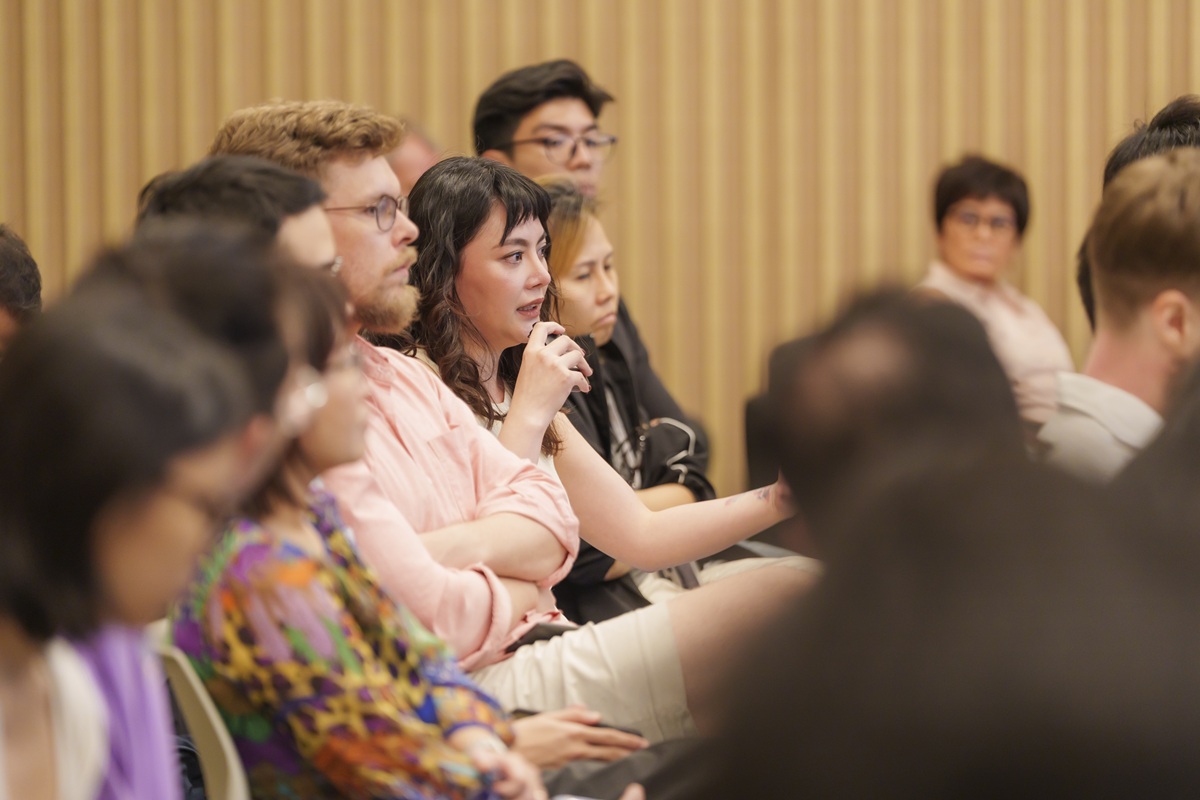
“In fine cooking, active “blending” (tiao 调) is needed to achieve not only balance but also renewal,” said Prof Chan. “Whereas the former sees harmony more as a desired end, the latter emphasises harmony as an ethical process. Not to suggest stark opposition, but logic of interpretation.”
For communities navigating religious and cultural diversity, these insights offered a timely reminder that harmony requires dialogue, ethical responsibility and a shared commitment to the common good. In Singapore, where strong interfaith relations and multiracial cohesion underpin the social fabric, such harmony had never been accidental, and required continuous and intentional effort to sustain.
Beyond lectures such as the evening session helmed by Prof Chan, the Kwan Im Thong Hood Cho Temple Chair Professorship aims to extend these conversations amongst a wider audience. Embedded within the SMU Core Curriculum under the Cultures of the Modern World basket, the initiative ensures that undergraduates are equipped with a nuanced understanding of religious diversity. Through collaborations with scholars, policymakers and community leaders, the University continues to new perspectives to global conversations on living together in an increasingly complex world.