

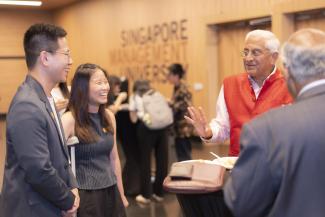
What does it take to thrive in an Asia increasingly shaped by the growth of India and China?
For Mr R. Gopalakrishnan, CEO of Mindworks and former director of Tata Sons, it begins with curiosity about other cultures, different ways of working and the possibilities that emerge when countries look beyond their differences.
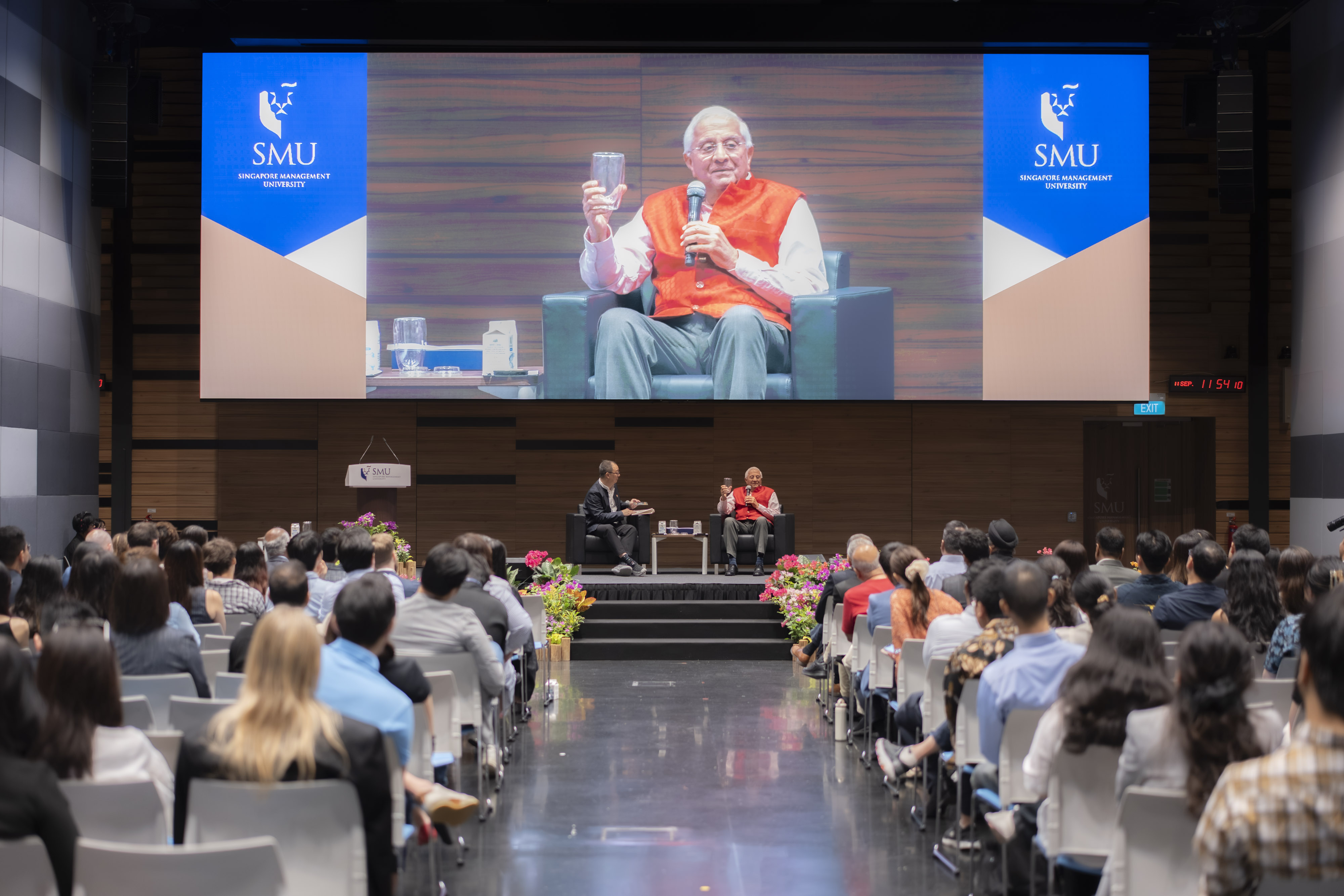
Speaking at the inaugural Asia Ready Conversations (ARC) on 11 September 2026, Mr Gopalakrishnan shared his perspectives with around 150 students, faculty and members of the SMU community. The session, titled “India, China and the Future of Asia: Navigating Opportunity and Change”, started with a keynote address by Mr Gopalakrishnan, followed by a fireside chat that was moderated by Professor Themin Suwardy, SMU Associate Provost for Postgraduate Professional Programmes.
The conversation drew on Mr Gopalakrishnan’s nearly six decades of business experience and his latest book, Chanakya and Sun Tzu: A Business Lens on Trade, Thought and Travel.
Finding common ground in Asia
Mr Gopalakrishnan argued that India and China’s relationship should be viewed through a broader lens than geopolitics. While differences between the two countries remain, businesses and individuals can focus on areas where cooperation is possible and mutually beneficial.
India and China have been connected for centuries through trade, travel and the exchange of ideas. He encouraged students to consider how these historical links could inform the region’s future as economic activity increasingly shifts towards Asia.
Mr Gopalakrishnan shared that India, China and ASEAN could become an important centre of global economic activity by 2050. This makes it increasingly important for young people to understand the region and participate actively in its development.
“You become wealthy through trade, travel and thought,” he said, adding that these exchanges require people and societies to continue communicating and learning from one another.
Staying curious without being judgemental
Throughout the session, Mr Gopalakrishnan returned to the importance of remaining open to unfamiliar cultures and environments.
Drawing on his experiences across China, India and the Middle East, he explained that cross-cultural understanding cannot be developed solely through books or formal instruction. It requires direct exposure and a willingness to question one’s assumptions.
“Curiosity requires you not to be judgemental,” he said.
He encouraged students to travel, learn new languages and experience different ways of living, even when these experiences feel unfamiliar. Rather than expecting others to follow the same customs, students should learn to adapt their own approaches to different contexts.
Learning beyond the classroom
The discussion also explored the limits of formal education and the role that experience plays in preparing students for their careers.
“There are things that can be taught,” Mr Gopalakrishnan said. “But most of life’s important lessons are not teachable. They are learnable, but not teachable.”
This makes lifelong learning especially important as technology continues to reshape the workplace. Asked about artificial intelligence, Mr Gopalakrishnan encouraged students to learn about it and take it seriously, while continuing to exercise their own judgement and natural intelligence.
He also noted that learning cannot be concentrated entirely at the beginning of a person’s life. Individuals must continue refreshing their knowledge, acquiring new skills and reconsidering practices that may no longer be relevant.
Singapore as a meeting point
When asked about Singapore’s place in future dialogue between India and China, Mr Gopalakrishnan highlighted its multicultural character and ability to bring different communities together.
He described Singapore as a valuable environment in which approaches to multiculturalism and cooperation can be explored. Its size allows it to adapt and experiment, while its diversity offers useful lessons for larger societies.
“Never think you’re too small,” he reminded the audience, encouraging Singapore to continue demonstrating how diversity can strengthen society.
The session concluded with questions from students and faculty on artificial intelligence, cross-border mobility, economic development and the opportunities available to young people in Asia.
ARC was launched alongside SMU’s Asia-Ready Education Framework, which helps students build their understanding of Asia through academic learning, regional exposure and sustained real-world engagement. By connecting students directly with business leaders, policymakers and other regional voices, the series creates space for them to explore the forces shaping Asia and consider how they can contribute to its next chapter.
Photo credit: SMU