

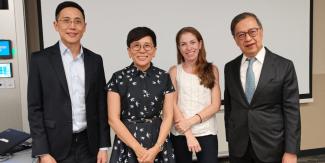
Education leaders as well as global climate and sustainability experts gathered on campus at Singapore Management University (SMU) on 8 September 2026 for the Planet+ Launch Salon. Together, they explored questions and exchanged perspectives on how education must evolve to prepare the next generation for a changing world.
Organised by SMU’s College of Integrative Studies (CIS), a knowledge partner of Columbia University’s Centre on Sustainable Investment (CCSI) and Planet+, the launch event marked the beginning of a partnership focused on advancing interdisciplinary and applied approaches to climate education.
The Planet+ Challenge, an international climate competition that will take place in March 2027 at SMU, is designed to give pre-university students and undergraduates opportunities to develop their systems-thinking, collaboration and problem-solving capabilities while addressing real-world climate case studies.
“Climate and sustainability challenges are what people in this field often call wicked problems. They do not respect the tidy boundaries we have drawn between disciplines over the last century or so,” said SMU Provost Prof Alan Chan in his welcome remarks, where he underscored sustainability's firm place in SMU's strategic directions.
Highlighting the importance of involving young people early in pushing the boundaries of how we approach sustainability, Prof Chan also noted that for a small country like Singapore, "climate change is not a theoretical issue," but very much an existential one. He emphasised that SMU's Urban Institute, headed by Prof Orlando Woods of CIS, exists precisely to examine the interrelated issues of climate, sustainability, and urban studies.
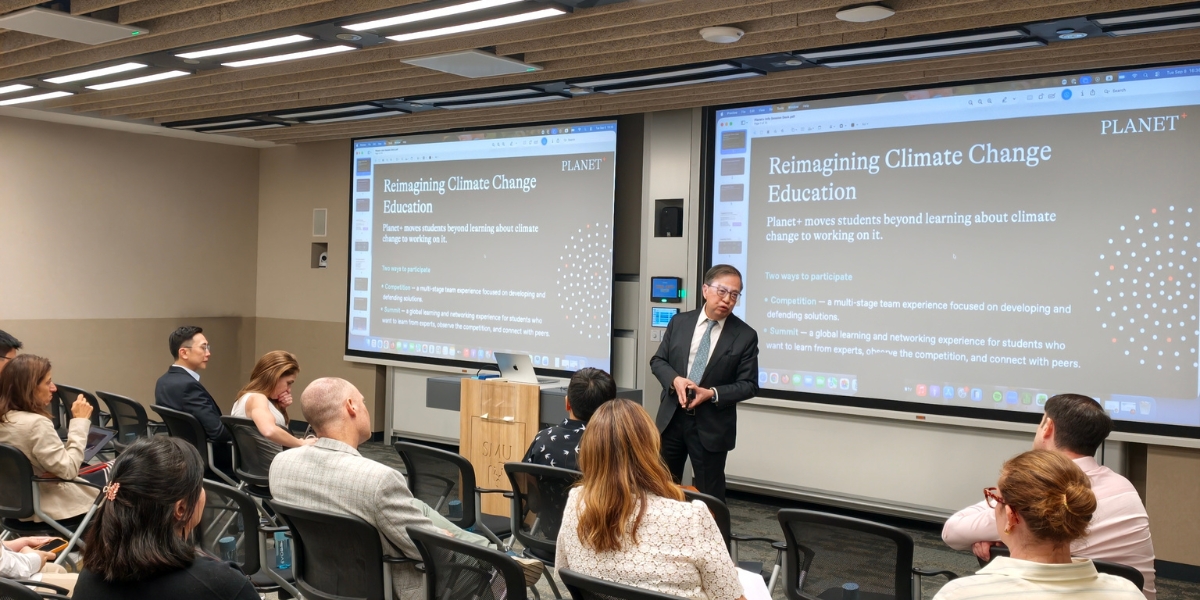
Addressing the challenges in education with the Planet+ Challenge
Speaking at the launch, CIS Dean Prof Elvin Lim focused on the human dimension of interdisciplinary collaboration. He emphasized that genuine integration of knowledge begins not with agreement but with productive confusion, as specialists discover that a shared word like "risk" means something different in each of their fields.
He described this initial difficulty as the most valuable stage of collaborative work, when researchers become legible to one another and confront the limits of their own disciplinary vision. Noting that CIS students design their own individualised majors and must therefore perform this act of translation themselves, Dean Lim said the College's graduates are conditioned to be collaborative.
Dean Lim welcomed the Planet+ competition format, observing that shared deadlines and real world problems build lasting professional relationships more reliably than networking events do, and invited participating institutions to nominate students who are curious beyond the boundaries of their own disciplines.

Ms Lisa Sachs, Director of Columbia Center for Sustainable Investment (CCSI) CCSI, expressed her enthusiasm for the partnership with SMU CIS, and her anticipation of how Planet+ would give students across the region the chance to grapple with real-world case studies, engage with the complexity of these problems, and seek new solutions.
The partnership between CCSI and CIS reflects a shared belief in the value of interdisciplinary learning, bringing together perspectives from different fields to understand complex sustainability challenges and develop more holistic solutions. By working together, Columbia and CIS aim to create a learning experience that connects academic rigour with the practical realities of sustainability challenges facing the region.
Planet+ Executive Director, Ms Cassie Xu, pointed up the importance of having students engage in climate work as practitioners, connecting their knowledge to real-world problems, and gaining access to practitioners and their professional networks.
“Planet+ provides an international platform for applied climate education, while CIS brings deep experience in interdisciplinary education and preparing students to work across traditional academic boundaries. Together, we want to create opportunities for high school and undergraduate students to engage with universities, researchers, practitioners, and one another in ways they would not ordinarily encounter in the classroom,” said Ms Xu.
She saw the launch salon at SMU as “the starting point for building a community around Planet+ in Singapore, bringing together people and institutions that may ultimately participate in, contribute to, or support the initiative,” commented Ms Xu.
“Students become very good at acquiring knowledge within individual subjects. But the problems they will encounter in their careers and communities rarely arrive neatly packaged as a science problem, an economics problem, or a policy problem. They are messy, interconnected, constantly changing, and involve people with competing priorities. Planet+ is designed to give students an opportunity to practice that kind of problem-solving earlier.”
Singapore and SMU as a host destination for the inaugural Planet+
Hosting the Planet+ 2027 Climate Competition supports the broader SMU2030 Strategic Plan, whose Education pillar seeks to impact society and transform lives by developing agile and adaptive graduates equipped to deliver innovative, real-world value as well as respond to the needs of industry and society.
The Planet+ competition will take place on SMU campus during Recess Week in March 2027, with the University aiming to provide a springboard for interdisciplinary ideas to be explored among educators, practitioners and potential partners, while creating opportunities for students to engage with climate challenges beyond the classroom.
Elaborating on the choice of Singapore as a destination for the event in March 2027, Ms Xu said: “Singapore was a deliberate choice for Planet+. It is globally connected, sits at the center of a dynamic region, and has demonstrated a forward-looking and pragmatic approach to climate action, sustainability, innovation, and long-term planning.
“SMU CIS was a natural institutional partner because interdisciplinary learning is already embedded in its educational philosophy. It also creates an important bridge between secondary and higher education: high school students can enter a university environment and encounter new ways of thinking, while undergraduates, academics, practitioners, and educators become part of the same learning ecosystem,” commented Ms Xu.
The successful launch of the Salon on 8 September embodied a shared belief between CIS, Columbia Climate School and Planet+, that addressing climate change requires more than expertise within individual disciplines. Click here for more information on the Planet+ Competition and Summit.