

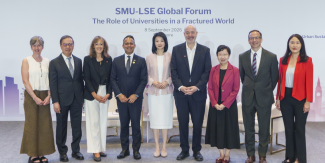
In an increasingly fragmented world, universities must rethink not only what they teach and research, but how they demonstrate the value of that work to society.
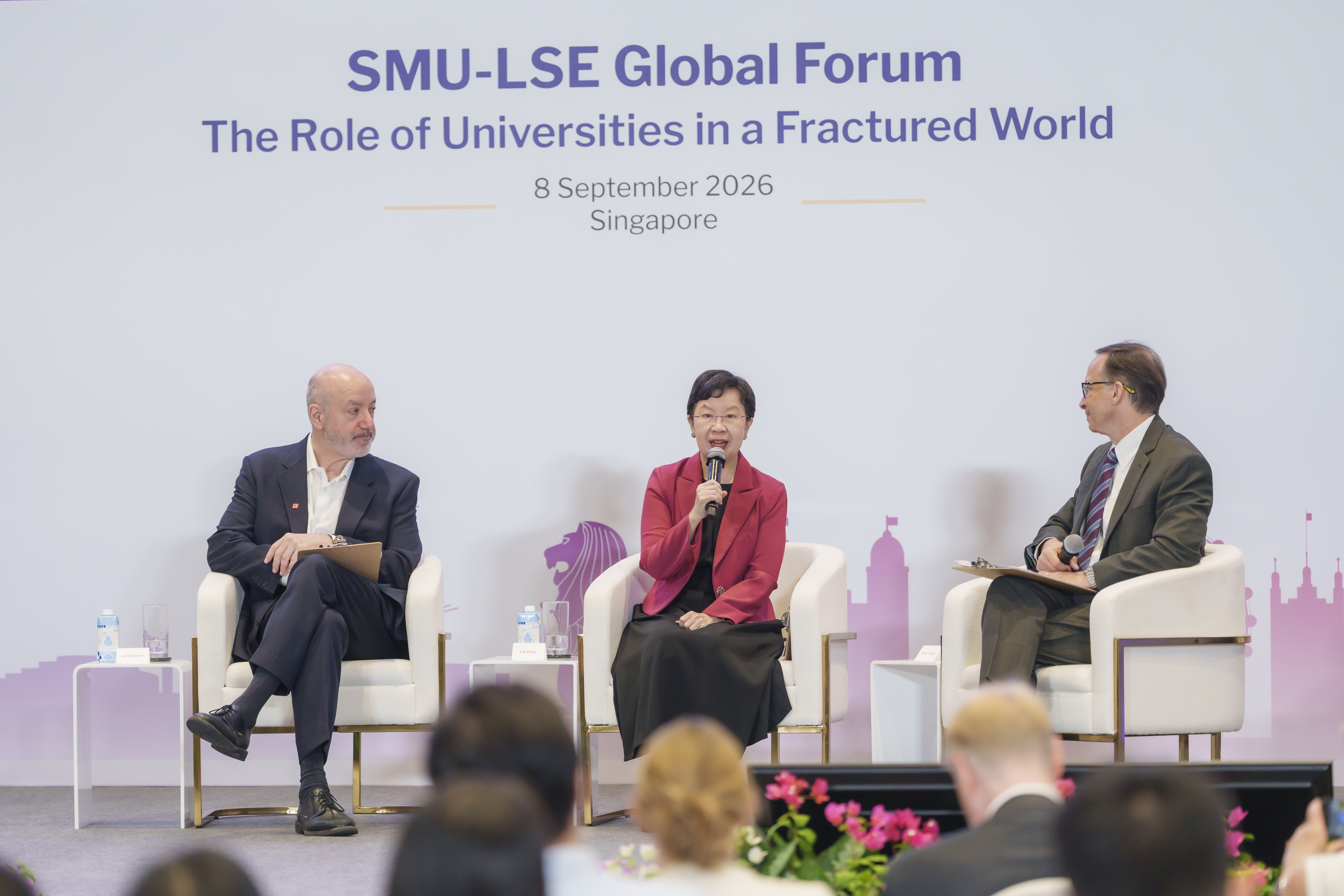
That was the central message from Singapore Management University (SMU) President Lily Kong and London School of Economics and Political Science (LSE) President and Vice Chancellor Larry Kramer during a fireside conversation at the inaugural SMU-LSE Global Forum today, moderated by SMU Vice President (Impact) Professor Scott Fritzen.
Professor Lily Kong said, “Academics have been trained to think about publications, citations and rankings. But in an increasingly complex world, universities must ask themselves how they can make a difference. We must encourage academics to think beyond publications—how their work can make a difference to business, government and society—and how university systems and academic culture can better support them. Changes to policy and practice are usually based on the accumulation of knowledge, oftentimes drawing on the work of various scholars. So we need to recognise the difference between an academic's contribution and the attribution of change to any single individual or work. Both are important.”
Professor Larry Kramer said, “If you think about the problems that we face within our societies, there are few institutions that are better set up than universities to be able to think clearly about this. The independence that universities have, the culture that we have for fostering honest and active debate across differences, is actually one of the best ways to get the best outcomes that we can. We are also training the generation of leaders who are going to go out and take the ideas that are coming out of universities and implement them in real life.”
Both university leaders argued that this requires a shift in academic culture, as well as in how universities and their work are assessed. While academic rigour and intellectual independence remain fundamental, they called for greater recognition of what scholarship achieves beyond traditional measures such as rankings and publication metrics.
This includes developing more human-centred systems of recognition that value the contribution research and education make to society, rather than only what can be measured and counted.
Universities as bridges in a fragmented world
In her opening address, Singapore’s Senior Minister of State for National Development and Transport and LSE alumna Sun Xueling emphasised the importance of universities in helping cities respond to challenges by developing talent, connecting knowledge across borders and turning research into practical urban solutions. She said that “SMU and LSE are well-placed to observe first-hand how artificial intelligence and the digital economy impact businesses, residents and communities. By serving as living laboratories, universities can contribute to building resilient cities that evolve and respond to changing needs.”
This was echoed by British High Commissioner to Singapore Nik Mehta in his remarks, where he underscored how the SMU-LSE partnership contributed to broader Singapore-UK ties, particularly in education, which he described as the “golden thread” running through the relationship alongside free trade and international law.
The Forum brought together more than 150 participants, including diplomatic representatives, industry leaders, faculty and alumni from both universities. Besides the British High Commissioner and the ambassadors of Finland and Norway, diplomatic representatives from Brunei, Canada, Denmark, France, Ireland, Germany, Switzerland and Vietnam were among the audience, reflecting the global relevance of the issues discussed.
Research collaborations for impact
The Forum also marked the first major research milestone under the SMU-LSE strategic partnership, with the announcement of three joint projects selected from a total of nine proposals under the LSE-SMU Research Seed Fund examining urban sustainability, artificial intelligence (AI) and the future of work, and longevity and healthy ageing.
The three projects focus on:
Urban sustainability
How the rapid growth of data centres in Johor, Singapore, and London is reshaping land, energy, water, and urban sustainability across regions. By mapping the infrastructure, governance, and cross-border flows behind digital economies, the project will explore the tensions between smart city ambitions and sustainable urban development.
AI and the future of work
How leaders use generative AI in decision-making, communication, and self-reflection, and how AI is reshaping leadership agency, authenticity, and identity. Through interviews and experiments in Singapore and the UK, the project will investigate when AI enhances leadership and when it may undermine judgment, accountability, and human collaboration.
Longevity and healthy ageing
Whether Singaporeans’ preference to age in place reflects informed choices or misconceptions about longevity and future care needs. Using a large-scale survey experiment, it measures how information about ageing and care risks influences housing preferences, helping policymakers design more effective ageing and housing policies.
Partnership built for a changing world
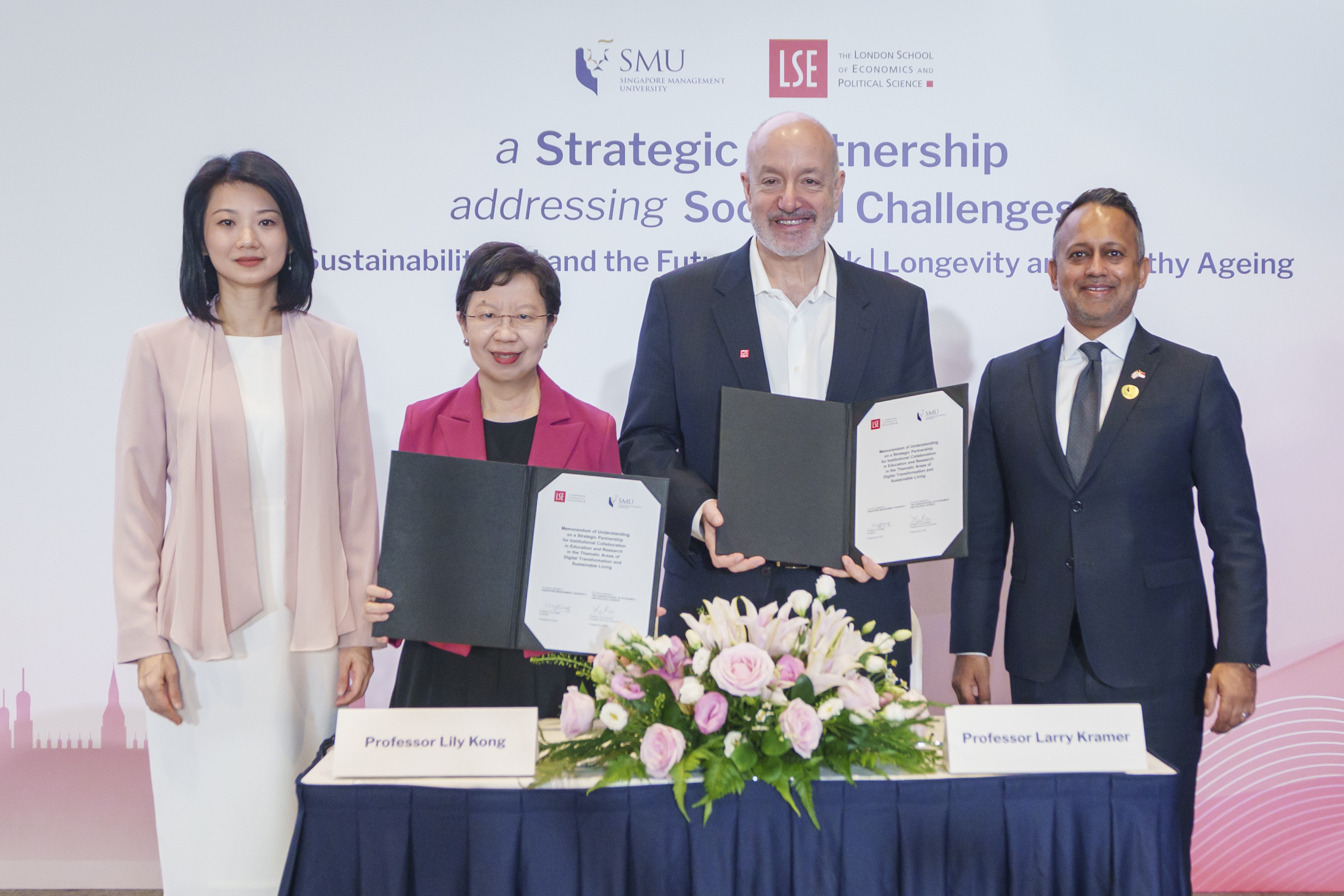
The SMU-LSE partnership was elevated to an institution-wide strategic partnership in January 2026, building on a shared commitment to address complex social challenges through interdisciplinary research and global engagement. Other collaborations include the Global Alliance on Sustainable Urban Societies, established in 2025 with SMU and LSE among its founding universities alongside Boston University, the University of Melbourne and the University of Toronto.
The alliance brings researchers together to examine how urban development can better respond to the needs of people and communities.