

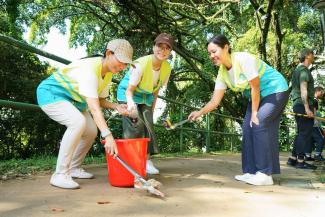
Singapore residents overwhelmingly believe that keeping Singapore clean is everyone’s responsibility, but fewer are willing to take part in broader community cleanliness efforts, according to the latest Public Cleanliness Satisfaction Survey (PCSS) by Singapore Management University (SMU).
While 98.6% of respondents agreed that keeping Singapore clean is the responsibility of every individual, the proportion willing to volunteer with a neighbourhood cleanliness group fell to 49.6% in 2025, from 63.5% in 2023. Support for community litter-picking exercises also fell, from 83.7% to 76.0%.
The findings suggest a gap between strong personal responsibility for cleanliness and willingness to participate in collective efforts beyond one’s immediate responsibilities.
The seventh wave of the PCSS was conducted from December 2025 to April 2026 among 2,007 Singapore Citizens and Permanent Residents aged 21 and above. The survey examined perceptions of public cleanliness and cleaning services, as well as attitudes and behaviours related to public cleanliness.
The study was led by Professor Paulin Tay Straughan, Professor of Sociology (Practice) at SMU, and Dr Mathew Mathews, Principal Research Fellow at the Institute of Policy Studies.
Singapore residents continue to report high satisfaction with public cleanliness
Despite the decline in willingness to participate in community cleanliness efforts, satisfaction with public cleanliness remained high.
Based on the Public Cleanliness Satisfaction Index, a composite measure of satisfaction across 20 public spaces frequented by respondents, 91% of respondents said they were satisfied with the cleanliness of public spaces they had recently visited, compared with 94% in 2023.
Transportation and leisure spaces continued to record the highest satisfaction levels, at 97.2% and 95.1% respectively.
Food outlets remained the lowest-rated domain, as it has been since 2021, with 82.4% of respondents satisfied. Satisfaction with neighbourhood spaces was also comparatively lower, at 87.4%, down from 93.3% in 2023.
Nevertheless, 90.1% of respondents believed that the cleanliness of public spaces had either been maintained or improved compared with one year ago.
Cleanliness behaviours remain strongly embedded
The survey found that strong personal responsibility continues to translate into everyday cleanliness behaviours.
Some of these behaviours have strengthened since 2023. A record 95.5% of respondents said they returned their trays and crockery all the time at food establishments, up from 95.0% in 2023.
This was despite a decline in awareness of enforcement, with 92.2% aware of enforcement in 2025, compared with 95.2% in 2023.
Eight in 10 respondents (79.8%) also said they cleaned up spills or wiped down tables after meals, broadly comparable with 80.6% in 2023. Meanwhile, 88.2% said they never littered in public spaces, up from 86.9% in 2023.
Personal and social responsibility remained prominent motivations for these behaviours. Social responsibility was the most commonly cited motivation for returning trays and crockery, at 77.7%, while 83.3% viewed individual patrons as primarily responsible for tray and crockery return.
For proper litter disposal, personal responsibility for keeping the environment clean was the most commonly cited reason, at 71.3%, up from 65.2% in 2023. Caring for the environment was cited by 53.6% of respondents, up from 48.1%.
The findings point to cleanliness behaviours becoming increasingly embedded as personal and social norms, rather than being driven solely by enforcement. However, the same sense of responsibility does not appear to translate as readily into participation in broader community efforts.
Strong support for shared responsibility, but weaker appetite to participate
Almost all respondents (98.6%) agreed that keeping Singapore clean is the responsibility of every individual, while 98.5% said they took pride in doing their part to keep Singapore clean.
At the same time, respondents were less likely to attribute cleanliness solely to professional cleaning services.
The proportion who agreed that Singapore is clean only because of the efficiency of its cleaning services fell from 90.8% in 2023 to 77.8% in 2025. Similarly, the proportion who believed maintaining neighbourhood cleanliness should be left to cleaners rather than residents fell from 52.7% to 39.7%.
There was also strong support for residents and cleaners sharing responsibility. Some 96.7% agreed that residents should be encouraged to help maintain neighbourhood cleanliness, while 96.5% agreed that residents and cleaners should work together to keep neighbourhoods clean.
Yet willingness to move from supporting shared responsibility to actively participating in it was considerably lower.
Only 49.6% said they would volunteer with a neighbourhood cleanliness group, down from 63.5% in 2023, while support for community litter-picking exercises slipped to 76.0%, from 83.7% in 2023.
Willingness to pay more for better cleaning services was lower still, at only 32.0%, compared with 45.5% in 2023.
Professor Paulin Tay Straughan said: “We are united in our pride that Singapore is a clean city, and in our belief that everyone has a part to play in keeping it that way. The challenge now is to move from awareness to action, embedding a culture where individual and community efforts to keep our shared spaces clean are routine, visible, and valued.”
Dr Mathew Mathews said: “The findings show that Singapore has built strong norms of personal responsibility for cleanliness. The next step is to deepen community ownership, so that residents see shared spaces not just as places to use, but as places they have a stake in caring for. Sustaining a clean Singapore in the future will depend on turning personal responsibility into a stronger sense of collective stewardship.”
The findings suggest that Singapore has a strong foundation of established cleanliness norms and personal responsibility. The challenge may now be to translate these everyday norms into greater ownership of shared spaces and sustained participation in community efforts.
As expectations of public cleanliness continue to evolve, strengthening the connection between personal responsibility and collective action could be important in sustaining Singapore’s cleanliness standards.