
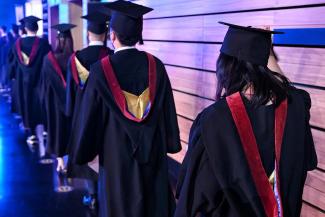
According to the latest Joint Autonomous Universities Graduate Employment Survey (JAUGES) 2025, nine in 10 graduates from SMU secured employment within six months of graduation, despite a cautious labour market. SMU graduates recorded a secured employment rate of 91.4%, with an overall employment rate of 87.1% and a full-time permanent employment rate of 79.8%. Graduate salaries also increased from the previous year. SMU reported an average gross monthly salary of S$5,116, up from S$5,057 in 2024, whilst the median salary increased to S$4,747 from S$4,600. Of SMU’s 2,331 graduates in the Class of 2025, 1,710 responded to the survey, representing a 73.4% response rate.
For some graduates, internships serve as a platform for exploration across sectors before committing to a career direction. SMU alumna Kylie Oh Yu Ning, who majored in politics, law and economics and interned across Government, technology and fintech organisations, including the Ministry of Home Affairs (MHA), SAP, Grab and Visa. Her final internship at Visa resulted in a full-time role in the company’s global leadership associate programme even before graduation.
SMU Provost Alan Chan, who is also Kwan Im Thong Hood Cho Temple Chair Professor of Inter-Religious Studies and Harmony (with courtesy appointment in the School of Social Sciences), remarked that while hiring conditions are becoming more cautious as organisations manage uncertainty and accelerate automation, this is precisely where SMU's learning model proves its strength. He said that they are intensifying the efforts to equip the students with essential human-centred competencies, such as strong critical thinking and communication skills, as well as a high degree of artificial intelligence (AI) fluency, which are vital to flourishing in a rapidly changing work environment. Prof Chan added that more internship and global education opportunities will be provided to ensure SMU graduates remain resilient, adaptable, and highly competitive.