

As the world shifts to a more decentralised web where users can use their data and digital assets through blockchain technology, Web3 is more than a technological trend. It is an emerging foundation for the next phase of the digital economy, defined by trusted data flows, decentralised governance, tokenised assets, AI-driven intelligence, and new forms of economic and social coordination.
“As a university deeply engaged in finance, technology, management, legal studies, social sciences, and the arts, SMU is uniquely positioned to shape Asia’s Web3 thought leadership,” said Professor Alan Chan, Provost of Singapore Management University (SMU), at the opening of the University’s inaugural Web3 Week recently.
Developing Talent for Web3 technologies
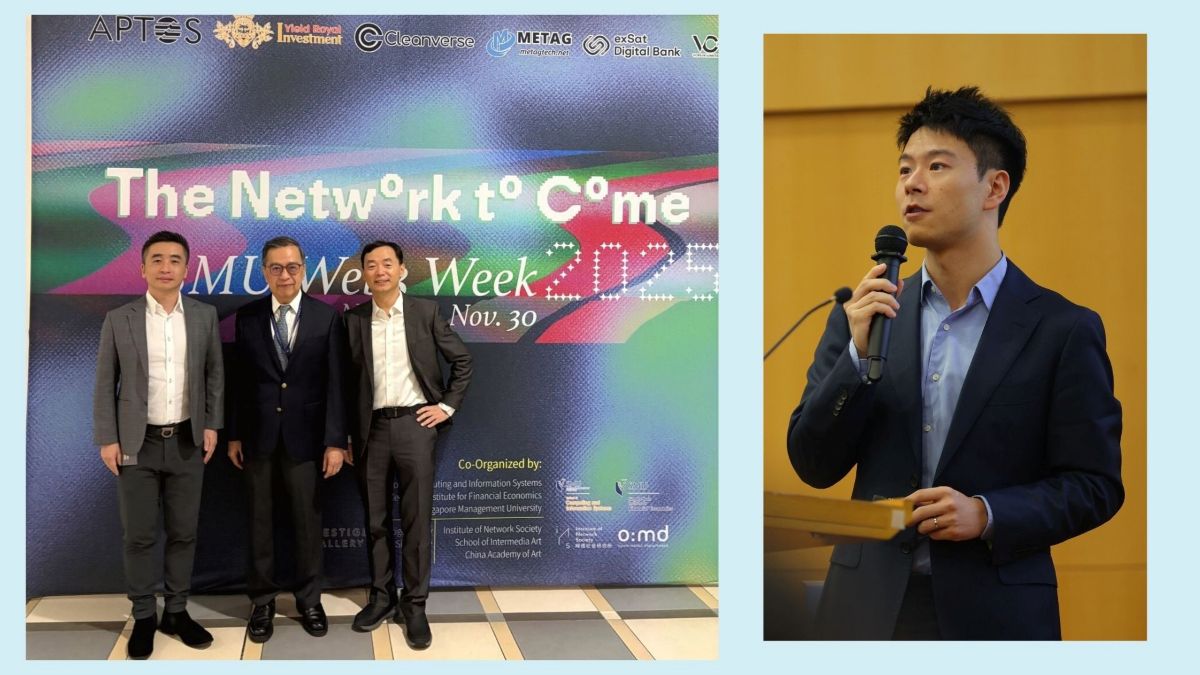
The four-day event, hosted by the School of Computing and Information Systems (SCIS), took place in November, with SMU’s Sim Kee Boon Institute of Financial Economics (SKBI) co-organising Day 1 as part of its 15th Annual Conference. The event covered the latest trends in digital asset management, the convergence between AI and creativity, a film screening on the internet and a hackathon.
Prof Chan noted that SMU’s initiatives have offered insights on how Web3 technologies can benefit society. Initiatives such as Web3@SMU, and cross-disciplinary research in digital assets, AI-driven regulation, tokenomics, decentralised identity, and green finance have also helped develop local talent, supported evidence-based policymaking, brought together industry and regulators.
New platform for learning about Web3
A new boost to these efforts is the SMU Web3 Dialogue Series, made possible by a gift of S$180,000 by SMU alumnus, Mr Xia Zhou, on behalf of Yield Royal Investment. Mr Zhou graduated with a Master of Science in Applied Finance from SMU in 2010.
The Dialogue Series will support a new flagship platform that brings students, alumni, industry professionals, and the public together to learn about the fast-changing Web3 landscape. The Series will focus particularly on collaborative intelligence, the tokenised economy, and cross-disciplinary innovation spanning technology, socio-economics, legal governance and business.
SMU Research on Blockchain
Day one of Web3 Week featured two keynote presentations by SKBI academics, offering a comprehensive view of the rapidly evolving Web3 landscape.
Keppel Professor in Financial Economics Zhang Hong addressed a structural weakness in crypto markets that makes them prone to sharp crashes, not just investor panic. Professor Zhang, who is also Director of SKBI, shared his research that shows identifying ‘inelastic’ assets can help predict and hedge crash risk.
Assistant Professor of Finance Yu Shihao unpacked how trading on decentralised exchanges works. Associate Professor Zhu Feida, presented the rise of AI-enabled RegTech, describing compliance as the ‘seatbelt for innovation.’ He highlighted continuous Know-Your-Transaction monitoring to detect suspicious activities and predictive compliance.
The opening day concluded with four lively panels discussing how fast Web3 is moving from theory to practice, and sessions were dominated by discussions on AI-driven finance, the creator economy, and the push toward greener, decentralised systems.
Exploring Trends in Web3.0

Day two of the event shifted its lens to an interdisciplinary discussion, with five speakers offering fresh takes on what happens when AI, blockchain, and culture converge. Day three used the screening of the film, ‘The End of the Internet’, and an art exhibition for a deep a discussions on the creative process and labour in online systems. The event concluded with a hackathon, when six student teams pitched their solutions to experts from SMU, the National University of Singapore, Moledao, and other industry partners.
Overall, the four-day event attracted 180 participants, including students and professionals from the industry, including representatives from Coinbase, Crypto.com, Ceffu, Fomo Pay, MatrixPort and the Blockchain Association Singapore. Many were keen on insights into the behaviour of Web3.0 and how to harness its strengths and mitigate its weaknesses.
Said Prof Zhang, “Our studies show that crypto markets should be studied as financial markets with their own rules, frictions, and risks. By analysing capital constraints and blockchain trading mechanisms, we can move beyond hype to understand how crypto prices are formed, why instability occurs, and how better market design can improve resilience and fairness.”
“I am happy to see that the inaugural SMU Web3 Week convened researchers, industry leaders, developers, and creatives to examine how Web3 is impacting not just finance and tech, but also the rest of society,” said Prof Zhu.
He thanked SMU’s Web3.0 ecosystem partners – Yield Royal, Cleanverse, MeTag, exSat, and VC Plus – for their generous sponsorship, adding that “Spanning crypto market stability, on-chain trading, AI, decentralised finance, and the creator economy, the four-day programme highlighted SMU’s interdisciplinary approach to understanding digital assets as mainstream financial and social systems.”