

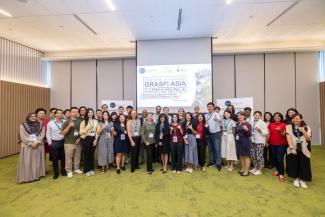
As Asia plays a vital role in sustainable finance and investment research, the region needs regionally grounded evidence, rather than generic global models, in spotlighting valuable best practices from Asian to practitioners and policymakers who want comparative evidence based on Asian case studies.
Professor Scott Fritzen, the Vice-President for Impact at Singapore Management University (SMU), made this observation in his opening address of the inaugural conference of the Global Research Alliance for Sustainable Finance and Investment in Asia (GRASFI Asia). The event held in December 2025 focused on sustainable finance and investment research relevant to Asia.
Hosted by the Singapore Green Finance Centre (SGFC) at SMU, GRASFI Asia brought together scores of world-class researchers, industry practitioners, and policymakers to share and grow knowledge in sustainable finance and investment.
The role of universities in sustainable finance and investment
Prof Fritzen highlighted two powerful forces shaping the practice. First, the growing need from Southeast Asia for adaptation, transition, and nature protection, as the financing gap remains wide. Second, global turbulence and uncertainty are shaping policy as countries become more cautious of their economic security and competitiveness. The convergence of these forces presents opportunities for the region if it can credibly mobilise capital at scale.
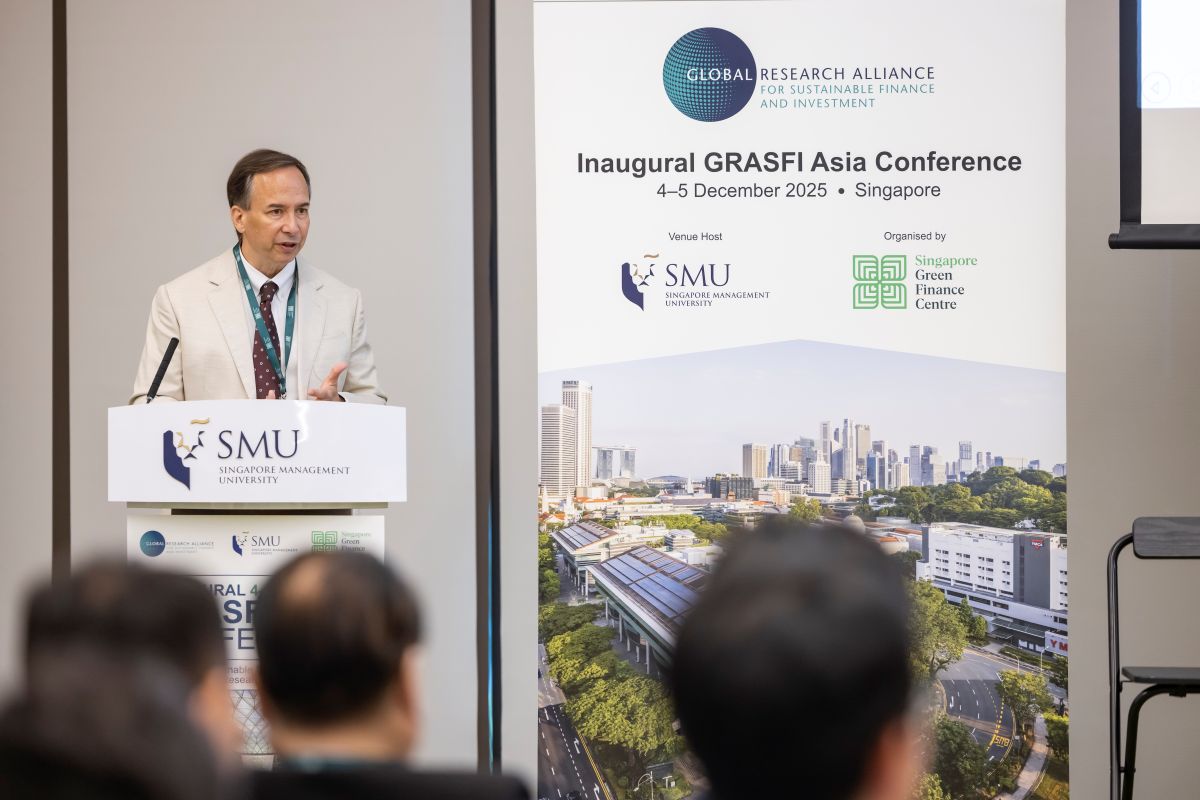
Universities like SMU have a role to play, he said, and they must bridge the academic community through translation-focused research centres. Referencing a strategic triangle framework, he said meaningful long-lasting change is possible when all three corners are strong: clarity of purpose and policy design, operational and institutional capacities, and stakeholder alignment and incentives.
The Executive Director of SGFC, Ms Nikki Kemp, highlighted the critical role of SGFC in translating Asia-focused research outputs into tangible, impactful industry solutions that move capital towards sustained, resilient development, with support from the Monetary Authority of Singapore (MAS) as well as global banking and asset management partners.
“SGFC and GRASFI represent an aligned vision for global research excellence for sustainable finance innovation and localised knowledge sharing,” she noted, and called on researchers to listen for specific asks from industry partners to close knowledge gaps, as these represent potential opportunities for new research or expansion of existing work.
SMU research on Asia and green finance
SMU faculty members shared their research on green finance in Asia, and several deeper threads on retail and real-economy impacts, policy-driven transition risks, and market pricing and behaviour.
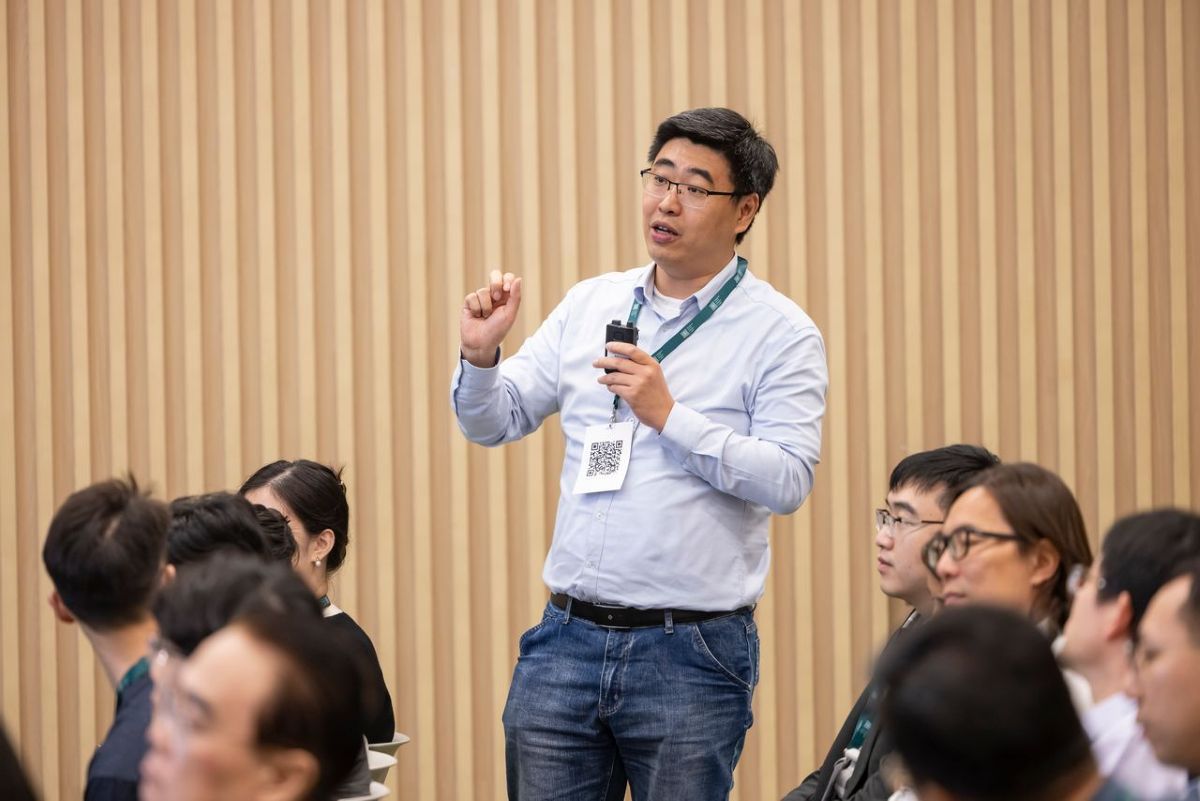
Professor of Finance at SMU’s Lee Kong Chian School of Business (LKCSB) and Co-Director of SGFC, Liang Hao, presented his research on nature transition risks. Using the adoption of the Kunming-Montreal Global Biodiversity Framework at COP15 of the Convention on Biological Diversity as a policy shock, his research found that Chinese firms showed negative abnormal stock returns on average, with machine-learning-measured conservation subsidies correlating with greater penalties.
This signals that while physical nature risks remain weakly priced, investors are beginning to recognise and price nature transition risks, especially where strong policy signals are present. By demonstrating how large language models can be used to quantify firm‑level exposure to nature policy, the research offers a practical tool for the sector and highlights how making “nature bankable” is now a pressing policy and market challenge.
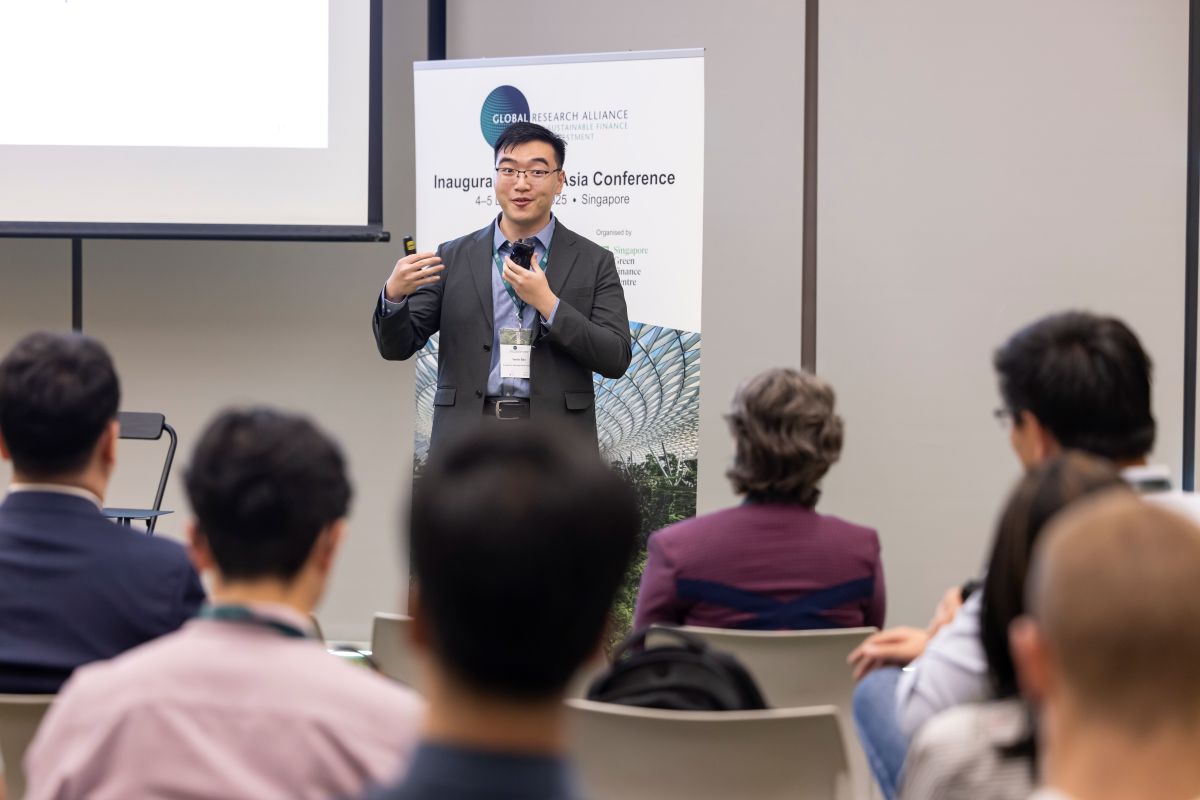
Another study by LKCSB PhD candidate Yanlin Bao investigated how retail investors of a major Indian bank navigate the tension between financial performance and sustainability goals. He found that without better incentives, information, or market structures, retail capital may struggle to flow consistently toward greener assets despite rising interest in sustainability.
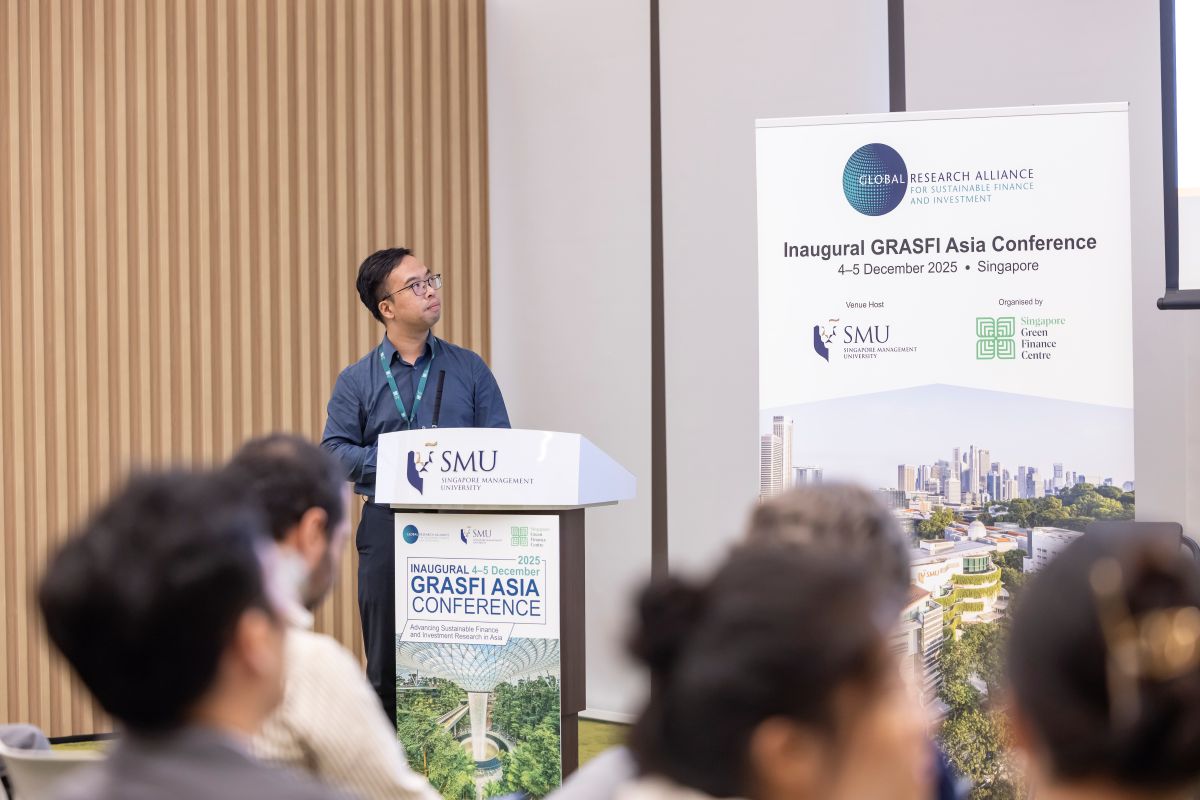
The third piece of research was presented by Professor Frank Weikai Li of City University of Hong Kong, who collaborated with SMU Professor of Finance Hong Zhang and EDHEC Business School Associate Professor of Finance Tinghua Duan. Their study on carbon pricing and firm performance reveals that carbon pricing cuts emissions without harming aggregate economies, but slashes profits, value and investments for high-emission firms.
Going beyond climate considerations alone for corporate performance
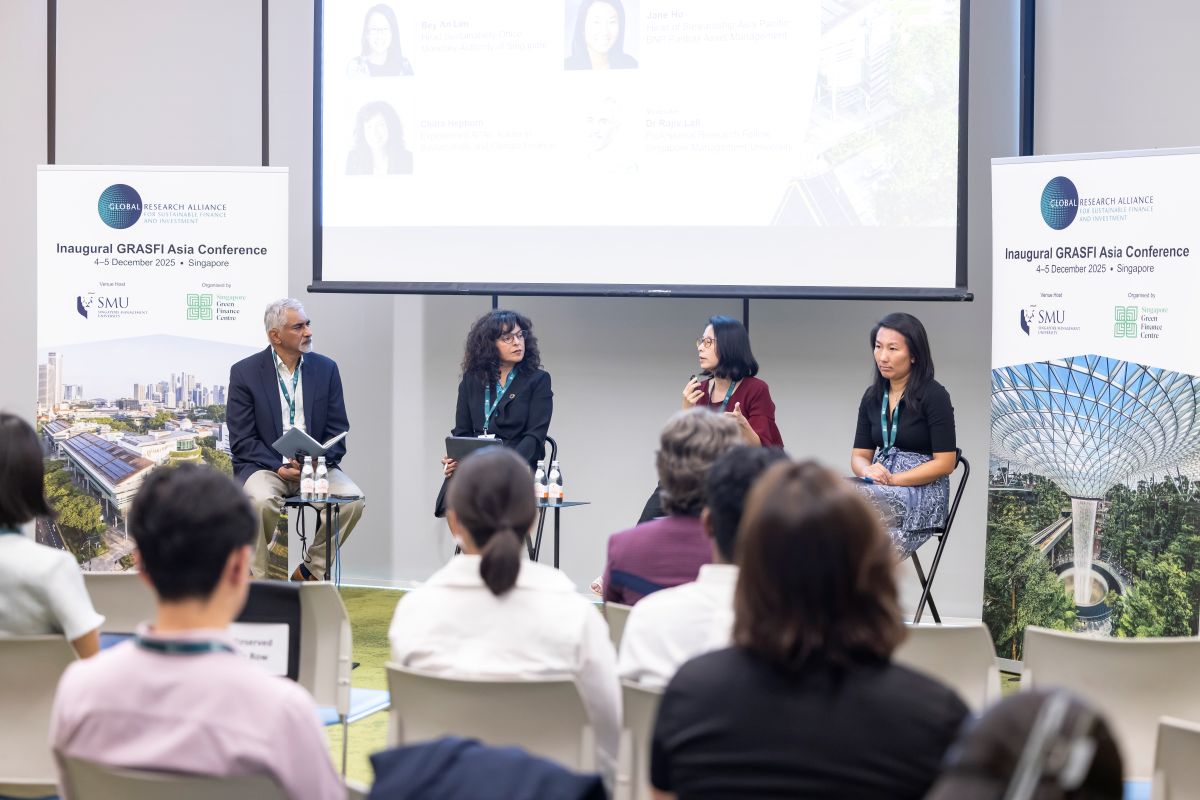
Panel discussions also focused on the increasing importance of ESG considerations.
Mr Calvin Quek, the Executive Director of Nature Finance at the Oxford Sustainable Finance Group, stated during the panel ‘Directing Capital for Optimal Impact’ that achieving optimal impact requires clarity on both the objective of finance and how that objective is pursued.
Using emissions reduction as an example, he noted that while the goal may be framed as reducing emissions relative to a baseline, the pathways to achieving this can vary significantly, ranging from asset retirement, retrofits, and technology upgrades to broader transition and technology-transfer strategies. He added that financiers must be realistic about their leverage over assets, as minority shareholders often have limited influence over corporate decisions.
In the concluding panel, “Maintaining Mitigation Action in the ‘Winter’ of Sustainability,” panellists agreed that evidence points to the need for corporates to look beyond climate issues and strengthen broader environmental and social resilience to remain competitive and sustainable over the long term.
The discussion also examined the challenge of balancing growth with mitigation and adaptation strategies. In this new environment of shifting sentiments where there is much pressure to convince internal and external stakeholders to stay the course, Ms Bey An Lim, Head Sustainability Office at MAS, opined that it would be crucial to frame and communicate sustainability as a tangible opportunity that can be capitailised on, while concurrently ensuring that the economy, business and society remain resilient. Moving entire sectors towards decarbonisation will require collective industry effort, which is harder to achieve by individual financial entities or regulators alone.
For firms in Asia to adopt greener practices and manage costs while promoting climate conscious investments, clear regulations, well-designed market mechanisms, enablers, and incentives are key to steer capital towards climate-positive actions. One such mechanism is the application of transition credits in phasing out fossil fuel plants, as it aligns the various stakeholders, including coal plant owners, to accelerate their shift towards more sustainable operations.
MAS, together with the Singapore Sustainable Finance Association, is also reviewing the Singapore-Asia taxonomy to deliver an updated version. The updated framework is expected to be launched in 2026.