

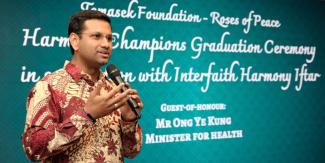
How can we make sure everyone feels heard? This question has influenced every part of Mohamed Irshad's work.
It was the question that first drove him, as a young undergraduate then undergoing his Bachelor of Business Management at SMU, to bring students of different backgrounds together in conversation. It is this same question that animates Roses of Peace, the volunteer-led movement he founded to bridge divides and foster understanding across Singapore’s multiracial, multi-religious society.
More than a decade on, Irshad’s bridging efforts have continued and grown from a small initiative into nationwide movement, and still his approach has stayed the same: start by listening, build trust through empathy, and let collective purpose do the rest.
A simple gesture, a profound response
The idea for Roses of Peace took shape in 2012, in the wake of the protest against a Charlie Hebdo publication in France, where a publication’s caricatures of the Prophet Muhammad sparked outrage and deepened divisions across communities.
Irshad remembers the moment it struck him that incidents of intolerances abroad could send shockwaves that affected those living here. It was a vivid reminder of how rare — and how easily overlooked — our social cohesion and religious harmony are, and how much care they require to sustain.
Some of his fellow students wanted to respond through protest. Irshad, however, saw another path. “Rather than holding a campus protest, I thought, ‘How can we channel that energy and frustration into something positive?’”
The idea he decided on was disarmingly simple: roses, each carrying a short message of peace drawn from the teachings of different faiths luminaries, handed by youths to strangers in public spaces across Singapore.
“According to Pew Research Centre, Singapore is the world’s most religiously diverse country,” he says. “We see ourselves as Singaporeans, not from a particular ethnic or religious group. The rose helped us exemplify that.”
What began as a one-time gesture soon took root. Volunteers returned year after year, bringing friends and family. By 2014, the number of roses distributed each time had grown from 3,000 to 5,000. “It grew from a small, ground-up response into a movement,” Irshad says.
In 2017, Roses of Peace was formally registered as a non-profit organisation – it is still entirely volunteer-run – and has continued to evolve its mission to meet Singapore’s changing social landscape, engaging younger generations through experiential formats, and even including local-foreign integration to address new forms of social tension.
What started as annual outreach events with roses as a medium has now grown into partnership-driven initiatives, with Roses of Peace collaborating with organisations such as Singapore Kindness Movement, UNIQLO Singapore and the Singapore Theatre Company to distribute roses with interfaith messages. On top of that, Roses of Peace trains youth with the skills they need to become peace ambassadors and harmony champions, and creates safe spaces for respectful dialogues on race, religion, and nationality to take place.
Through it all, Irshad has remained guided by the belief that peacebuilding must begin long before conflict arises. “You build reservoirs of goodwill in peacetime,” he says, “so that when crises come, those relationships won’t be strained.”
Forged in SMU’s culture of initiative
Irshad’s instinct for creating meaningful change was nurtured during his years at SMU. As a student, he co-founded multiple co-curricular activities (CCA) clubs. The first was SMU Ventures, an entrepreneurship society inspired by a desire to explore the world of startups hosted under the university’s Institute of Innovation & Entrepreneurship.
A similar motivation spurred his founding of the SMU Islamic Business & Finance Society hosted under the SMU International Islamic Law and Finance Centre (IILFC). At the time, Islamic finance was a thriving field, and while SMU had IILFC, Irshad felt that the activities were not attracting the youths population of SMU. Hence IBFS served as a bridge to involve them.
He also established SMU Apolitical Society, SMU’s first student political association, which had initially been suggested by his seniors. Despite reservations from SMU, which had to remain politically neutral, SMU Apolitical was formed in 2010, and eventually hosted under the university’s Office of Student Life to ensure its neutrality.
“Most of these things had no precedence,” he reflects. “It’s easier for people to stick with what’s known than venture into the unknown. It took a lot of persuasion, a lot of time convincing people to support your cause.”
Just before graduating in 2014, Irshad also set his last CCA club, the SMU Muslim Society, drawing from all his experiences, including the founding of Roses of Peace.
%20-%20ROSES%20OF%20PEACE.jpg)
These experiences were essential in allowing him to develop what he calls his three pillars of leadership: purpose, people, and proof. “If your purpose is good, you attract people,” he explains. “Then you need to shape why you exist, so new members can align themselves to that purpose. And then you must execute well, so people see there’s a real need for what you’re doing.”
SMU’s collaborative, interactive learning environment gave him the confidence to experiment and the resilience to persist. “If there’s one leadership style I’d describe,” he says, “it’s being an empathetic leader. Listening to different viewpoints and finding a landing point where everyone feels aligned.”
From the ground to the national stage
Irshad went from working at the grassroots level to Parliament in 2018, when he became a Nominated Member of Parliament (NMP). “When I started Roses of Peace, I never expected to advocate for it in Parliament later on,” he says. “But I realised the government also saw this as an important area of work.”
As an NMP, he championed issues of social cohesion, racial and religious harmony, and youth causes. “We have many laws,” he notes, “but what’s also important is for people to be more open to discussing these things, sharing best practices, and having safe spaces. Discrimination still happens. It’s not completely zero.”
During his term as an NMP, Irshad returned to SMU, as a student, to pursue his master’s degree in the Master’s in Communication Management programme. After completing his Master’s, he joined SMU as an adjunct lecturer of strategy & entrepreneurship teaching “Business, Government, and Society” at the SMU Lee Kong Chian School of Business. “I’ve always liked interacting with young people,” he says. “You understand what their concerns are. And it’s a way of giving back.”
Leadership across sectors
Today, Irshad balances his civic work with his role as Head of Corporate Affairs at Tata Consultancy Services. His work includes government engagement, public policy, and community partnerships.
On top of that, Roses of Peace now works with corporates, bringing together the best practices from both public and private sectors.
“In the corporate world, people use LEGO Serious Play to foster creativity,” he says, sharing one of the group’s newest initiatives. “So now we’re trying to use that at Roses of Peace to help young people explore ideas of social cohesion in a fun, hands-on way.”
Continuing the conversation
Looking back, Irshad sees his journey not as a series of achievements, but as a conversation that continues to evolve today. “I was never passionate about this at the start,” he admits. “It was just a response to what was happening around us. But over time, you see the impact, and you realise how important it is to preserve what we have for the next generation, as our forefathers did for us.”
The rose, he says, remains “a symbol of kindness”. But it has also come to represent something deeper: the belief that empathy, sustained through action, can hold a society together.
In that sense, Irshad’s journey, starting from the classrooms at SMU and continuing down through community halls and corporate boardrooms, reflects the very spirit his alma mater seeks to cultivate thoughtful leaders who listen first, act with purpose, and build bridges that endure.
The SMU Edge
While Mohamed Irshad’s journey stemmed as a result of circumstances rather than passion, his time at SMU was integral in building the mindset and skills which he now uses to translate ideas to impact in his work at Tata Consultancy Services, as well as his volunteerism at Roses of Peace.
- A culture that rewards initiative
SMU’s seminar-style learning and support of student-led projects gave Irshad the confidence to experiment, from founding new clubs to launching Roses of Peace. - Leadership through empathy
SMU’s heavy emphasis on team-based coursework and a diverse community with which to grown in taught Irshad to lead by listening, an approach he still values today. - Real-world perspective
Exposure to policy, business, and social-impact conversations across disciplines have helped Irshad to bridge sectors later in life in areas spanning civic advocacy to corporate affairs. “SMU gave me the language to connect business, government, and society,” he says, “and that’s exactly what I do now.”
See also: The making of a change-maker.