

Scientific breakthroughs are only part of the answer to some of society’s most pressing challenges. Whether people live longer lives better, cities become more sustainable or artificial intelligence empowers us to work more productively, depend on how societies redesign their institutions, align economic incentives and preserve human judgement.
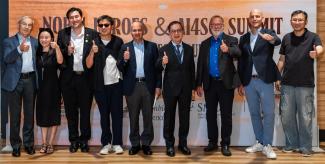
That was the central thread running through three dialogues at Singapore Management University’s Nobel Heroes & AI4SCI Summit Grand Challenges Forum on 6 October 2026, where five Nobel Laureates joined SMU faculty and industry thought leaders to examine the future of longevity, urban sustainability and artificial intelligence.
The forum brought to SMU Dr Fred Ramsdell, 2025 Nobel Laureate in Physiology or Medicine; Professor Benjamin List, 2021 Nobel Laureate in Chemistry; Professor Omar M. Yaghi, 2025 Nobel Laureate in Chemistry; Sir Konstantin Novoselov, 2010 Nobel Laureate in Physics; and Sir Christopher Pissarides, 2010 Laureate in Economic Sciences.
The discussions explored a broader common challenge: how to turn new knowledge and technological possibilities into meaningful improvements in people’s lives. The forum also demonstrated the role that SMU can play in connecting scientific discovery with the people and institutions responsible for translating technology into practice, from industry and research to public policy and social systems.
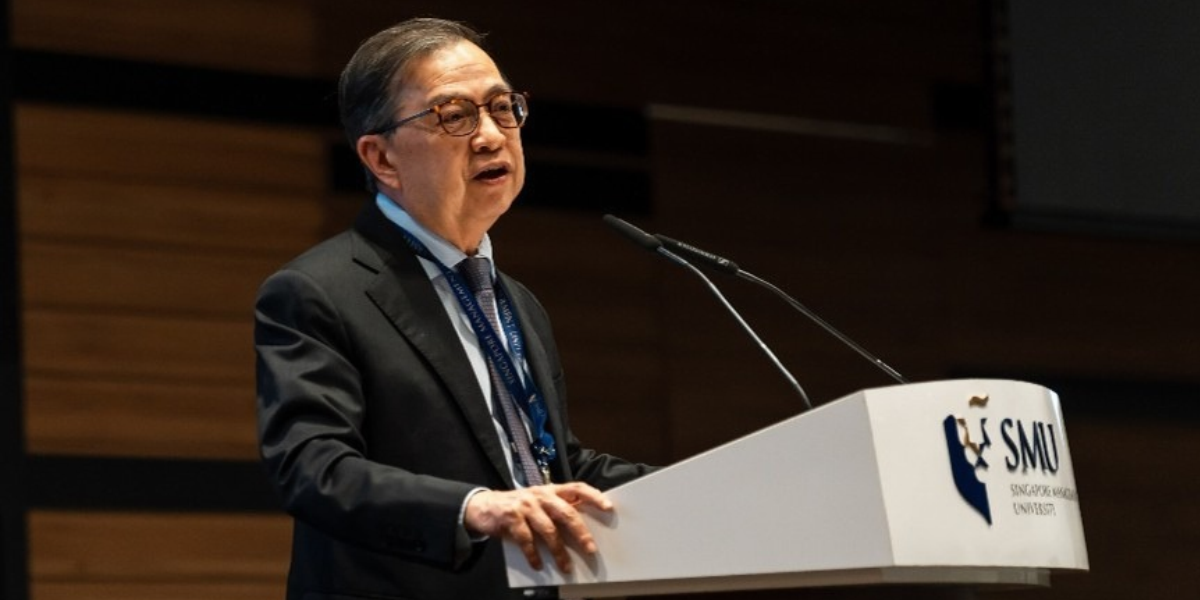
In his welcome address, SMU Provost Professor Alan Chan said: “Bringing together Nobel Laureates, researchers, industry leaders and policymakers around the shared challenges of humanity is exactly what a global city university like SMU should do.”
Longer lives require a rethink of how society works
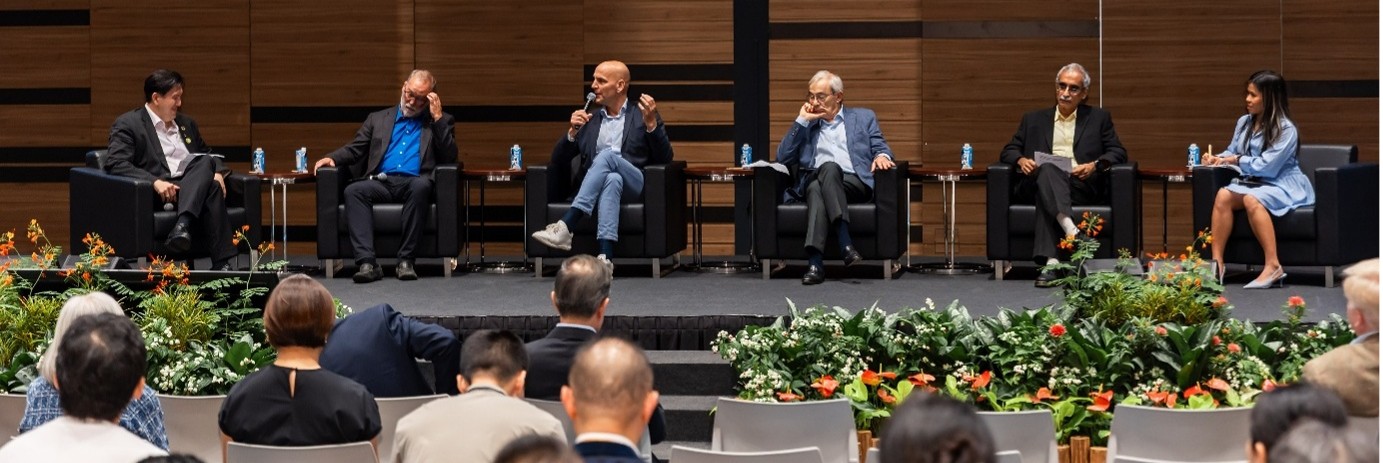
The discussion on longevity challenged the idea that scientific advances alone will determine whether longer lives are healthier and more fulfilling.
As medicine continues to progress, societies will need to reconsider how retirement, healthcare financing, social support and employment are structured around longer lifespans. The ambition is not simply to extend life, but to narrow the gap between lifespan and healthspan, enabling people to remain healthy and engaged purposefully for more of their lives.
Sir Christopher Pissarides highlighted the importance of purpose and social contribution, observing that “People feel much happier when they feel that they are of use in society.”
The point extends beyond individual wellbeing. Longer lives raise questions about whether existing economic and social systems give people meaningful opportunities to contribute, as well as the financial and institutional support they need as they age.
Professor Rajesh Balan called for “an integrated design of the entire economic and social system”. Healthcare and social programmes are often designed around different objectives, even though their needs increasingly overlap as people grow older. Treating them separately can lead to confusion and duplication.
The discussion placed longevity in a broader policy context: the challenge is not only to develop better medical interventions, but also to redesign both the social and economic systems that shape how people live, work and age.
Sustainable cities need more than better technology

The sustainability dialogue turned to a different challenge: why promising technologies do not always achieve widespread adoption, and if our cities could better facilitate it.
Scientific discovery and public expectations often operate on different timelines. Research takes time to mature, while attention, funding and commercial interest can move rapidly between emerging technologies. The result is a gap between what science might make possible and what society is equipped or willing to adopt.
Professor Benjamin List drew a distinction between scientific discovery and the work needed to translate it into wider use. “Actually, this is my job. I'm the scientist,” he said, underlining that the responsibility for discovery is not the same as that for deployment.
The exchange highlighted a role for institutions and industry beyond the laboratory: building the capabilities, partnerships and commercial pathways needed to bring research into everyday use. Associate Professor Yangfang Helen Zhou pointed to the economics of adoption, arguing: “It is not the technology. It is... finding the right business model to make it commercially viable.”
A technically sound solution may still struggle to reach citizens if commercial incentives, financing and the interests of different parties involved are not aligned. How a technology is funded and made accessible can matter as much as its underlying engineering. This means progress cannot be measured by technological innovation alone. It also depends on whether solutions can be adopted at scale and supported by viable business models and public participation.
The dialogue brought into focus the importance of connecting scientific expertise with commercial and societal realities, rather than assuming that better technology will inevitably produce better outcomes.
AI may change how we think, not just how we work
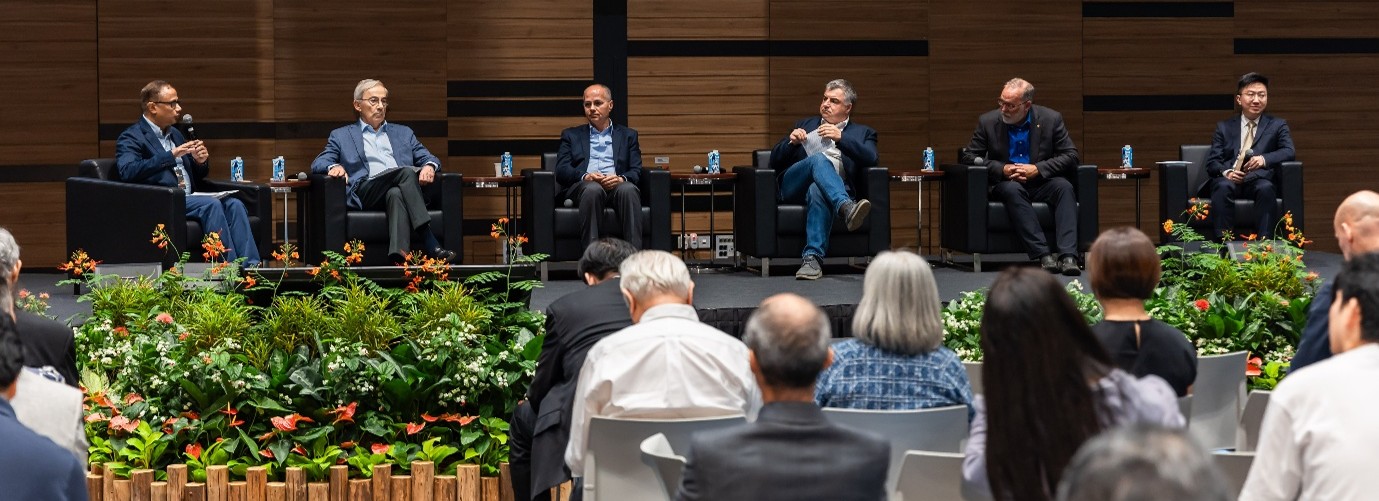
The final dialogue examined AI’s implications for employment, learning and research. While panellists recognised its potential, they also questioned whether current systems could produce genuine insight and raised concerns about attribution, reproducibility and the speed of disruption.
Professor Omar M. Yaghi suggested that AI can still be useful when its answers are wrong. “Even from that incorrect answer, it [AI] does trigger us to think in a different way,” he said.
An inaccurate response may prompt a researcher or user to question an assumption, explore another possibility or approach a problem from a different angle. Its value, in this instance, lies not in the answer itself but in the human thinking it provokes.
Sir Konstantin Novoselov offered a more cautious assessment, arguing that AI was “not yet good enough” to generate genuine insight and that it largely recycles material that has already been written.
Together, the perspectives raised a distinction between AI’s ability to generate outputs and human capacity to evaluate them, recognise what is missing and develop genuinely new ideas. As AI becomes more embedded in research and work, questions of attribution, reproducibility and human oversight will remain important.
The implications for employment are similarly uncertain. Sir Christopher Pissarides cautioned against confident predictions about AI’s eventual effects: “No one really knows. And if they say they know, just don't believe them.”
Jobs are likely to be shaped by changing demand, costs and commercial viability, rather than by technological capability alone. The discussion pointed to a future in which the impact of AI will depend not only on what systems can do, but also on how organisations choose to use them and how work is reorganised around them.
Concluding Thoughts: Connecting discovery to real-world impact
Across the three dialogues, the challenges differed, but a common question emerged: what must change beyond the technology itself?
Longer lives call for closer integration between healthcare, social support and economic policy. Sustainable cities require viable business models and the coordination of interests to bring solutions to scale. AI demands a more considered understanding of the relationship between machine-generated outputs, human judgement and the changing nature of work.
These are not problems that any single discipline or institution can resolve. They require scientific expertise to be brought into conversation with the commercial, social and policy questions that determine whether new possibilities translate into public value.
That is where SMU’s role as a convenor intersects at the nexus of management, social sciences and technology. By bringing Nobel Laureates together with researchers, industry participants and policymakers, SMU created a platform to examine not only what scientific advances make possible, but also the societal and economic conditions required for their adoption and wider impact.
As Professor Chan noted in his welcome address, universities need not always have the answers. Their contribution can lie in creating the conditions for conversations and partnerships that move society closer to them.
For SMU, this event was an opportunity to connect world-leading scientific thinking with the economic, social institutional and human questions that determine how our society and economy responds to some of its most consequential changes.